Uttar Pradesh organises mass yoga sessions on International Yoga Day
Source:newsonair ↗
Why It Matters
UPPSC PCS Prelims frequently asks questions about state-specific historical sites (such as Jhansi and Lucknow Residency during the 1857 Revolt), ancient history (Harshavardhana's charity assemblies at Prayag), and the dates/themes of major international observances like Yoga Day.
Summary
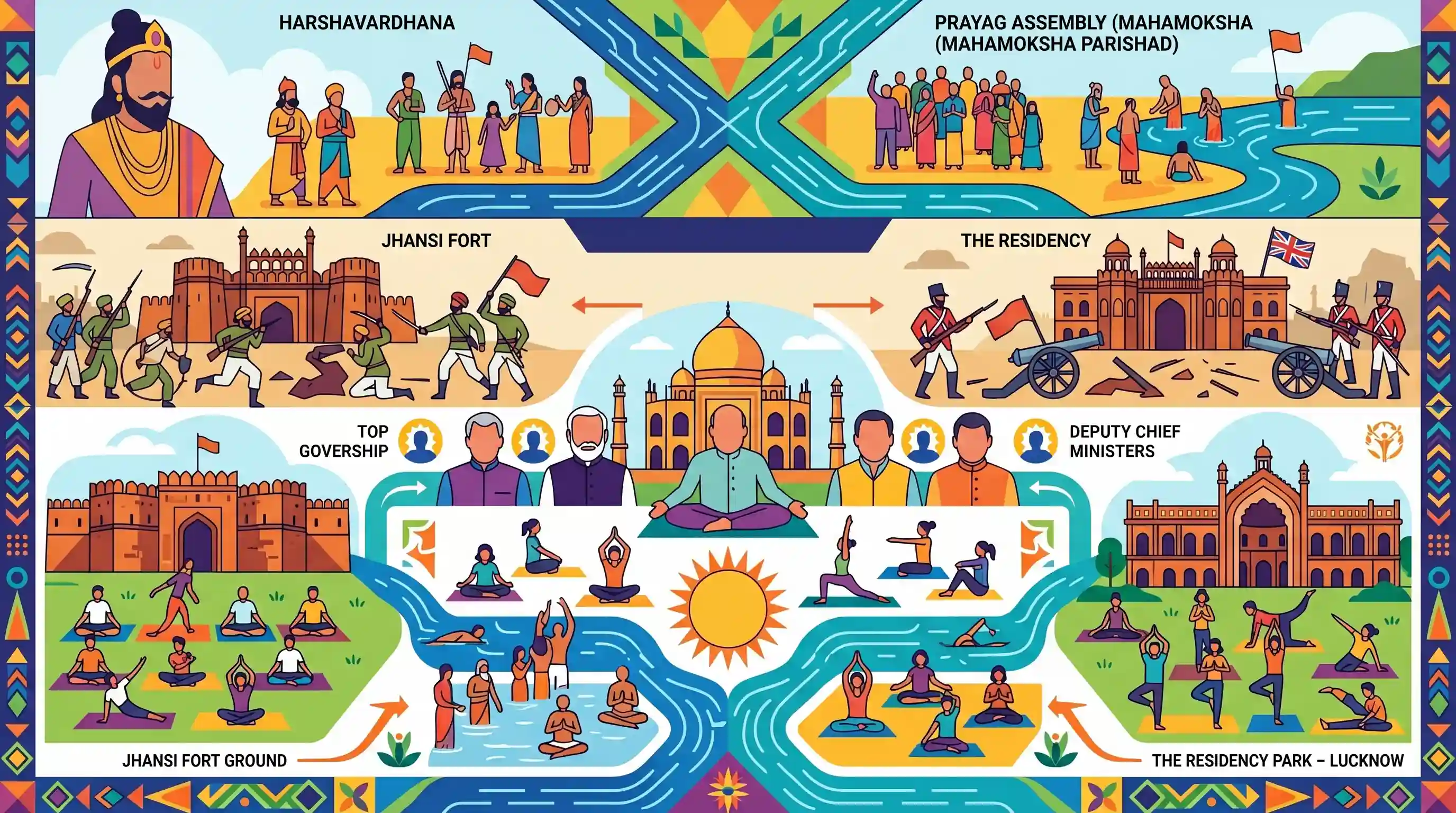
The article describes the large-scale celebrations of the International Yoga Day across Uttar Pradesh on June 21, 2026. Top leadership, including the Governor, Chief Minister, and Deputy Chief Ministers, participated in mass sessions organized at prominent historical and cultural landmarks in the state, such as the Jhansi Fort Ground, Triveni Sangam in Prayagraj, and The Residency Park in Lucknow. This integration of health events with heritage sites highlights Uttar Pradesh's deep historic and cultural significance.
Key Points
- On June 21, 2026, special yoga sessions were organized across Uttar Pradesh to mark International Yoga Day.
- Governor Anandiben Patel led the session at Raj Bhavan in Lucknow, encouraging regular practice of yoga for health.
- Chief Minister Yogi Adityanath performed yoga at the historic Jhansi Fort Ground in Jhansi, linking cultural heritage with wellness.
- Deputy CM Keshav Prasad Maurya joined the session at the famous Sangam Nose, Triveni in Prayagraj.
- Deputy CM Brajesh Pathak performed yoga at the historic Residency Park in Lucknow.
- The use of significant heritage sites like Jhansi Fort and the Lucknow Residency serves to highlight both UP's revolutionary history and ancient wellness traditions.
Important Terms
UN General Assembly Resolution 69/131

A United Nations resolution adopted on December 11, 2014, which proclaimed June 21 as the International Day of Yoga, recognizing its global appeal and holistic approach to health and well-being.
UPSC context
GS Paper II (International Relations). Tests awareness of international bodies, global health diplomacy, and India's cultural soft power.
Triveni Sangam
The sacred confluence of three rivers—the Ganga, the Yamuna, and the mythical, underground Saraswati—located in Prayagraj, Uttar Pradesh, serving as a major Hindu pilgrimage site and hosting the historic Kumbh Mela.
UPSC context
GS Paper I (Geography/Art & Culture). Tests physical geography of major river confluences and associated cultural heritages.
The Residency, Lucknow
A historic complex of ruined buildings in Lucknow that served as the residence of the British Resident and became the central site of the intense 147-day siege during the Revolt of 1857.
UPSC context
GS Paper I (Modern Indian History). Tests knowledge of key geographical centers and major events of the 1857 Revolt.
Prayag Assembly
Also known as Maha Moksha Parishad, a grand religious and charitable assembly held every five years at Prayag by Emperor Harshavardhana, characterized by multi-faith debates and extensive state charity.
UPSC context
GS Paper I (Ancient Indian History). Tests knowledge of Vardhana administration, ancient socio-religious assemblies, and accounts of foreign travelers.
Jhansi Fort
A 17th-century fortress in Uttar Pradesh, built by Bir Singh Deo, which became a major center of anti-colonial resistance led by Rani Lakshmibai during the Revolt of 1857.
UPSC context
GS Paper I (Modern Indian History). Tests military-architectural heritage, key regional leaders, and major events of the 1857 uprising.
Prelims Trap
Jhansi Fort was originally constructed by the Marathas under Peshwa Baji Rao I as their primary northern stronghold.
The fort was built much earlier in 1613 by the Bundela chief Raja Bir Singh Deo. The Marathas only gained control of it in the 18th century under Peshwa Baji Rao I.
Static Concepts Connected
What is the significance of the Lucknow Residency and Begum Hazrat Mahal in the 1857 Revolt?
- Begum Hazrat Mahal: Led the Awadh rebellion and proclaimed her minor son, Birjis Qadr, as the Wali (ruler) of Awadh after British annexation.
- The Siege: The British Residency became the focal point of the Siege of Lucknow (July-Nov 1857), where Chief Commissioner Sir Henry Lawrence was killed.
- Recapture: The British garrison was eventually relieved and Lucknow recaptured by Sir Colin Campbell in March 1858.
What is UNESCO's Representative List of Intangible Cultural Heritage?
- Origin & Purpose: Established under the 2003 Convention to safeguard and raise awareness of oral traditions, performing arts, rituals, and festive events.
- Yoga's Inscription: Inscribed in 2016 during the 11th session, recognizing its influence on health, medicine, and physical-spiritual well-being.
- Other Indian Elements: Includes Vedic Chanting, Ramlila, Kutiyattam, Kumbh Mela, and the Garba of Gujarat (added in 2023).
Cross-Topic Patterns
Soft Power & Heritage Diplomacy
Merging ancient wellness traditions with sites of national struggle projects civilizational continuity and utilizes regional heritage for modern public diplomacy.
Architecture & Military Strategy in 1857
Comparing Bundela military forts (Jhansi) with colonial administrative quarters (Lucknow Residency) reveals how architectural design shaped defense strategies in 1857.

Pairing 1857 revolt sites like Jhansi & Lucknow with their original builders and colonial-era besieging officers is a probable 2026 match.
Linked PYQs · 3
Linked PYQs · 3
- 2023UPPSC_PRELIMSGS1
Which one of the following (Place of the revolt of 1857 – Start of rebellion) is not correctly matched?
- 2003UPPSC_PRELIMSGS1
Two great religious conference were held by King Harshvardhan at:
- 2021UPPSC_PRELIMSGS1
‘The Clock is Ticking’ is the theme of which of the following days?
