KERA Project and Climate Resilient Agriculture in Kerala
Source:The Hindu ↗
Why It Matters
The KERA project serves as a concrete case study for GS3 answers on climate-resilient agriculture, backward and forward linkages in food processing, and state-led interventions for doubling farmers' income through crop diversification and branding.
Summary
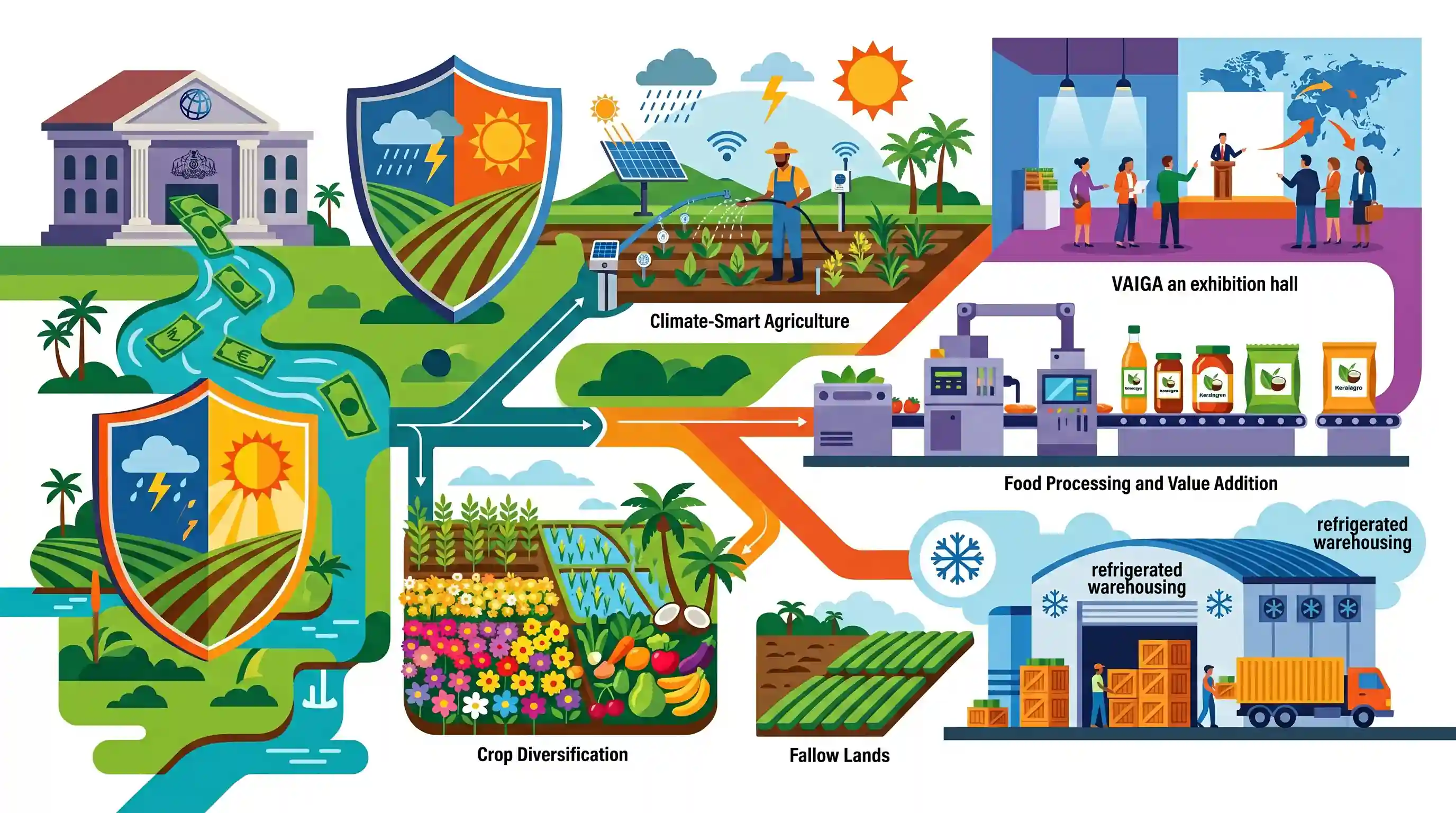
Kerala's newly launched ₹2,365-crore 'KERA' project, supported by the World Bank, seeks to shield its agricultural sector from climate change vulnerabilities while fostering robust value addition. Key components include the popularization of the 'Keralagro' brand for agricultural products and organizing the VAIGA meet to explore new markets. The initiative integrates climate resilience with economic viability by expanding crop diversification (e.g., floriculture) and aggressively utilizing fallow lands, complemented by infrastructural support like refrigerated warehousing to manage surplus production.
Key Points
- Kerala introduced the ₹2,365-crore KERA project, supported by the World Bank, to mitigate climate change impacts on agriculture.
- The initiative strongly emphasizes value addition in agriculture, establishing the 'Keralagro' brand to market products domestically and globally.
- The state focuses on diversification and land utilization by providing financial assistance for cultivating fallow land and expanding floriculture and ornamental plant cultivation.
- Investments in infrastructure, such as subsidies for refrigerated warehouses, are being made to support the significant increase in fruit and vegetable production from 6 lakh tonnes to 19.6 lakh tonnes.
Important Terms
KERA Project

The Kerala Climate Resilient Agri-Value Chain Modernization Project is a ₹2,365-crore World Bank-funded initiative aimed at modernizing agriculture supply chains and building climate resilience for four lakh farmers in Kerala.
UPSC context
GS Paper 3: Agriculture and Climate Change. Important for questions on state-led climate adaptation and multilateral funding in agriculture.
Climate-Smart Agriculture (CSA)
An integrated approach to managing landscapes—cropland, livestock, forests, and fisheries—that addresses the interlinked challenges of food security and accelerating climate change through productivity, adaptation, and mitigation.
UPSC context
GS Paper 3: Environment & Agriculture. A recurring theme in Prelims (e.g., 2021) and Mains regarding sustainable development goals.
VAIGA Meet
Acronym for 'Value Addition for Income Generation in Agriculture,' an annual international workshop and expo organized by the Kerala government to promote agri-entrepreneurship and market linkages for value-added products.
UPSC context
GS Paper 3: Food Processing and Related Industries. Demonstrates sub-national efforts in promoting value-addition and 'Farm to Fork' models.
Keralagro
The unified brand launched by the Kerala government to market and promote over 100 agricultural products from the state, ensuring quality standards and better price realization for farmers.
UPSC context
GS Paper 3: Agricultural Marketing. Relevant for discussions on branding, e-commerce in agriculture, and improving farmer income.
Value Addition
The process of changing a raw agricultural product into a more valuable state through processing, packaging, or branding, thereby increasing its shelf life and economic worth.
UPSC context
GS Paper 3: Food Processing. A core pillar for doubling farmers' income and reducing post-harvest losses.
World Bank
A global financial institution that provides loans and grants to the governments of low- and middle-income countries for the purpose of pursuing capital projects and sustainable development.
UPSC context
GS Paper 2: International Institutions. Important for understanding the role of Bretton Woods institutions in funding India's developmental infrastructure.
Prelims Trap
The KERA project is a Central Sector Scheme implemented by the Ministry of Agriculture with FAO assistance.
KERA is a state-specific initiative by Kerala, heavily supported by the World Bank, not a centrally sponsored scheme or an FAO-led program.
Static Concepts Connected
What are the three pillars of Climate-Smart Agriculture (CSA) as defined by the FAO?
- Productivity: Sustainably increasing agricultural productivity and enhancing the incomes of farmers.
- Adaptation: Building and improving resilience to climate change vulnerabilities.
- Mitigation: Reducing or completely removing greenhouse gas emissions from agricultural activities where possible.
What is the legal and operational framework of a Farmer Producer Company (FPC)?
- Legal framework: Registered under the Companies Act, combining the cooperative principles of mutual assistance with a formal corporate structure.
- Primary objective: Enhances bargaining power for small/marginal farmers, enabling bulk input procurement, credit access, and direct market linkages.
Cross-Topic Patterns
Multilateral funding + State Agri-Reforms
Like Maharashtra's PoCRA, KERA highlights a growing trend of multilateral development banks directly funding sub-national climate-resilience and agricultural value-chain projects in India.
Post-Harvest Infra + Grassroots Collectives
Linking Farmer Producer Companies (FPCs) to formal agribusinesses through "Productive Alliances" reflects the GS3 shift from mere production augmentation to market-led crop diversification.

State-level World Bank-funded agri-climate projects (like KERA, PoCRA) will likely form a 'Match the following' Prelims question in 2026.
Linked PYQs · 4
Linked PYQs · 4
- 2021PrelimsGS1
In the context of India's preparation for Climate-Smart Agriculture, consider the following statements : 1. The 'Climate-Smart Village' approach in India is a part of a project led by the Climate Change, Agriculture and Food Security (CCAFS), an international research programme. 2. The project of CCAFS is carried out under Consultative Group on International Agricultural Research (CGIAR) headquartered in France. 3. The International Crops Research Institute for the Semi-Arid Tropics (ICRISAT) in India is one of the CGIAR's research centres. Which of the statements given above are correct?
- 2025MainsGS3
Examine the scope of the food processing industries in India. Elaborate the measures taken by the government in the food processing industries for generating employment opportunities.
- 2022MainsGS3
Elaborate the scope and significance of the food processing industry in India.
- 2021MainsGS3
What are the present challenges before crop diversification? How do emerging technologies provide an opportunity for crop diversification?
