Bihar PM SHRI Schools to Host Disability Assessment Camps
Source:insidebihar ↗
Why It Matters
This initiative showcases grassroots-level, inter-departmental efforts in Bihar to strengthen inclusive education and deliver social welfare services (for Divyangjan) directly in schools under a centrally sponsored scheme.
Summary
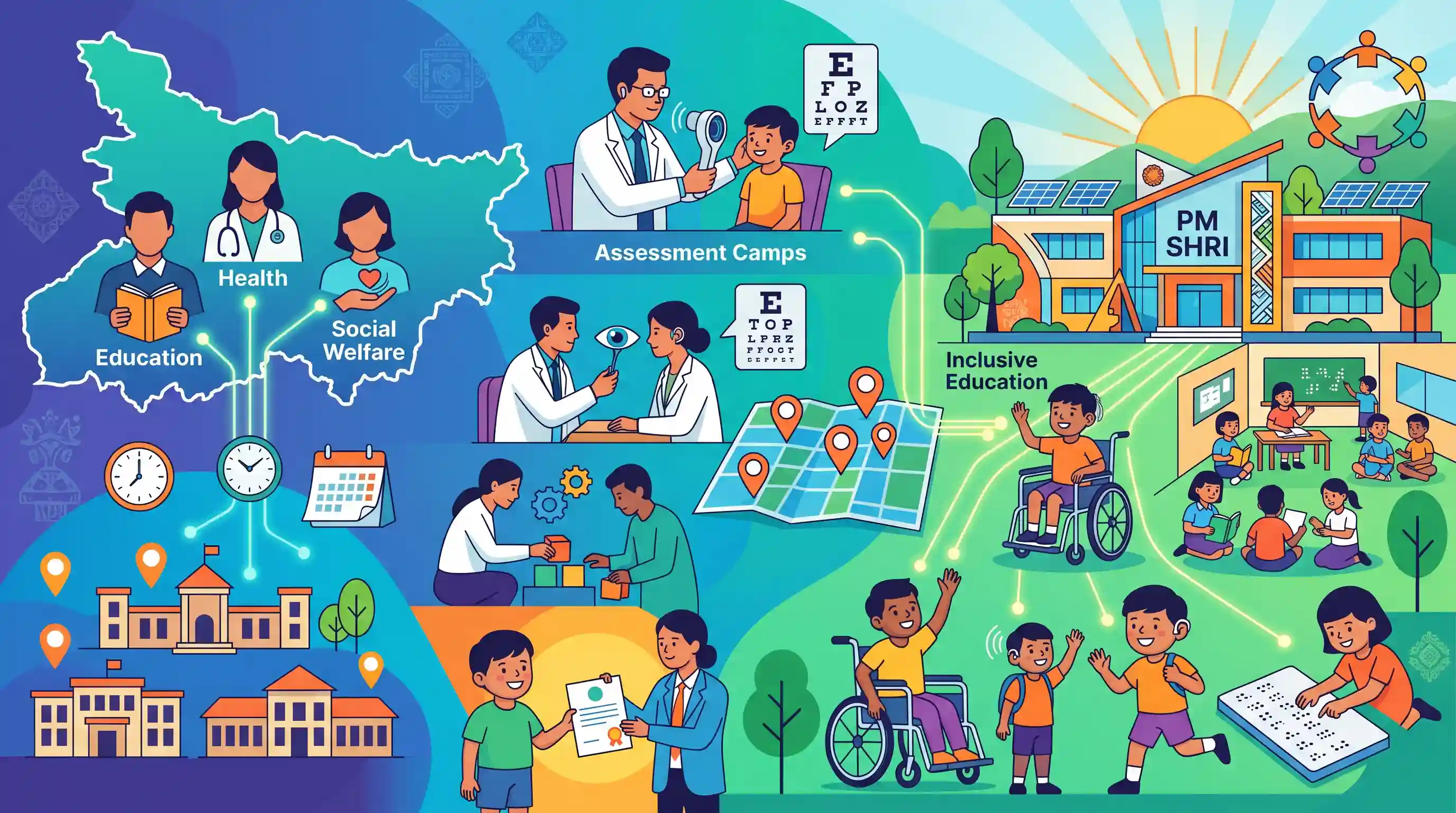
The Bihar government has launched a collaborative initiative between the state's Education, Health, and Social Welfare Departments to conduct special disability assessment camps across 836 PM SHRI schools from July 1 to July 20, 2026. Held at the district, sub-divisional, and block levels, these camps aim to identify, assess, and certify children with physical, intellectual, or sensory disabilities. Eligible students will receive essential assistive devices like wheelchairs, hearing aids, and Braille kits to streamline their inclusion in school life, reinforcing the objectives of the PM SHRI scheme in Bihar.
Key Points
- The Bihar government is conducting special disability assessment camps from July 1 to July 20, 2026, across 836 PM SHRI schools in the state.
- The program is a collaborative effort between Bihar's Education Department, Health Department, and Social Welfare Department.
- The camps will be held at district, sub-divisional, and block levels with a team of specialist doctors, audiologists, ophthalmologists, and physiotherapists conducting the evaluations.
- Eligible children will receive simplified, expedited disability certification and free assistive devices, such as wheelchairs, tricycles, crutches, hearing aids, smart canes, and Braille kits.
- The initiative serves as an awareness-building platform to guide parents and guardians about other welfare benefits and early intervention healthcare strategies for children with disabilities.
- The camps align with the broader objectives of the central PM SHRI scheme, which aims to transition selected schools into model, fully inclusive institutions with modern digital and physical infrastructure.
Important Terms
PM Schools for Rising India (PM SHRI)

A centrally sponsored scheme launched in 2022 to upgrade over 14,500 existing government schools into model institutions showcasing the holistic and experiential learning principles of the National Education Policy (NEP) 2020.
UPSC context
GS Paper II (Education/Social Justice); tests knowledge of central educational reforms, cooperative federalism, and schooling infrastructure.
Rights of Persons with Disabilities Act, 2016
A landmark legislation safeguarding the rights of disabled citizens, expanding recognized conditions from 7 to 21, and mandating reservation, accessibility standards, and inclusive education in line with international obligations.
UPSC context
GS Paper II (Social Justice/Welfare); tests understanding of legal rights, reservation frameworks, and inclusive state policies.
School Management Committees
Statutory local bodies mandated under the RTE Act, 2009, composed primarily of parents, designed to foster community ownership, decentralized planning, and collaborative governance in school operations.
UPSC context
GS Paper II (Governance/Education); tests conceptual clarity on decentralized governance and grassroot-level community-led monitoring.
Prelims Trap
Under the RPwD Act 2016, children with benchmark disabilities have the right to free education up to the age of 14 years.
The RPwD Act 2016 guarantees free education for children with benchmark disabilities aged 6 to 18 years, unlike the general RTE Act 2009 which limits it to 14 years.
Static Concepts Connected
What is the difference between Central Sector and Centrally Sponsored Schemes?
- Funding Pattern: Central Sector Schemes are 100% funded by the Union Government, whereas Centrally Sponsored Schemes involve cost-sharing (e.g., 60:40 or 90:10) with states.
- Implementation Agency: Central Sector Schemes are implemented directly by central ministries, while Centrally Sponsored Schemes are executed by state government machinery.
- Syllabus Alignment: Central Sector Schemes usually cover Union List subjects, whereas Centrally Sponsored Schemes target State or Concurrent List subjects like education and health.
What are the key education and reservation mandates under the RPwD Act, 2016?
- Free Education Age: Guarantees free education in appropriate environments for children with benchmark disabilities aged 6 to 18 years.
- Higher Education Quota: Mandates at least 5% reservation for persons with benchmark disabilities in all government-aided higher education institutions.
- Public Employment Reservation: Increases reservation in public employment from 3% to 4% for designated categories of benchmark disabilities.
Cross-Topic Patterns
Centrally Sponsored Schemes and Fiscal Federalism
The mandatory MoU for states implementing NEP 2020 to access PM SHRI funding highlights how central fiscal leverage influences state-level concurrent policies.
Inclusive Tech and Accessibility Standards
Distributing smart devices connects grassroots disability camps with the broader Accessible India Campaign and national assistive technology initiatives.

RPwD Act 2016 provisions on education (6-18 age group) and the funding architecture of PM SHRI will likely be tested in 2026.
Linked PYQs · 2
Linked PYQs · 2
- 2015BPSC_PRELIMSGS1
The International Day of Persons with Disabilities is celebrated on:
- 2025BPSC_PRELIMSGS1
What is the primary objective of Bihar’s Mission Daksh?
