Indore Grievance Redressal Camp Held Under Jan-Vishwas Abhiyan
Source:freepressjournal ↗
Why It Matters
Highlights Madhya Pradesh's localized approach to good governance and prompt public grievance redressal through dedicated campaigns and technological integration like the CM Helpline. Crucial for State Services aspirants focusing on MP's administrative schemes.
Summary
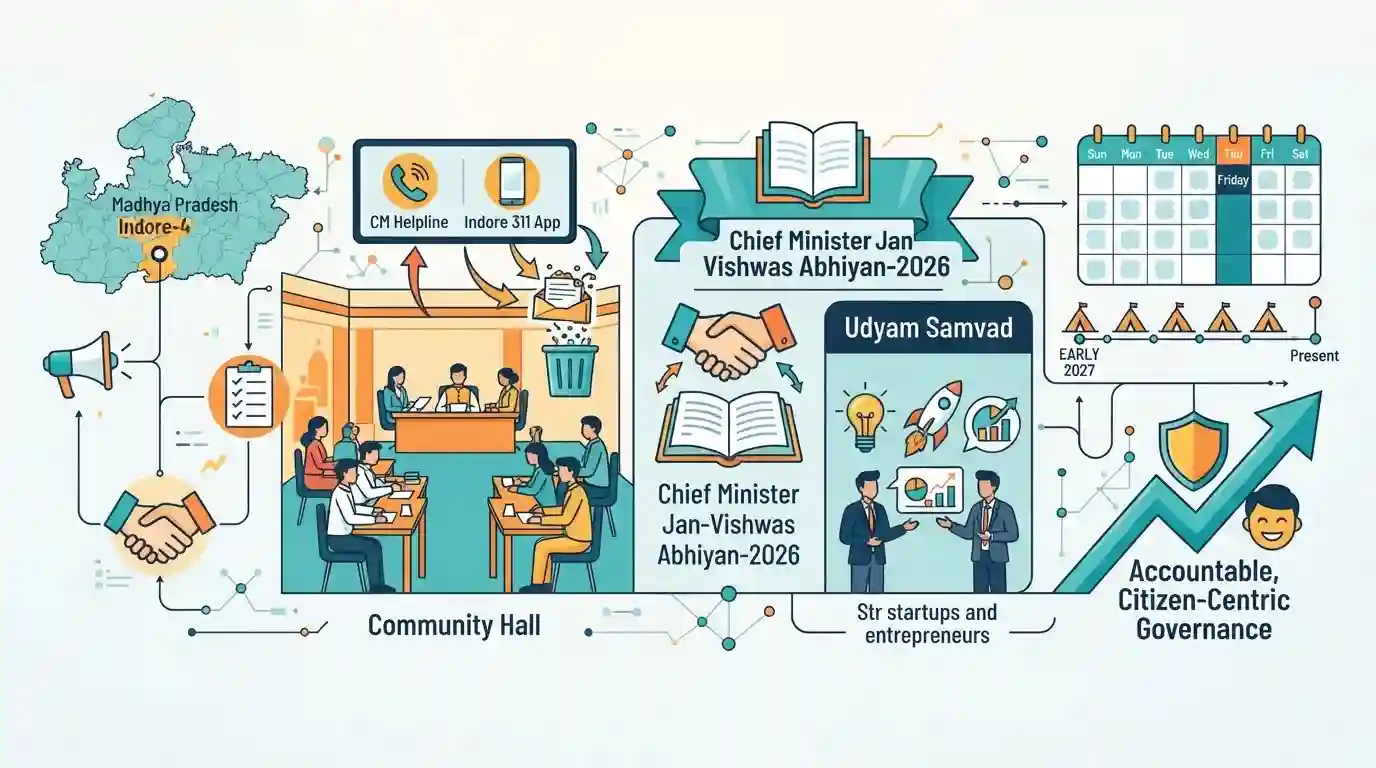
A localized public grievance redressal camp is scheduled in Indore-4 under Madhya Pradesh's Chief Minister Jan-Vishwas Abhiyan-2026. Designed to clear a backlog of civic complaints logged via the CM Helpline and the Indore 311 app, the camp represents the state's broader push towards accountable, citizen-centric governance. In addition to resolving public grievances, the camp will host an 'Udyam Samvad' programme to assist local entrepreneurs and startups. The overarching campaign will continue to hold weekly camps every Friday until early 2027.
Key Points
- A special public grievance redressal camp is being organized in Indore-4 on August 14 under the Chief Minister Jan-Vishwas Abhiyan-2026.
- The initiative focuses on resolving long-pending complaints registered on platforms like the CM Helpline, Indore 311 app, and earlier public hearings.
- The camp also includes an 'Udyam Samvad' session designed to support and guide entrepreneurs and startup beneficiaries.
- This overarching grievance redressal campaign is conducted every Friday across the state and is scheduled to continue until January 8, 2027.
Important Terms
Chief Minister Jan-Vishwas Abhiyan-2026

A public grievance redressal campaign in Madhya Pradesh running from August 2026 to January 2027, featuring weekly local camps to resolve citizen complaints on the spot and assess welfare scheme implementation.
UPSC context
Relevant for GS Paper 2 (Governance). Demonstrates state-level models for accountable, citizen-centric administration and effective public service delivery.
CM Helpline (Madhya Pradesh)
An integrated grievance redressal portal and toll-free number (181) in Madhya Pradesh allowing citizens to register complaints, seek government services, and provide feedback on public administration.
UPSC context
Important for GS Paper 2 (E-Governance). Showcases the use of ICT tools for ensuring transparency and accountability in governance.
Indore 311 App
A civic engagement mobile application by the Indore Municipal Corporation enabling residents to report non-emergency local issues (like uncollected garbage or potholes) and track their resolution in real-time.
UPSC context
Fits GS Paper 2 (E-Governance) and GS Paper 3 (Urban Development). An excellent example of crowd-sourced civic management and smart city digital infrastructure.
Udyam Samvad
An interactive program bringing together local MSME entrepreneurs, startup beneficiaries, and government officials to share experiences, raise operational issues, and find prompt administrative resolutions.
UPSC context
Relevant for GS Paper 3 (Economic Development, MSMEs). Highlights participatory governance approaches to foster local entrepreneurship and ease of doing business.
Prelims Trap
Jan-Vishwas Abhiyan is a Central government initiative for decriminalizing minor offenses.
Aspirants may confuse Madhya Pradesh's state-level grievance redressal campaign with the Union government's Jan Vishwas Act, which decriminalizes minor economic offenses.
Static Concepts Connected
What are the key institutional mechanisms for public grievance redressal in India?
- CPGRAMS: An online web-enabled system routing citizen complaints to respective central and state government ministries or departments.
- Citizen's Charters: Publicly declared commitments by government departments regarding the standards, timeframes, and transparency of their service delivery.
- Lokpal and Lokayuktas: Statutory anti-corruption ombudsmen established to inquire into and redress public grievances regarding corruption by public functionaries.
What are the core pillars required for successful e-governance implementation?
- Process Re-engineering: Radically restructuring traditional bureaucratic workflows to suit seamless, transparent, and digital-first service delivery.
- Digital Infrastructure: Establishing reliable digital infrastructure, such as broadband connectivity (BharatNet) and secure cloud environments for data hosting.
- Capacity Building: Upskilling civil servants and creating hybrid offline models to ensure inclusive access for non-digital populations.
Cross-Topic Patterns
Hybrid e-governance mitigating the digital divide
Physical camps designed to resolve app-based complaint backlogs perfectly illustrate hybrid governance. This ensures marginalized citizens lacking digital literacy are not structurally excluded from state service delivery.
Integrated administrative delivery for MSMEs
Combining citizen grievance redressal with MSME/startup outreach ('Udyam Samvad') reflects an emerging convergence of basic welfare administration and localized economic promotion.

Expect a GS2 Mains question evaluating hybrid grievance redressal models—blending digital helplines with physical localized camps.
Linked PYQs · 2
Linked PYQs · 2
- 2024MPPSC_PRELIMSGS1
UNNATI (Agri-GISl project of Madhya Pradesh Government is for :
- 2025MPPSC_PRELIMSGS1
The objective of "Mukhyamantri Ladli Behna Yojana" implemented in entire Madhya Pradesh, in addition to economic self-reliance is:
