Judicial review of Speaker decisions under anti-defection law
Source:The Hindu ↗
हे का महत्त्वाचे आहे
This judgment reinforces the boundary between legislative autonomy and judicial review, particularly concerning the impartiality of the Speaker under the Tenth Schedule, making it crucial for GS2 Polity.
सारांश
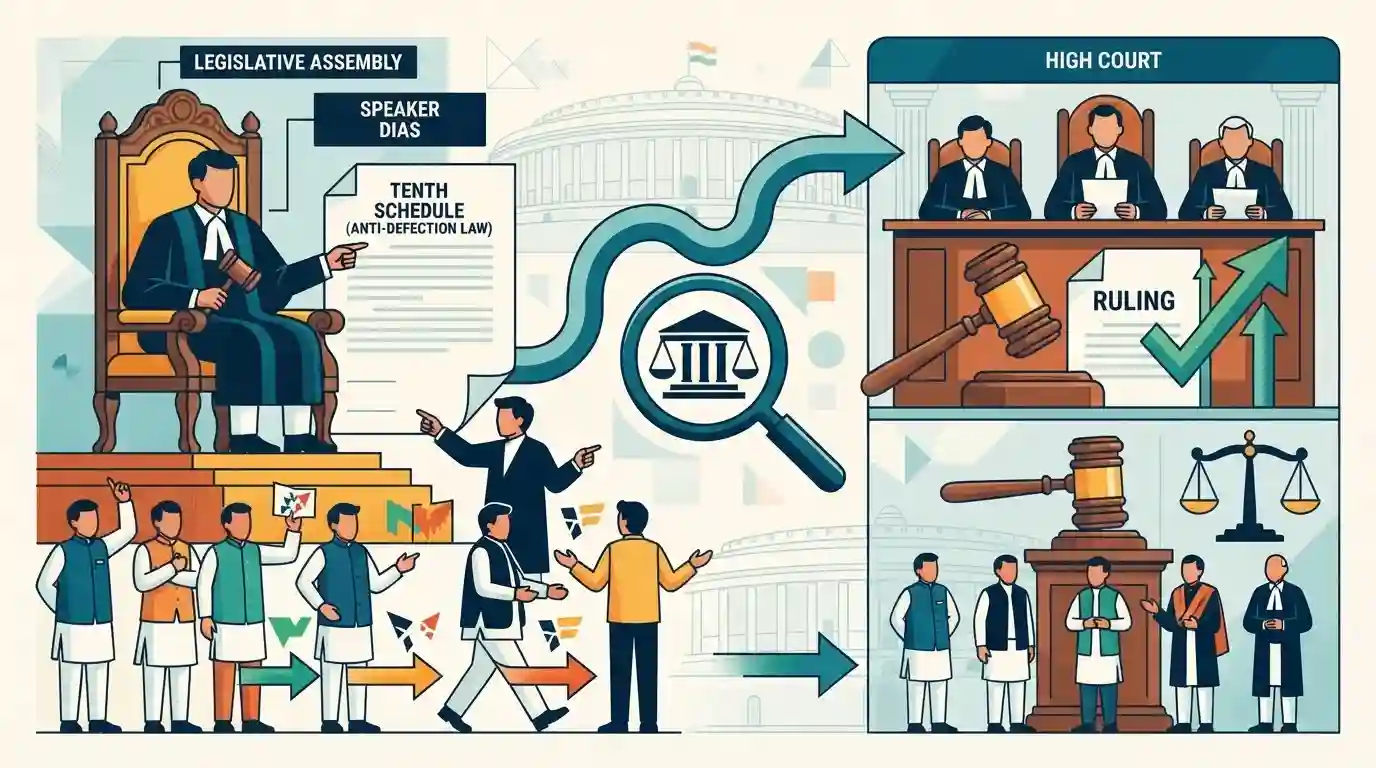
A ruling by the High Court underlining that the decision of a Legislative Assembly Speaker can be reviewed by the judiciary, bringing focus to judicial review of speaker decisions under the anti-defection law.
मुख्य मुद्दे
- The High Court ruled that a Speaker's decision can be subjected to judicial review and cannot be sustained if it suffers from perversity, mala fides, or violation of constitutional principles.
- The case highlights ongoing tensions regarding the dual role of the Speaker as a political party member and an impartial adjudicator under the Tenth Schedule.
- Emphasizes the necessity of judicial oversight to prevent arbitrary delays or biased outcomes in disqualification proceedings.
महत्त्वाच्या संज्ञा
Anti-Defection Law

A constitutional law introduced via the 52nd Amendment Act (1985) to prevent political defections by legislators, disqualifying them if they switch parties or defy party whips.
UPSC context
GS Paper II (Indian Polity - Parliament and State Legislatures, Salient Features of Constitution). Tests knowledge of disqualification norms and political stability measures.
Tenth Schedule
Added to the Constitution by the 52nd Amendment Act, the Tenth Schedule contains provisions for disqualifying MPs and MLAs on the grounds of defection, assigning adjudication powers to the Speaker.
UPSC context
GS Paper II (Polity - Constitutional Provisions and Structure). Important for questions regarding legislative control, federalism, and the separation of powers.
Judicial Review
The power of the judiciary to examine the constitutionality and legality of legislative or executive actions, including the decisions of legislative Speakers under the Tenth Schedule.
UPSC context
GS Paper II (Indian Polity - Basic Structure, Judiciary). Frequently tested under checks and balances and landmark Supreme Court rulings.
Role of Speaker
Constitutional head of a State Legislative Assembly responsible for conducting proceedings, maintaining order, and deciding defection cases as a quasi-judicial authority.
UPSC context
GS Paper II (Functioning of Parliament and State Legislatures). Evaluates neutrality, impartiality, and quasi-judicial accountability of presiding officers.
पूर्वपरीक्षा सापळा
A Speaker's decision under the Tenth Schedule enjoys absolute immunity from judicial scrutiny because the office is constitutionally independent.
Aspirants often believe the Supreme Court banned judicial review of a Speaker's decision entirely prior to disqualification; however, judicial review is available *after* the Speaker makes a decision (or fails to within a reasonable time), but not *quia timet* (beforehand) except in exceptional circumstances.
संबंधित स्थिर संकल्पना
What are the constitutional provisions, key judgments, and grounds for judicial review under the Tenth Schedule?
- Constitutional Basis: Added by the 52nd Amendment Act (1985), it provides for disqualification of MPs/MLAs on grounds of defection, with certain exceptions for splits and mergers (amended by 91st Act).
- Kihoto Hollohan Case: Kihoto Hollohan (1992) upheld the law's constitutional validity but struck down Paragraph 7 barring judicial review, ruling the Speaker acts as a tribunal subject to judicial oversight.
- Judicial Review Limits: Permissible only on grounds of mala fides, perversity, violation of constitutional mandates, or breach of natural justice—courts generally do not judge merits directly.
- Meghachandra Recommendation: SC recommended amending the Constitution to remove disqualification powers from Speakers and vest them in an independent external tribunal to ensure political neutrality.
आंतर-विषय नमुने
Legislative Immunity vs. Judicial Review
The constitutional friction between legislative immunity (Article 105/194) and judicial review mirrors debates over executive privilege and ordinance-making power.
Tenth Schedule Reform & Independent Tribunals
Proposals for an independent tribunal to decide disqualifications connect anti-defection reform with broader debates on administrative tribunals and judicial backlog.

Expect a multi-statement prelims question combining Kihoto Hollohan grounds with Keisham Meghachandra independent tribunal recommendations.
संबंधित PYQ · 2
संबंधित PYQ · 2
- 2020MainsGS2
Once a Speaker, Always a Speaker' ! Do you think this practice should be adopted to impart objectivity to the office of the Speaker of Lok Sabha ? What could be its implications for the robust functioning of parliamentary business in India?
- 2023MainsGS2
Discuss the role of Presiding Officers of state legislatures in maintaining order and impartiality in conducting legislative work and in facilitating best democratic practices.
