Speaker and Not Police Holds Power Over Assembly Rules Breach
Source:The Hindu ↗
Why It Matters
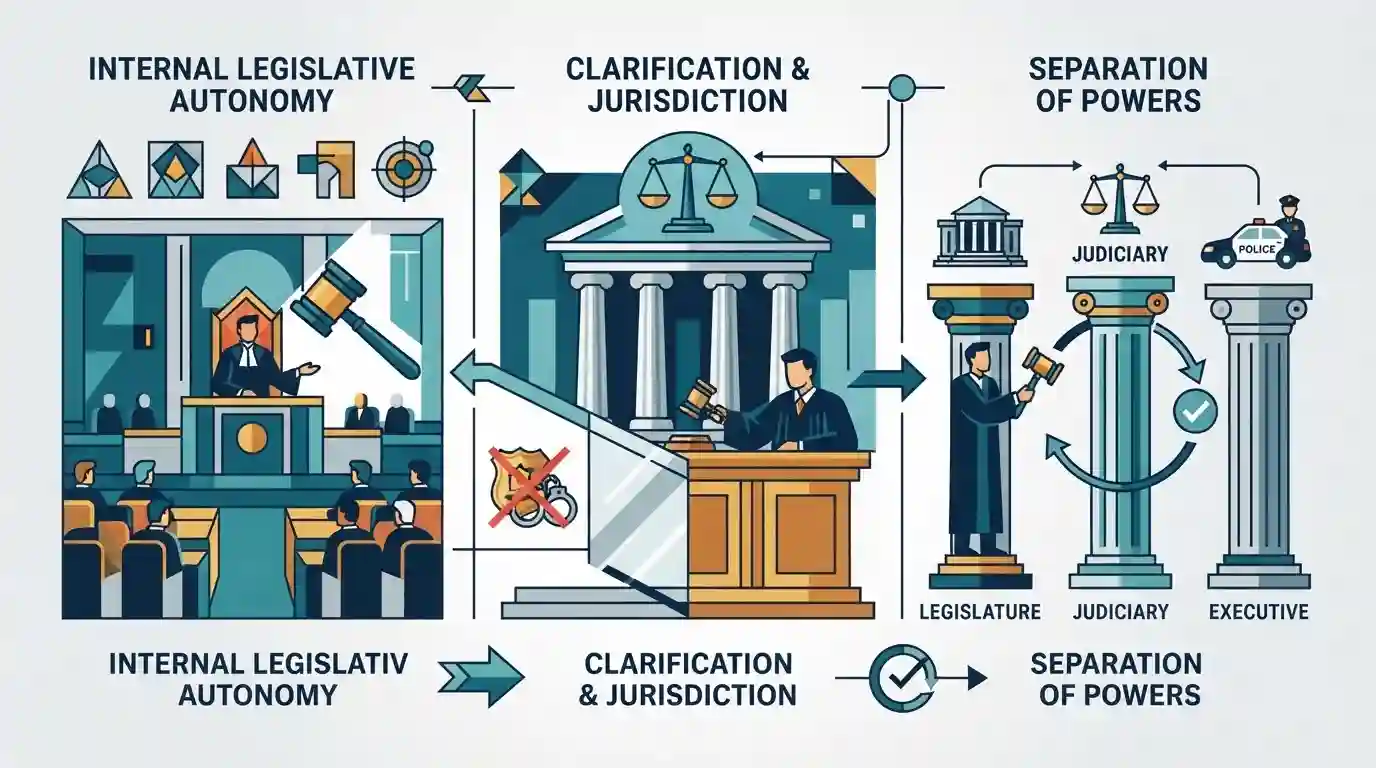
This judgment addresses the crucial boundary between legislative privileges and executive/police intervention, reinforcing the doctrine of separation of powers and the exclusive authority of the Speaker over House proceedings.
Summary
The High Court clarified that action against any violation of Assembly rules falls under the exclusive jurisdiction of the Speaker and not the police, reinforcing legislative privileges, internal autonomy, and the separation of powers between organs of the state.
Key Points
- The High Court held that the Speaker, and not the police, holds the authority to take action against the violation of Assembly rules.
- The ruling emphasizes the internal autonomy and exclusive privilege of the legislature in regulating its proceedings and handling matters of discipline within the House.
- It underscores the separation of powers and limits executive or police intervention inside the legislative domain without explicit authorization from the Speaker.
Important Terms
High Court

The constitutional court at the state level in India, exercising writ jurisdiction under Article 226 to protect fundamental and legal rights, and enforcing the separation of powers against executive overreach.
UPSC context
GS Paper II (Polity & Governance - Judiciary structure and jurisdiction). Tests understanding of judicial review and separation of powers.
Assembly
The directly elected lower house of a state legislature in India responsible for lawmaking, representing public constituencies, and regulating its internal proceedings through an elected Speaker.
UPSC context
GS Paper II (Legislatures - Structure, Functioning, Conduct of Business, Powers & Privileges). Tests knowledge of state-level legislative mechanics and autonomy.
Prelims Trap
Police can take direct penal action for rule violations inside the Assembly floor without the Speaker's consent.
Aspirants often assume police can enter legislative premises to register FIRs or take suo motu cognizance of disturbances without realizing the Speaker's exclusive oversight.
Static Concepts Connected
What are the constitutional provisions governing the conduct of business and legislative privileges in State Legislatures?
- Article 208:: Empowers State Legislatures to make rules for regulating their procedure and the conduct of their business.
- Article 212:: Provides that courts shall not inquire into the proceedings of the Legislature on the ground of any alleged irregularity of procedure.
- Article 194:: Grants members freedom of speech in the Legislature, subject to constitutional provisions and rules of the House.
Cross-Topic Patterns
Legislative Privilege vs. Executive Overreach
While Article 212 bars courts from inquiring into legislative proceedings, the High Court clarified executive overreach limits, reinforcing the delicate boundary between judicial restraint and executive non-interference.

Article 208 rules of procedure combined with Speaker's exclusive jurisdiction over internal discipline is a prime match-list/statement trap.
Linked PYQs · 2
Linked PYQs · 2
- 2020MainsGS2
Judicial Legislation is antithetical to the doctrine of separation of powers as envisaged in the Indian Constitution. In this context justify the filing of large number of public interest petitions praying for issuing guidelines to executive authorities.
- 2024PrelimsGS1
With reference to the Speaker of the Lok Sabha, consider the following statements : While any resolution for the removal of the Speaker of the Lok Sabha is under consideration 1. He/She shall not preside. 2. He/She shall not have the right to speak. 3. He/She shall not be entitled to vote on the resolution in the first instance. Which of the statements given above is/are correct?
