Spain Rejection of Iran Conflict Amid US Trade Threats
Source:Indian Express ↗
Why It Matters
The article provides a clear contemporary example of 'sovereign nationalism' and the weaponization of economic trade for geopolitical coercion. It is highly relevant for GS2 questions on the shifting dynamics of trans-Atlantic alliances, the resilience of the EU as a trading bloc, and the global reverberations of the US-Iran conflict.
Summary
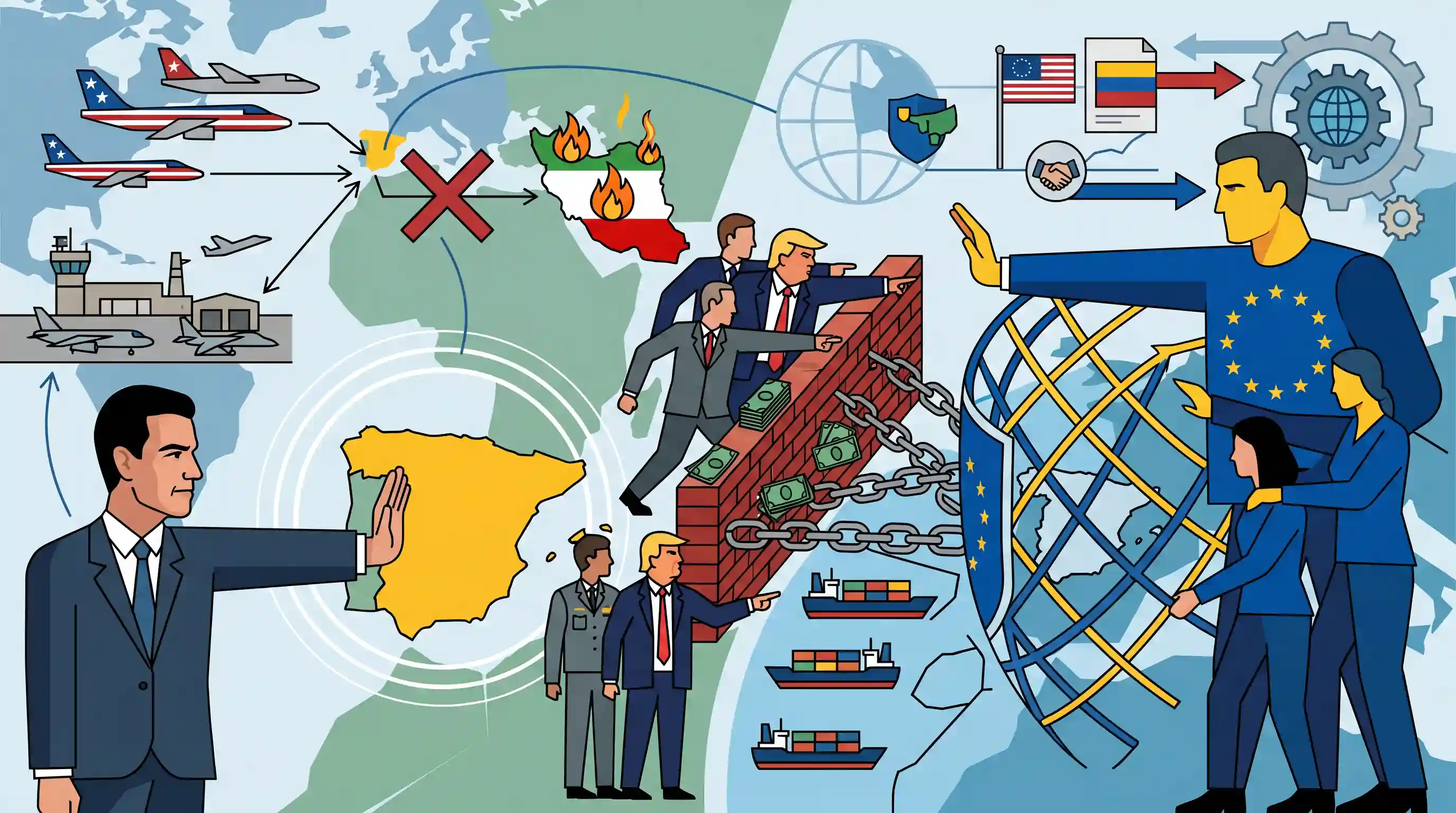
Spanish Prime Minister Pedro Sánchez refused to allow the US to use joint military bases in Spain for military strikes against Iran, condemning the actions as a dangerous escalation. In response, US President Donald Trump threatened a comprehensive trade embargo against Spain. The dispute highlights the growing weaponization of trade by the US to enforce geopolitical alignment and underscores the structural role of the European Union, which warned that an economic attack on Spain would be treated as an attack on the entire EU bloc due to its collective trade policy.
Key Points
- Spanish PM Pedro Sánchez denied the US access to joint military bases in Rota and Morón for military operations against Iran, citing opposition to military escalation in the Middle East.
- US President Donald Trump threatened a complete trade embargo and high tariffs on Spain in retaliation, illustrating the use of economic coercion to achieve strategic objectives.
- The European Commission stated it would defend Spain, highlighting that trade is an exclusive EU competence and any US tariffs on Spain would be viewed as an attack on the entire bloc.
- The confrontation reflects widening trans-Atlantic rifts over US unilateralism, the Middle East conflict, and NATO alliance dynamics.
Important Terms
Agreement on Defense Cooperation (US-Spain)

A 1988 bilateral treaty, updated via protocols, regulating U.S. military access to Spanish bases like Rota and Morón, requiring Spanish authorization for offensive missions.
UPSC context
GS-II International Relations; vital for understanding bilateral security pacts and sovereignty issues in host-nation agreements.
EU Common Trade Policy
The EU's unified trade framework (Common Commercial Policy) where the bloc exercises exclusive competence, preventing individual member states from negotiating separate trade deals or being targeted unilaterally.
UPSC context
GS-II International Relations; key for questions on regional blocs, trade sovereignty, and India-EU FTA dynamics.
European Commission
The EU's executive arm responsible for proposing legislation, enforcing trade rules, and managing the bloc's collective response to external economic threats.
UPSC context
GS-II Global Institutions; tests knowledge of executive functions within supranational organizations.
Weaponization of Trade
The strategic use of economic tools, such as tariffs or embargoes, as leverage to force political or security concessions from other nations.
UPSC context
GS-II International Relations; essential for analyzing contemporary geopolitical shifts and "de-risking" strategies.
Anti-Coercion Instrument (ACI)
An EU trade defense tool (Regulation 2023/2675) allowing the bloc to impose countermeasures against third countries that use economic pressure to influence member state policies.
UPSC context
GS-II IR & Economy; highly relevant for questions on trade wars and "Strategic Autonomy."
NATO
A 32-member intergovernmental military alliance; current tensions involve U.S. demands for members (like Spain) to significantly increase defense spending to 5% of GDP.
UPSC context
GS-II International Relations; crucial for security architecture and collective defense debates.
Prelims Trap
Individual EU member nations like Spain can independently negotiate trade tariffs and retaliatory embargoes with the USA.
Trade is an "exclusive competence" of the EU. Individual member states cannot negotiate tariffs or embargoes; the European Commission handles trade policy for the whole bloc.
Static Concepts Connected
How does the EU's Common Commercial Policy govern external trade?
- Exclusive competence: Only the EU, not individual member states, can legislate on trade matters or conclude international trade agreements.
- Customs Union: All EU member states apply a common external tariff to goods imported from non-EU countries.
- WTO representation: The European Commission acts as the single negotiator and represents all 27 member states collectively at the World Trade Organization.
What is the legal standing of unilateral economic sanctions in international relations?
- UN Mandate: Sanctions authorized by the UN Security Council under Chapter VII are legally binding on all member states.
- Unilateral actions: Sanctions or embargoes imposed by a single country (like the US) lack universal legal backing and are considered coercive diplomacy.
- Extraterritorial reach: Applying domestic trade penalties to third-party countries or entities trading with a sanctioned nation, often opposed internationally.
Cross-Topic Patterns
EU trade competence & India-EU BTIA
The EU's collective trade mechanism explains why India's Bilateral Trade and Investment Agreement (BTIA) requires broad European consensus, complicating negotiations over tariffs and intellectual property.
NATO autonomy & India's multi-alignment
Spain's refusal of US military access reflects a growing European 'strategic autonomy', mirroring India's foreign policy template of multi-alignment and resistance to blanket US unilateralism.

Expect a Prelims question on the EU's 'exclusive competences' (trade/customs) vs shared competences, driven by US-EU tariff disputes.
Linked PYQs · 2
Linked PYQs · 2
- 2025MainsGS2
"With the waning of globalization, post-Cold War world is becoming a site of sovereign nationalism.” Elucidate.
- 2018MainsGS2
In what ways would the ongoing US-Iran Nuclear Pact Controversy affect the national interest of India? How should India respond to this situation?
