ISRO Successfully Executes SPADEX Satellite Docking Mission
Source:The Hindu ↗
Why It Matters
SPADEX represents a significant milestone in India's space capabilities, perfectly aligning with UPSC's focus on India's indigenous achievements in science and technology, and the development of future space infrastructure like the Bharatiya Antariksha Station.
Summary
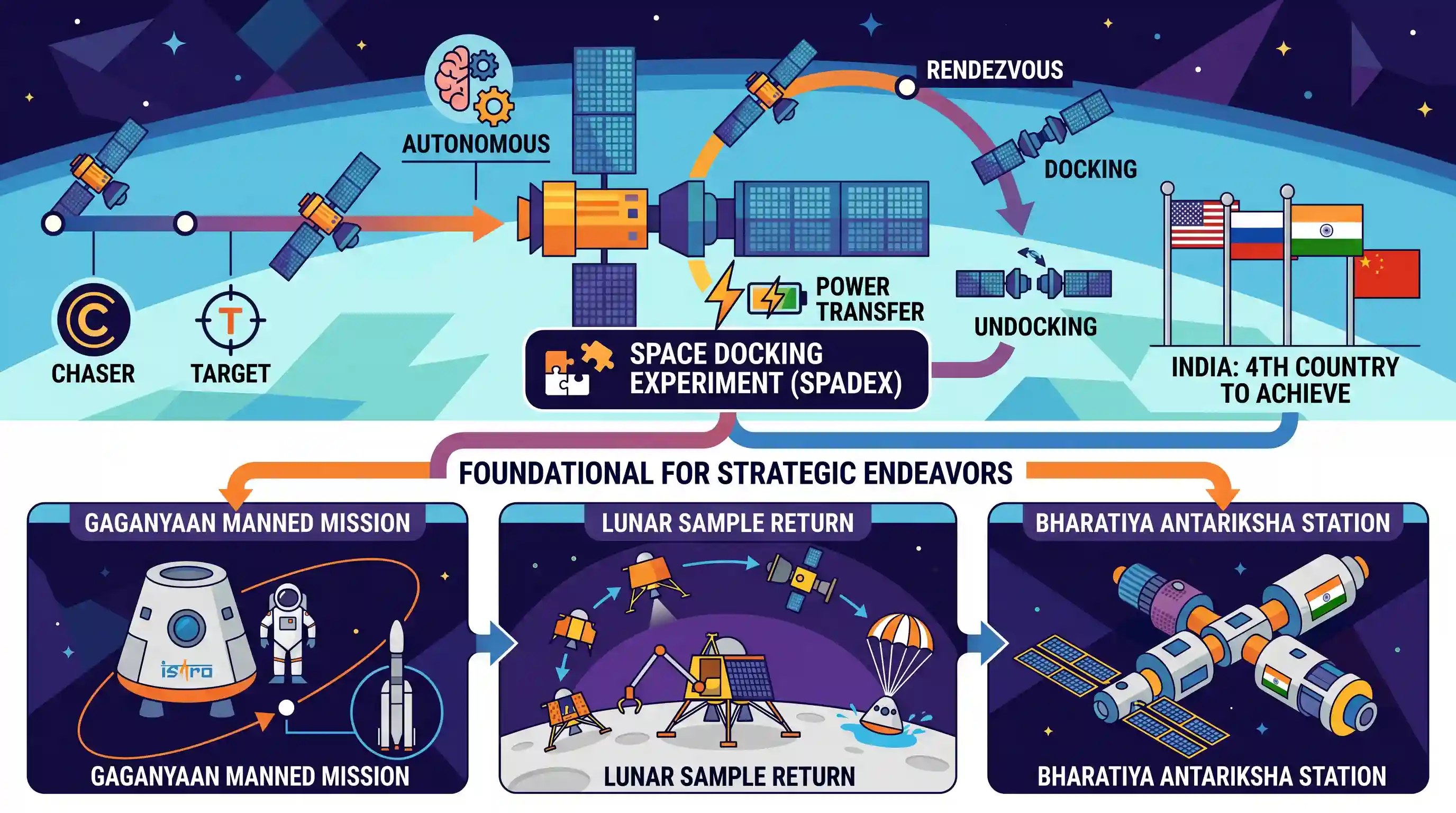
ISRO has successfully conducted its second satellite docking maneuver under the Space Docking Experiment (SPADEX) mission involving the SDX01 (Chaser) and SDX02 (Target) satellites. This technology demonstration makes India the fourth country in the world to achieve autonomous space docking, a critical precursor to advanced space operations. The mission proved key capabilities including rendezvous, docking, undocking, and power transfer, which are foundational for India's upcoming strategic endeavors like the Gaganyaan manned mission, lunar sample return, and the establishment of the Bharatiya Antariksha Station.
Key Points
- ISRO successfully executed the second docking of satellites SDX01 (Chaser) and SDX02 (Target) under the SPADEX mission.
- India has become the fourth country globally (after the US, Russia, and China) to demonstrate autonomous satellite docking technology in space.
- The SPADEX mission validates crucial technologies like spacecraft rendezvous, docking, undocking, and electrical power transfer between composite spacecraft.
- These capabilities are essential for future complex ISRO missions, including the human spaceflight program (Gaganyaan), lunar sample return missions, and establishing the Bharatiya Antariksha Station.
Important Terms
SPADEX (Space Docking Experiment)

An ISRO technology demonstrator mission for autonomous rendezvous and docking of two satellites. It validates critical maneuvers like power transfer and unified control for future space stations.
UPSC context
GS Paper III (Science & Tech); tests indigenous technology for complex space assembly, satellite servicing, and lunar sample returns.
Bharatiya Antariksha Station (BAS)
India's first modular space station planned for Low Earth Orbit. It aims for a 2028 base module launch and full 2035 operationality for microgravity research.
UPSC context
GS Paper III (Science & Tech); represents India’s strategic roadmap for a permanent, independent human presence in space.
Gaganyaan
India's maiden human spaceflight programme designed to send a crew of three to Low Earth Orbit for a three-day mission and return them safely.
UPSC context
GS Paper III (Science & Tech); tests critical human-rated launch systems, life support, and crew safety protocols.
Chandrayaan-4
A future ISRO mission for lunar sample return. It will employ docking technology to transfer lunar soil samples between modules in orbit for return to Earth.
UPSC context
GS Paper III (Science & Tech); tests complex multi-modular coordination and robotic sample-return capabilities for deep-space exploration.
ISRO (Indian Space Research Organisation)
India's national space agency responsible for research, satellite launches, and planetary exploration. It is the primary architect of India's indigenous space technology.
UPSC context
GS Paper III (Science & Tech); core institution for space-based development, security, and international scientific leadership.
Prelims Trap
SPADEX successfully demonstrated the autonomous docking and power transfer of satellites in lunar orbit.
SPADEX was conducted in Low Earth Orbit (LEO), not lunar orbit. While its technology will eventually be used for lunar missions, this test was strictly near-Earth.
Static Concepts Connected
What foundational technologies are required for building a modular Space Station?
- Autonomous Docking: The capability of spacecraft to independently track, approach, and mechanically connect with each other without human intervention.
- Power Transfer: The ability to share electricity and data between connected spacecraft modules, validated by the SPADEX composite maneuver.
- Life Support Systems: Closed-loop systems for air, water recycling, and thermal management to sustain a continuous human presence (ECLSS).
How does Lunar Orbit Rendezvous differ from Low Earth Orbit (LEO) docking?
- Gravity Constraints: Lunar rendezvous relies on the Moon's weaker gravity and lacks atmospheric drag, requiring entirely different orbital mechanics and thruster calibrations.
- Communication Lag: Deep space docking faces higher telemetry latency (communication lag) compared to near-real-time LEO tracking, making autonomy crucial.
- Mission Architecture: Lunar docking is specifically designed to minimize the fuel load that needs to land on and launch from the lunar surface.
Cross-Topic Patterns
Docking tech & Lunar Sample Return
SPADEX's autonomous docking is the critical enabler for Chandrayaan-4, as the lunar surface ascent module must precisely dock with the orbiting return module to bring samples back to Earth.
Modular Space Station Assembly
India's proposed Bharatiya Antariksha Station (BAS) relies on SPADEX's capability to mechanically dock and transfer electrical power, essential for maintaining a multi-module orbital habitat.

Expect a multi-statement question combining SPADEX LEO power transfer, BAS 2035 timeline, and Chandrayaan-4 lunar docking architecture.
Linked PYQs · 3
Linked PYQs · 3
- 2016MainsGS3
Discuss India's achievements in the field of Space Science and Technology. How the application of this technology has helped India in its socio-economic development?
- 2023MainsGS3
What is the main task of India's third moon mission which could not be achieved in its earlier mission? List the countries that have achieved this task. Introduce the subsystems in the spacecraft launched and explain the role of the Virtual Launch Control Centre' at the Vikram Sarabhai Space Centre which contributed to the successful launch from Sriharikota.
- 2025PrelimsGS1
Consider the following space missions : I. Axiom-4 II. SpaDeX III. Gaganyaan How many of the space missions given above encourage and support micro-gravity research?
