ISRO Chairman highlights oxygen leak oversight before Axiom 4
Source:The Hindu ↗
Why It Matters
The article underscores the technical complexities and risks inherent in human spaceflight. It is highly relevant for UPSC as it demonstrates ISRO's globally recognized technical acumen in liquid propulsion systems, the evolving dynamics of international and private space collaborations, and the operational groundwork being laid for India's indigenous Gaganyaan mission.
Summary
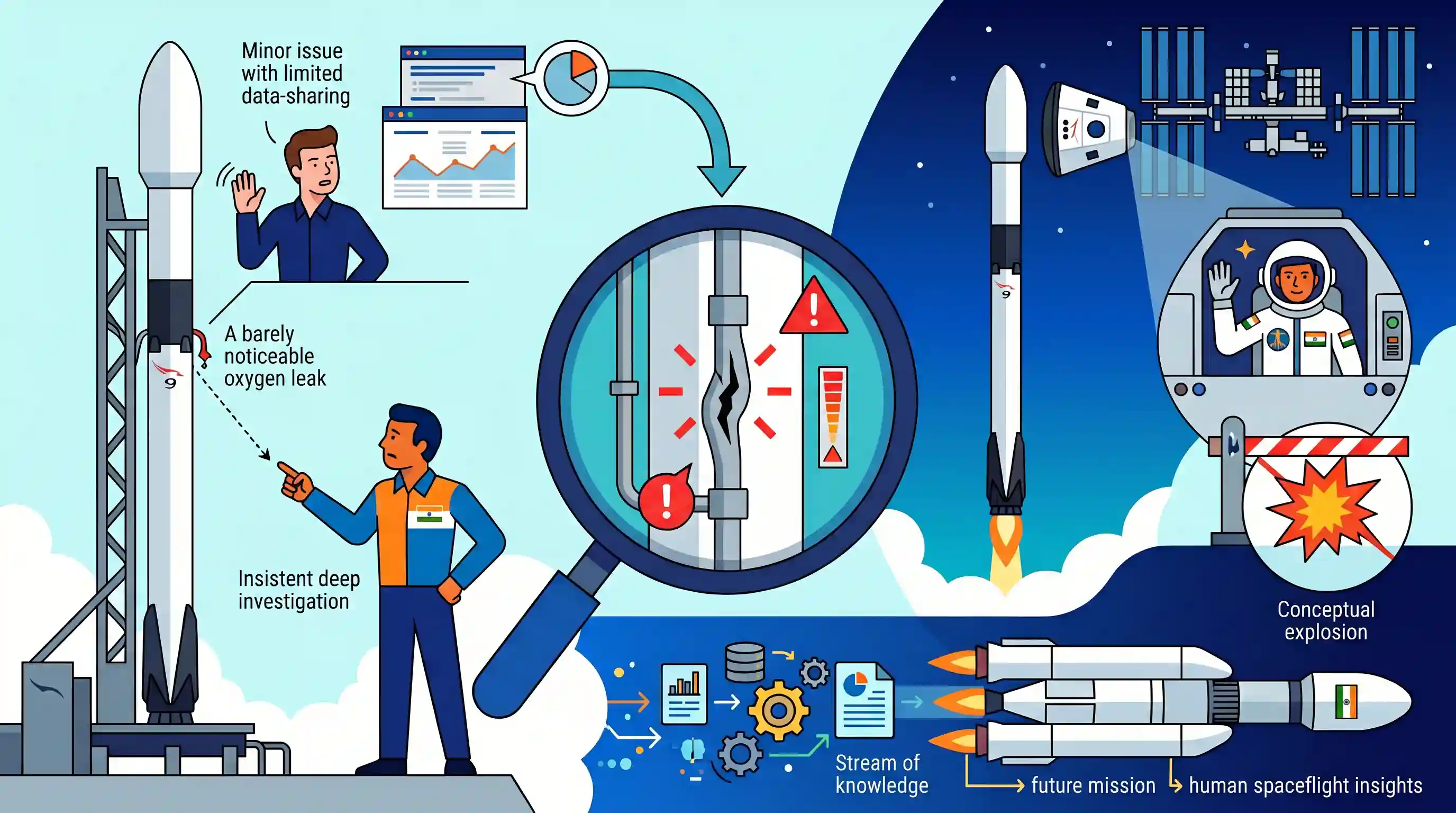
ISRO Chairman V. Narayanan revealed that SpaceX initially downplayed an oxygen leak in the Falcon 9 rocket ahead of the Axiom-4 mission, which carried Indian astronaut Group Captain Shubhanshu Shukla to the ISS. Citing its extensive expertise with liquid engines, ISRO insisted on a complete investigation and correction despite initial data-sharing reluctance from SpaceX. The probe eventually revealed a widening crack in the fuel line, averting a potential disaster. The successful mission is a major milestone, providing India with critical insights for the upcoming Gaganyaan human spaceflight mission.
Key Points
- The Axiom-4 mission aboard SpaceX's Falcon 9 rocket carried Indian astronaut Group Captain Shubhanshu Shukla to the International Space Station (ISS).
- Prior to the launch, a liquid oxygen leak was detected in the oxidiser line, which SpaceX initially deemed minor and was reluctant to share detailed data about.
- Leveraging decades of expertise in liquid engines, ISRO successfully pressed SpaceX for a thorough investigation, uncovering a widening crack in the fuel line that could have caused a catastrophic failure during liftoff.
- The mission, marking the first time in 40 years an Indian reached space, provides crucial data and operational experience for ISRO's upcoming manned Gaganyaan mission.
Important Terms
Axiom-4 mission

A 2025 private commercial mission to the International Space Station (ISS) involving ISRO, NASA, and SpaceX. It featured Indian astronaut Shubhanshu Shukla, marking India's second human spaceflight and first ISS visit.
UPSC context
GS Paper III: Awareness in Space. Tests knowledge of international collaborations and milestones in India’s human spaceflight journey.
Gaganyaan mission
ISRO's flagship indigenous program aimed at demonstrating human spaceflight capability by sending a three-member crew to Low Earth Orbit (LEO) for three days and returning them safely.
UPSC context
GS Paper III: Indigenization of technology. Critical for questions on India's strategic autonomy in space and indigenous aerospace engineering.
ISRO
The premier national space agency of India, responsible for space research, satellite launches, and planetary exploration. It leads the Gaganyaan mission and partners globally for crew training and missions.
UPSC context
GS Paper III: Science and Technology. Core institution for questions regarding India’s space achievements, institutional framework, and international cooperation.
SpaceX
An American private aerospace manufacturer providing launch services via Falcon 9 rockets and Dragon capsules. It collaborated on Axiom-4 and was involved in the controversial oxygen leak safety investigation.
UPSC context
GS Paper III: Space Technology. Illustrates the growing role of private players and public-private partnerships in global space exploration.
Axiom Space
An American commercial spaceflight company that coordinates private missions to the ISS. It facilitates training, mission management, and research for government-sponsored and private astronauts.
UPSC context
GS Paper III: Science and Technology. Relevant to the commercialization of Low Earth Orbit and evolving international space treaties.
NASA
The U.S. government agency responsible for civil space programs. It partners with ISRO through the iCET framework and oversees ISS operations for missions like Axiom-4.
UPSC context
GS Paper II: Bilateral relations. Key to India-US space diplomacy and collaborative frameworks like NISAR and Artemis Accords.
Prelims Trap
Axiom-4 is a joint government-operated ISRO-NASA spaceflight launched on India's LVM3 rocket.
Axiom-4 is a commercial mission operated by Axiom Space using a SpaceX Falcon 9 rocket, not a direct government-to-government spaceflight on an ISRO vehicle.
Static Concepts Connected
What makes cryogenic rocket engines highly efficient but technically challenging?
- Propellants: Uses Liquid Oxygen (LOX) and Liquid Hydrogen (LH2) stored at extremely low temperatures (-183°C and -253°C respectively).
- Specific Impulse: Delivers significantly more thrust per kilogram of propellant compared to solid or earth-storable liquid rocket engines.
- Structural risks: Requires advanced thermal insulation and metallurgy to prevent cryogenic fluid flashing, micro-fractures, and undetected leaks.
What are the core parameters of India's indigenous Gaganyaan mission?
- Mission Profile: Aims to send a 3-member crew to a Low Earth Orbit (LEO) of 400 km for a 3-day mission before safe oceanic recovery.
- Launch Vehicle: Utilizes the Human-Rated LVM3 (HLVM3), which consists of solid strap-on motors, a liquid core stage, and a cryogenic upper stage.
- Critical Tech: Depends on complex indigenous developments like the Crew Escape System (CES) and the Environmental Control and Life Support System (ECLSS).
Cross-Topic Patterns
Rise of commercial human spaceflight
Axiom-4 highlights the global transition to private human spaceflight operations. This directly parallels India's ongoing space sector reforms aiming to boost domestic private participation via IN-SPACe and NSIL.
Post-ISS orbital infrastructure
With the ISS scheduled to retire around 2030, focus is shifting toward commercial orbital modules (like Axiom's) and sovereign outposts like India's planned Bharatiya Antariksha Station (BAS).

Expect a multi-statement prelims question contrasting Gaganyaan's human-rated LVM3 components with commercial spaceflight operations.
Linked PYQs · 3
Linked PYQs · 3
- 2025PrelimsGS1
Consider the following space missions : I. Axiom-4 II. SpaDeX III. Gaganyaan How many of the space missions given above encourage and support micro-gravity research?
- 2016MainsGS3
Discuss India's achievements in the field of Space Science and Technology. How the application of this technology has helped India in its socio-economic development?
- 2017MainsGS3
India has achieved remarkable successes in unmanned space missions including the Chandrayaan and Mars Orbitter Mission, but has not ventured into manned space missions. What are the main obstacles to launching a manned space mission, both in terms of technology and logistics? Examine critically.
