SpaceX Shifts Exploration Priority From Mars To Lunar Settlement
Source:The Hindu ↗
Why It Matters
The shift in focus highlights the growing convergence of private space ventures (like SpaceX) with national space policies (like NASA's Artemis). Understanding these developments is crucial for tracking global priorities in space exploration, lunar colonization, and the role of private actors in shaping human spaceflight timelines.
Summary
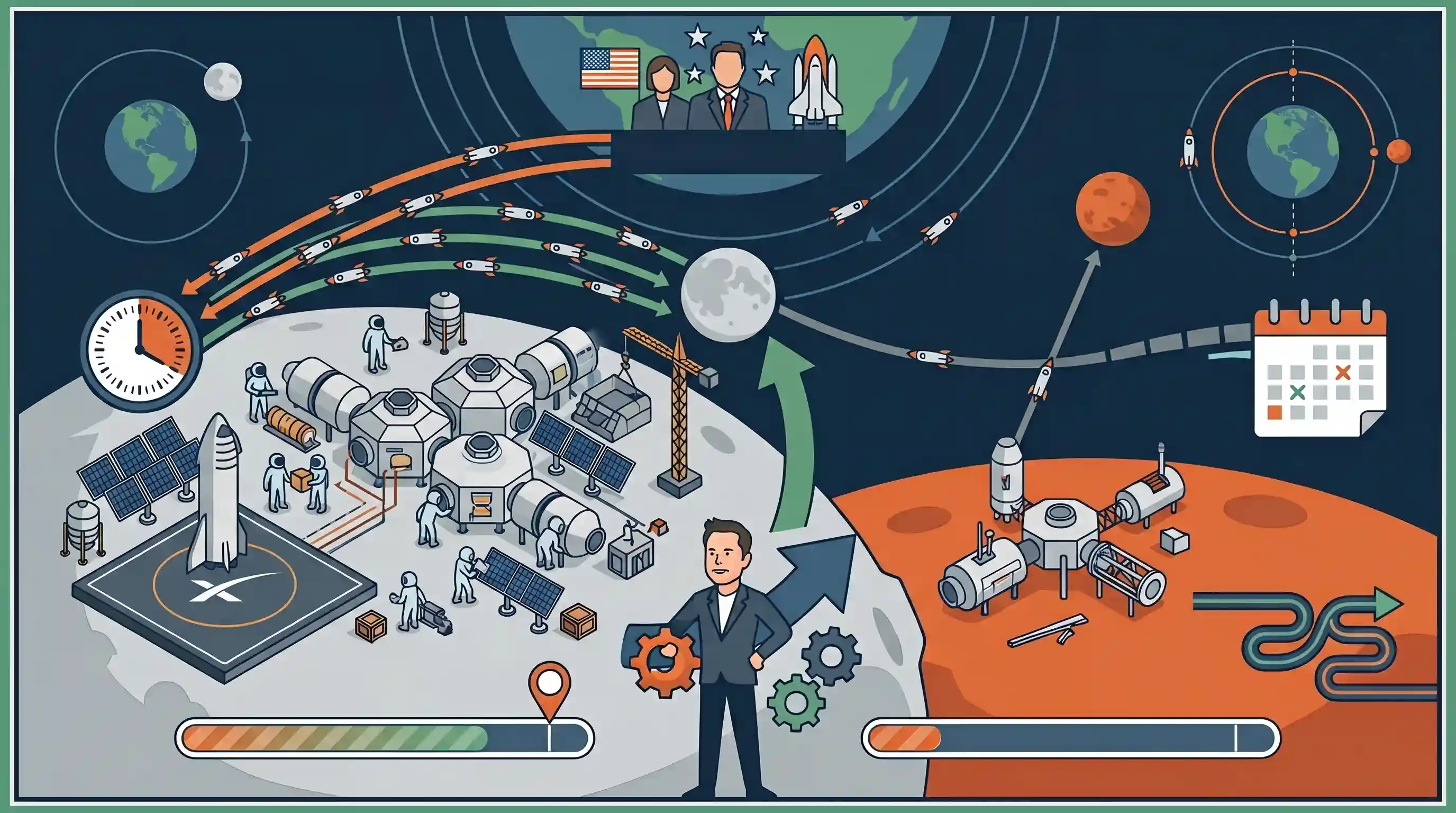
Elon Musk has announced a significant strategic shift for SpaceX, prioritizing the establishment of a permanent settlement on the Moon over its long-stated goal of colonizing Mars. This pivot aligns with the US space policy under the Trump administration and NASA's Artemis program, which prioritizes a return to the Moon. Musk cited orbital logistics as a primary reason, noting that the Moon is reachable every 10 days, enabling faster iterative development of a lunar city. In contrast, Mars missions are limited by launch windows that open only every 26 months when planetary orbits align. Consequently, SpaceX aims to build a Moon city in less than a decade, delaying its timeline for a Mars city to beyond 10 years.
Key Points
- Elon Musk announced that SpaceX is shifting its primary focus from colonizing Mars to establishing a settlement on the Moon.
- The decision aligns with the Trump administration's broader shift in US space policy, focusing on lunar exploration via NASA's Artemis program.
- The shift is driven by orbital mechanics: the Moon is accessible every 10 days, allowing for faster mission iterations, whereas Mars launch windows only open every 26 months.
- The timeline for a Mars city is now pushed beyond 10 years, while SpaceX aims to establish a Moon city within the next decade.
Important Terms
Artemis program

A NASA-led international mission aiming to establish a sustainable human presence on the Moon and land the first woman and person of color by the mid-2020s.
UPSC context
GS Paper III: Science and Technology. Relevant for space exploration, international cooperation, and future lunar-to-Mars transition strategies.
SpaceX
A private American aerospace manufacturer and space transport company founded by Elon Musk, pioneering reusable rocket technology to reduce space access costs.
UPSC context
GS Paper III: Science and Technology. Tests awareness of private sector participation in space and its impact on the global space economy.
NASA
The U.S. federal agency responsible for civilian space programs, aeronautics, and space research, serving as a primary partner for global space agencies like ISRO.
UPSC context
GS Paper III: Science and Technology. Important for international collaborations (e.g., NISAR) and comparative studies of global space programs.
Starship
A fully reusable heavy-lift launch vehicle developed by SpaceX, designed to transport crew and cargo to Earth orbit, the Moon, and Mars.
UPSC context
GS Paper III: Science and Technology. Highlights advancements in propulsion and reusable technology essential for long-term space colonization.
Artemis Accords
A US-led non-binding multilateral arrangement between governments based on the Outer Space Treaty of 1967, establishing principles for peaceful and sustainable space exploration.
UPSC context
GS Paper II/III: International Relations and Space Policy. India is a signatory; crucial for governance of lunar resources and international law.
Orbital logistics
The planning and management of spacecraft trajectories, launch windows, and supply chains in orbit to ensure timely mission execution between celestial bodies.
UPSC context
GS Paper III: Science and Technology. Tests technical understanding of constraints like launch windows (e.g., 26-month Mars cycle) in interplanetary missions.
Prelims Trap
Optimal launch windows for Mars occur every 26 months because that is the time taken for a spacecraft to reach the planet.
The 26-month gap is dictated by orbital mechanics (planetary alignment), not travel time. The actual journey to Mars typically takes only 7 to 9 months.
Static Concepts Connected
What dictates the 26-month launch window constraint for Mars missions?
- Hohmann Transfer Orbit: An elliptical trajectory used to transfer a spacecraft between two orbits using the least amount of fuel possible, requiring precise planetary positioning.
- Planetary Alignment: Earth and Mars align optimally for this low-energy, fuel-efficient transfer only once every 26 months (known as the synodic period).
- Lunar Contrast: In contrast, the Moon orbits Earth roughly every 27 days, presenting highly frequent launch opportunities and much simpler orbital logistics.
What is NASA's Artemis program and its broader significance?
- Lunar Settlement: An international human spaceflight initiative aiming to establish a sustainable, permanent human presence on the Moon as a logistical stepping stone to Mars.
- Artemis Accords: A parallel set of non-binding multilateral principles guiding peaceful and cooperative space exploration, which India signed in 2023.
Cross-Topic Patterns
Space commercialization & India's IN-SPACe
SpaceX’s pivot highlights private capital directing planetary exploration. India mirrors this via IN-SPACe and the Indian Space Policy 2023, which enables non-government entities to participate in deep-space missions.
Artemis vs Sino-Russian Lunar Base
The US acceleration of lunar settlements via Artemis directly counters the planned China-Russia International Lunar Research Station (ILRS), shifting geopolitical competition from Earth to the lunar south pole.

Expect a 2026 prelims question contrasting the orbital mechanics (launch windows/transfer orbits) of Lunar versus Martian space missions.
Linked PYQs · 2
Linked PYQs · 2
- 2023MainsGS3
What is the main task of India's third moon mission which could not be achieved in its earlier mission? List the countries that have achieved this task. Introduce the subsystems in the spacecraft launched and explain the role of the Virtual Launch Control Centre' at the Vikram Sarabhai Space Centre which contributed to the successful launch from Sriharikota.
- 2017MainsGS3
India has achieved remarkable successes in unmanned space missions including the Chandrayaan and Mars Orbitter Mission, but has not ventured into manned space missions. What are the main obstacles to launching a manned space mission, both in terms of technology and logistics? Examine critically.
