SpaceX Launches World First Commercial Nuclear Powered Satellite
Source:Indian Express ↗
Why It Matters
Understanding alternative power sources for deep-space and lunar missions is a core theme in S&T. This development highlights the transition from highly regulated, government-controlled RTGs (using plutonium) to private, commercially viable betavoltaic systems (using tritium), which is highly relevant for future lunar south pole exploration (e.g., Artemis, Chandrayaan missions) and is directly linked to past UPSC questions on RTGs and lunar exploration.
Summary
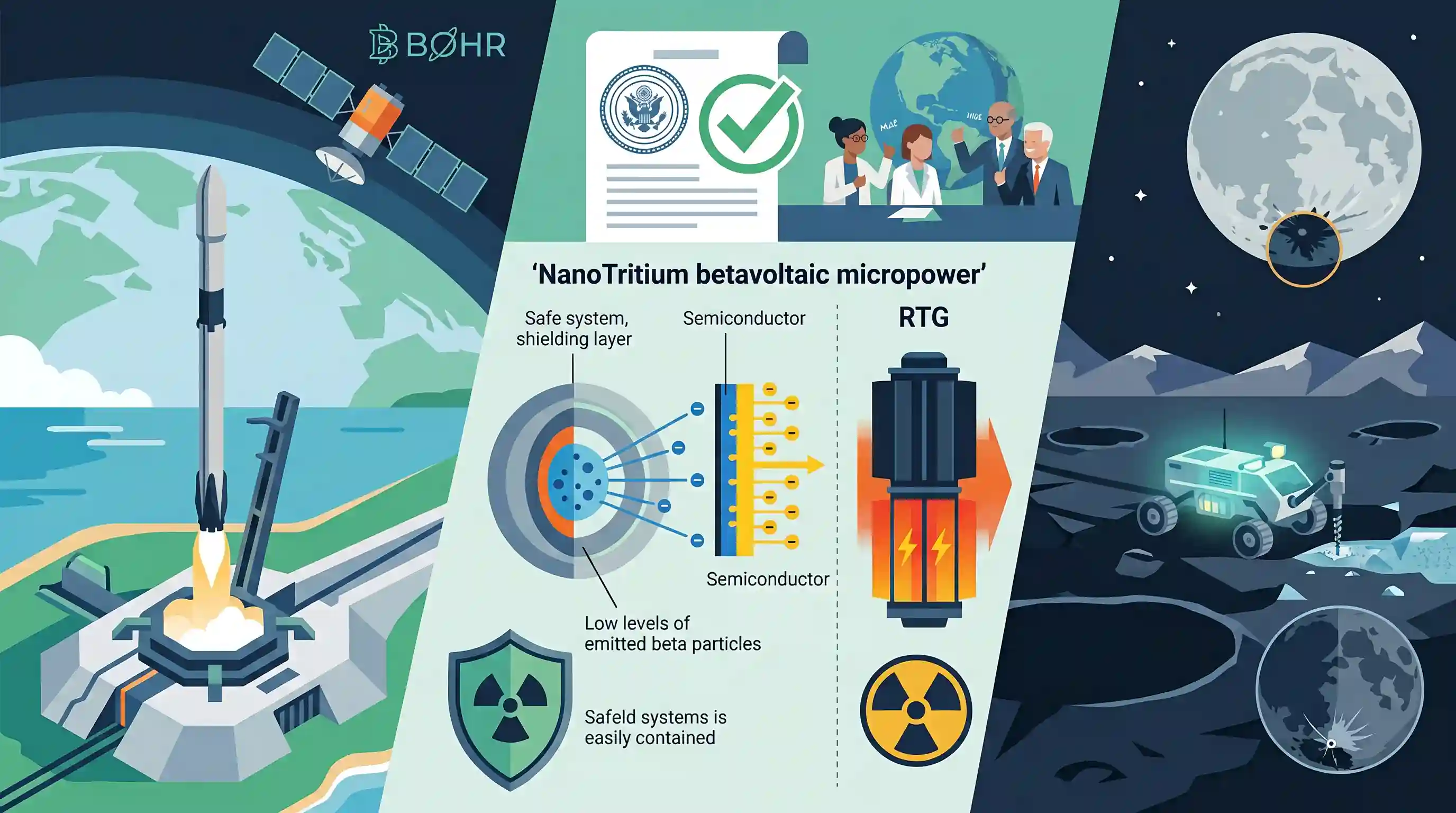
SpaceX launched BOHR (Betavoltaic Orbital High-Reliability), developed by City Labs, marking the world's first commercial launch of a nuclear-powered satellite. Testing 'NanoTritium betavoltaic micropower' technology, BOHR converts beta particles from tritium decay directly into electricity using a semiconductor. This is distinct from heat-based plutonium RTGs traditionally used in deep-space missions. Safe due to low radiation levels, the system was approved under the 2019 FAA nuclear launch framework and is a critical step for future space exploration in sunlight-deprived zones, such as the lunar south pole.
Key Points
- SpaceX successfully launched BOHR (Betavoltaic Orbital High-Reliability), the world's first commercially built nuclear-powered satellite, aboard a Falcon 9 rocket as part of the Transporter-17 rideshare mission.
- Developed by Florida-based City Labs, BOHR is a demonstration mission designed to test the proprietary NanoTritium betavoltaic micropower source in space.
- Unlike Radioisotope Thermoelectric Generators (RTGs) that convert plutonium decay heat into electricity using thermocouples, NanoTritium generates electricity by directly converting beta particles from tritium (a radioactive isotope of hydrogen) decay using a semiconductor.
- Though BOHR still uses solar panels for core spacecraft operations, the technology is a pathfinder for powering systems in environments with scarce sunlight, such as permanently shadowed regions (PSRs) and craters of the lunar south pole.
- Because tritium emits relatively low levels of radiation compared to heavier radioisotopes like plutonium, it is safer for integration into commercial launch environments.
- BOHR is the first nuclear-powered mission approved under the US FAA's nuclear launch framework established in 2019, funded partly through a US Department of Defense contract.
Important Terms
Artemis programme

A NASA-led international space exploration program aiming to land humans on the Moon, build a sustainable lunar base, and prepare for future crewed missions to Mars.
UPSC context
GS Paper III (Space Technology); tests international collaborations, lunar exploration, and India's partnership through the Artemis Accords.
FAA nuclear launch framework (2019)
A regulatory process derived from National Security Presidential Memorandum-20 (NSPM-20) that categorizes, safety-evaluates, and licenses spacecraft carrying commercial nuclear technologies or radionuclides.
UPSC context
GS Paper III (Science and Technology); tests commercial space exploration policies, nuclear security frameworks, and risk-management protocols.
Federal Aviation Administration (FAA)
The U.S. government agency that regulates civil aviation and commercial space transportation, including launches and reentries, ensuring compliance with safety and national security standards.
UPSC context
GS Paper III (Space/Security Regulation); tests understanding of commercial space regulatory frameworks comparable to India's IN-SPACe.
SpaceX
A private American aerospace company that manufactures advanced rockets and spacecraft, pioneering reusable launch vehicles and expanding commercial satellite deployment globally.
UPSC context
GS Paper III (Space Technology, Economy); tests private sector participation in space and development of low-cost reusable launch systems.
NASA
The U.S. federal agency responsible for civilian space exploration, scientific aerospace research, and international space programs like the Lunar Gateway and James Webb Space Telescope.
UPSC context
GS Paper III (Space Technology); tests global space cooperation, lunar/deep space missions, and joint programs (such as NISAR with ISRO).
City Labs
A private company specializing in tritium-based betavoltaic micro-power batteries, pioneering the first commercial applications of safe, nuclear-powered technologies for deep-space and extreme environments.
UPSC context
GS Paper III (Alternative Energy/Space Tech); tests knowledge of novel, non-thermal space power systems and nuclear micro-power technology.
Prelims Trap
Betavoltaic micro-power cells operate on the same thermal-conversion principles as traditional Plutonium-based RTGs.
RTGs rely on the thermodynamic Seebeck effect to convert decay heat into electricity using thermocouples. Betavoltaics directly convert beta-decay electrons into electrical current using a semiconductor, generating virtually no heat.
Static Concepts Connected
What are the physical and radioactive properties of Hydrogen isotopes?
- Isotopic Distribution: Protium has no neutrons (99.98% abundant); Deuterium has one neutron (stable, used as a moderator in heavy water reactors).
- Tritium Half-Life: Tritium has two neutrons and is highly unstable, decaying with a half-life of 12.3 years.
- Decay Mode: Tritium undergoes beta-minus (β-) decay, emitting a low-energy electron (beta particle) and an antineutrino to transform into Helium-3.
How do RTGs differ from Space Nuclear Fission Reactors?
- RTG Principle: Passive devices converting natural decay heat of radioisotopes (usually Plutonium-238) into electricity using thermocouples (Seebeck effect). No chain reaction occurs.
- Fission Reactor Principle: Active systems that split heavy nuclei (Uranium-235) in a controlled chain reaction to produce immense heat, converted via mechanical engines or turbines.
- Power & Scale: RTGs generate continuous low-to-medium power (watts) for decades; reactors generate high-power kilowatts/megawatts for advanced propulsion or habitats.
Cross-Topic Patterns
Space Law + Nuclear Commercialization
The 1967 Outer Space Treaty bans weapons of mass destruction in space but permits non-weaponized nuclear power sources like betavoltaics and RTGs for peaceful, commercial scientific exploration.
Lunar Exploration + Alternative Energy Systems
Chandrayaan-3 highlighted the vulnerability of solar-powered systems during lunar nights. Betavoltaics offer a survival blueprint for long-duration landers in permanently shadowed regions.

Betavoltaics vs RTGs and the radioactive properties of Tritium are highly likely to feature as a comparative S&T statement in 2026.
Linked PYQs · 2
Linked PYQs · 2
- 2024PrelimsGS1
With reference to radioisotope thermoelectric generators (RTGs), consider the following statements: 1. RTGs are miniature fission reactors. 2. RTGs are used for powering the onboard systems of spacecrafts. 3. RTGs can use Plutonium-238, which is a by-product of weapons development. Which of the statements given above are correct?
- 2023MainsGS3
What is the main task of India's third moon mission which could not be achieved in its earlier mission? List the countries that have achieved this task. Introduce the subsystems in the spacecraft launched and explain the role of the Virtual Launch Control Centre' at the Vikram Sarabhai Space Centre which contributed to the successful launch from Sriharikota.
