SpaceX Launches International Astronaut Crew for NASA Station Mission
Source:The Hindu ↗
Why It Matters
Understanding international space cooperation (especially regarding the ISS) and the growing role of private space corporations (like SpaceX) is crucial for the UPSC GS3 Science & Technology syllabus. It demonstrates the shift from purely state-run space agencies to public-private partnerships in orbital human spaceflight.
Summary
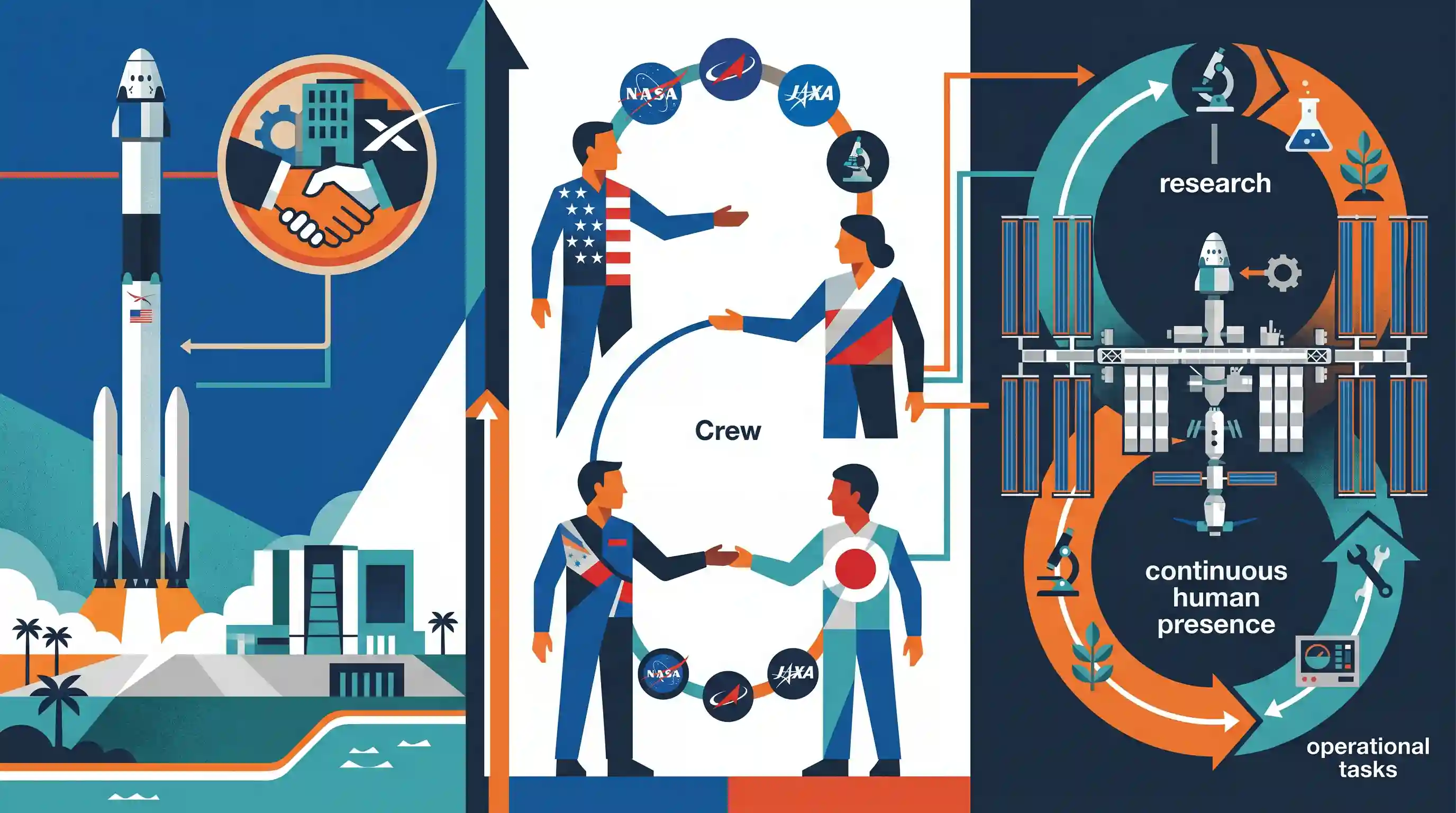
SpaceX has launched NASA's Crew-11 mission, sending an international crew of four astronauts to the International Space Station (ISS). Carried by a SpaceX Dragon capsule atop a Falcon 9 rocket from the Kennedy Space Center in Florida, the crew includes members from NASA, Russia's Roscosmos, and Japan's JAXA. The mission underscores the crucial role of private commercial entities in modern space exploration and demonstrates the endurance of international partnerships in space science, maintaining the continuous human presence on the ISS for research and operational tasks.
Key Points
- SpaceX successfully launched NASA's Crew-11 mission to the International Space Station (ISS) using a Falcon 9 rocket and a Dragon capsule.
- The mission carries an international four-person crew comprising two NASA astronauts, one Russian cosmonaut (Roscosmos), and one Japanese astronaut (JAXA).
- The crew launched from NASA's Kennedy Space Center in Florida and will spend several months conducting research aboard the orbital laboratory.
- The launch highlights the continuous reliance of NASA on commercial space partners like SpaceX for human spaceflight and the ongoing international cooperation in space despite geopolitical tensions on Earth.
Important Terms
Crew-11 mission

The eleventh operational crew rotation flight to the International Space Station (ISS) under NASA's Commercial Crew Program, featuring an international crew from the US, Russia, and Japan.
UPSC context
Prelims/Mains (GS III: Space); highlights ongoing international scientific collaboration and the operational success of public-private partnerships in space.
SpaceX
An American private aerospace company that developed the Falcon 9 and Dragon spacecraft. It pioneered reusable rocket technology, significantly reducing the cost of access to space.
UPSC context
GS III (Science & Tech); relevant for discussing the 'New Space' era, privatization of space, and technological innovation.
Commercial Crew Program
A NASA initiative that partners with private industry (SpaceX, Boeing) to transport astronauts to the ISS, ending US reliance on foreign rockets and fostering a commercial space economy.
UPSC context
GS III (Science & Tech); tests understanding of policy shifts towards commercializing low Earth orbit and enhancing mission frequency.
International Space Station (ISS)
A collaborative modular research laboratory in low Earth orbit, jointly operated by five space agencies: NASA (USA), Roscosmos (Russia), JAXA (Japan), ESA (Europe), and CSA (Canada).
UPSC context
GS III (Space) & GS II (IR); symbolizes global scientific cooperation and serves as a precursor to future lunar/Mars stations.
NASA
The U.S. government agency responsible for civilian space programs and aeronautics research. It leads major international space initiatives like the Artemis Accords and the ISS.
UPSC context
GS II (IR) & GS III; critical for India-US space relations, including the NISAR mission and training Indian astronauts.
Roscosmos
Russia's state corporation for space activities. It provides critical ISS modules, propulsion for orbital boosts, and has historically been a primary provider of crew transportation via Soyuz.
UPSC context
GS II (IR); relevant for understanding the endurance of space diplomacy despite terrestrial geopolitical tensions.
JAXA (Japan Aerospace Exploration Agency)
Japan’s national aerospace agency involved in satellite development, lunar exploration, and ISS operations. It contributed the Kibo laboratory module to the space station.
UPSC context
GS III (Space); highlights Japan's role as a major scientific partner and potential collaborator with ISRO (e.g., LUPEX).
Prelims Trap
"The ISS is a joint project of all major space agencies, including ISRO and China's CNSA."
India (ISRO) and China (CNSA) are not ISS partners. China built Tiangong due to US restrictions, and India plans its own Bharatiya Antariksha Station. The ISS is backed only by US, Russia, Europe, Japan, and Canada.
Static Concepts Connected
What are the characteristics and participating agencies of the ISS?
- Low Earth Orbit: Located in LEO at ~400 km altitude, completing an orbit every ~90 minutes.
- Microgravity Research: Acts as an orbital laboratory for biology, physics, and astronomy experiments in sustained microgravity.
- Participating Agencies: A joint project of 5 agencies: NASA (USA), Roscosmos (Russia), JAXA (Japan), ESA (Europe), and CSA (Canada).
How do SpaceX launch vehicles compare to ISRO's reusable vehicle concepts?
- Vertical Landing (SpaceX): Falcon 9 first stage lands vertically using retro-propulsion (VTVL) to reuse boosters.
- Horizontal Landing (ISRO): ISRO's RLV-TD is a winged spaceplane designed to return and land horizontally on a runway (VTHL).
- Cost Reduction: Both systems aim to drastically lower the cost of payload delivery to Low Earth Orbit by recovering key vehicle components.
Cross-Topic Patterns
Commercial Crew vs. Sovereign Capacity
While NASA outsources LEO transport to private players like SpaceX, India is building baseline sovereign human spaceflight capacity through Gaganyaan before opening LEO crew transport to its nascent private sector.
Space cooperation amidst geopolitical sanctions
The continuous inclusion of Russian cosmonauts on US rockets highlights a rare diplomatic carve-out, showing how the ISS remains functionally insulated from broad US-Russia sanctions regarding the Ukraine war.

Expect a comparative 2026 prelims question linking ISS retirement, China's Tiangong, and India’s Bharatiya Antariksha Station timelines.
Linked PYQs · 2
Linked PYQs · 2
- 2025PrelimsGS1
Consider the following space missions : I. Axiom-4 II. SpaDeX III. Gaganyaan How many of the space missions given above encourage and support micro-gravity research?
- 2018PrelimsGS1
With reference to India's satellite launch vehicles, consider the following statements: 1. PSLVs launch the satellites useful for Earth resources monitoring whereas GSLVs are designed mainly to launch communication satellites. 2. Satellites launched by PSLV appear to remain permanently fixed in the same position in the sky, as viewed from a particular location on Earth. 3. GSLV Mk III is a four-staged launch vehicle with the first and third stages using solid rocket motors; and the second and fourth stages using liquid rocket engines. Which of the statements given above is/are correct?
