ISRO Analog Missions And Training For Gaganyaan Human Spaceflight
Source:The Hindu ↗
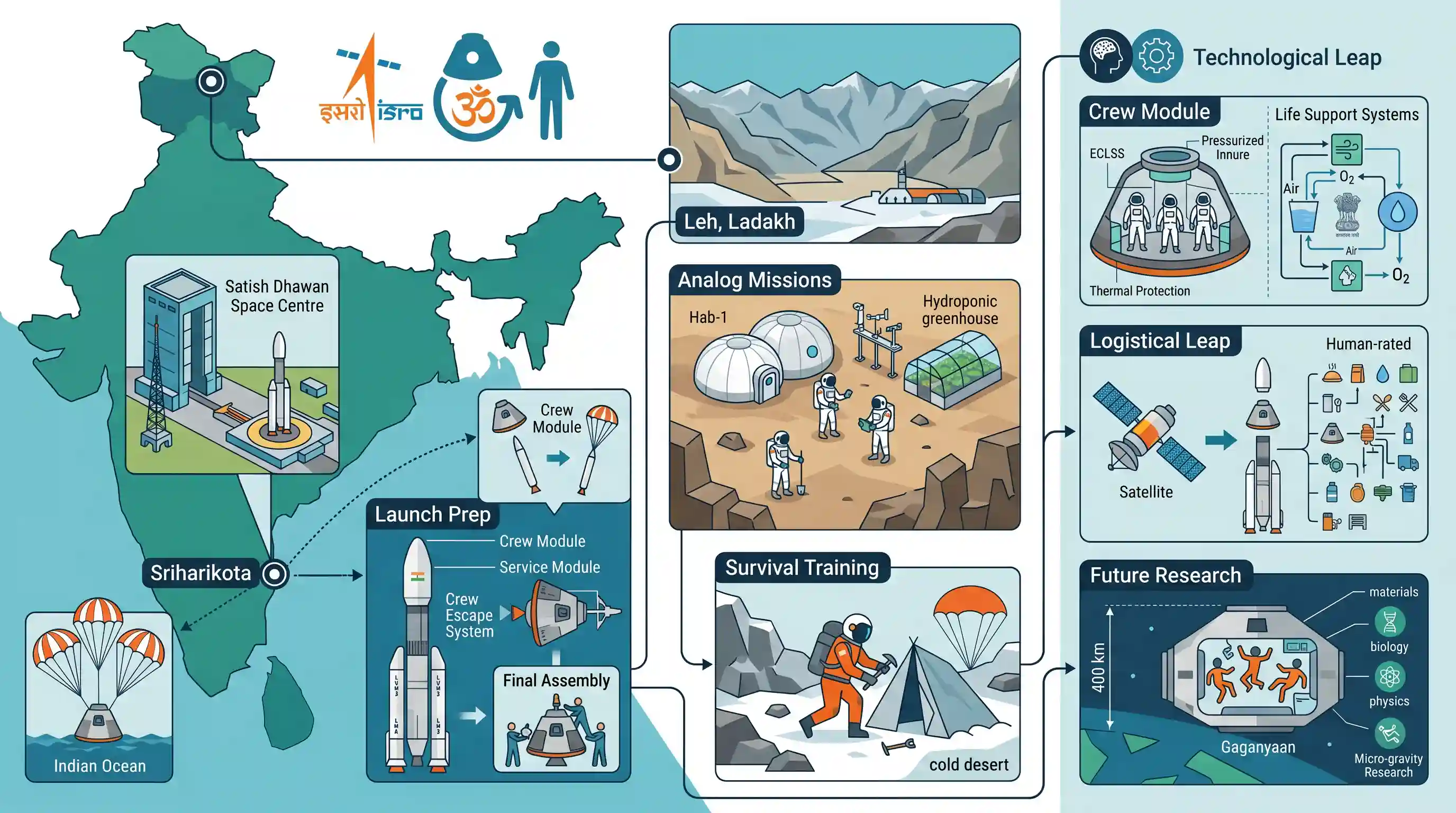
Why It Matters
The Gaganyaan mission is a prime topic for both Prelims and Mains (GS3) science and technology sections. Understanding the logistical complexities—such as the necessity of analog missions in extreme geographical locations like Leh—directly equips aspirants to answer recurring questions on the technological obstacles and achievements of India's human spaceflight ambitions.
Summary
Preparations for ISRO's Gaganyaan mission, India's maiden human spaceflight endeavour, are in full swing across various strategic locations in the country. While Sriharikota remains the central hub for launch preparations, the high-altitude, cold desert environment of Leh is being utilized for crucial analog space missions and astronaut survival training. The mission represents a massive technological and logistical leap for India's space program, focusing on the development of crew modules, life support systems, and enabling future micro-gravity research.
Key Points
- ISRO's preparations for the Gaganyaan mission—India's first human spaceflight programme—are actively progressing across multiple specialized locations.
- Sriharikota (Satish Dhawan Space Centre) serves as the primary operational hub where launch vehicles (LVM3) and modules are prepared.
- Leh is being utilized for analog space missions and extreme-environment survival training for astronauts, leveraging its high-altitude, cold desert terrain.
- The mission highlights India's technological leap in building indigenous Environmental Control and Life Support Systems (ECLSS), crew escape mechanisms, and facilitating micro-gravity research.
Important Terms
Gaganyaan mission

India's maiden human spaceflight programme by ISRO, designed to send a 3-member crew to Low Earth Orbit (400 km) for three days and return them safely to Earth.
UPSC context
GS Paper III (Science and Technology); tests knowledge of indigenous high-tech capabilities and India's standing as an elite spacefaring nation.
ISRO
India's national space agency under the Department of Space, mandated to develop space technology and harness it for national development through satellite launches and planetary exploration.
UPSC context
GS Paper III (Science and Technology); core institution for space-related developments and questions on technological self-reliance.
Analog Space Mission
Ground-based simulations, like those in Ladakh, that replicate extraterrestrial environments to test technologies, mission protocols, and the psychological and physical endurance of astronauts before actual spaceflight.
UPSC context
GS Paper III (Science and Technology); relevant for understanding astronaut training methodologies and mission-critical simulation research.
Human-Rated LVM3 (HLVM3)
A specifically modified version of the LVM3 (GSLV Mk III) rocket, featuring enhanced safety systems and higher reliability standards required for carrying human crew into orbit.
UPSC context
GS Paper III (Science and Technology); essential for questions on launch vehicle technology and safety protocols in manned spaceflight.
Crew Module (CM)
The pressurized habitat of the Gaganyaan spacecraft that houses astronauts, providing life support systems and protection during atmospheric re-entry and splashdown in the sea.
UPSC context
GS Paper III (Science and Technology); focuses on indigenous spacecraft design, material science (heat shields), and astronaut safety.
Environmental Control and Life Support System (ECLSS)
A suite of critical technologies that maintains Earth-like conditions (oxygen, pressure, temperature) inside a spacecraft, ensuring the survival and comfort of astronauts during a mission.
UPSC context
GS Paper III (Science and Technology); tests understanding of vital life-sustaining technologies required for transitioning to human spaceflight.
Prelims Trap
"The Gaganyaan mission aims to place astronauts in a Geostationary orbit."
UPSC frequently swaps orbits to confuse candidates. Gaganyaan targets a 400 km Low Earth Orbit (LEO), not the 35,786 km GEO used for communication satellites.
Static Concepts Connected
What distinguishes Low Earth Orbit (LEO) from Geosynchronous Orbit (GEO)?
- Altitude: LEO is typically under 2000 km (Gaganyaan at 400km), while GEO is fixed at exactly 35,786 km above the equator.
- Applications: LEO is ideal for earth observation and human spaceflight (ISS, Gaganyaan). GEO is primarily for communications and weather monitoring.
- Orbital Period: Satellites in LEO orbit Earth every 90-120 minutes. GEO satellites take 24 hours, appearing stationary from the ground.
What are the three stages of the LVM3 launch vehicle used for Gaganyaan?
- Solid Stage: Two S200 solid strap-on boosters that provide massive liftoff thrust during the initial ascent phase.
- Liquid Stage: The L110 core stage, powered by two Vikas engines using Earth-storable liquid propellants.
- Cryogenic Stage: The C25 upper stage utilizing liquid hydrogen and liquid oxygen, providing high efficiency for heavy payloads.
Cross-Topic Patterns
Cold Deserts as Extraterrestrial Analogs
Leh's high-altitude, cold, and arid environment mimics Martian and Lunar terrains, bridging physical geography (cold deserts) with advanced space technology testing (analog missions).
Strategic Autonomy in Space Tech
Developing an indigenous Environmental Control and Life Support System (ECLSS) reduces reliance on foreign space agencies, mirroring India's broader strategic autonomy goals in critical dual-use technologies.

Expect a multi-statement question blending HLVM3 stages, LEO altitude (400km), and the specific purpose of Leh analog missions.
Linked PYQs · 3
Linked PYQs · 3
- 2017MainsGS3
India has achieved remarkable successes in unmanned space missions including the Chandrayaan and Mars Orbitter Mission, but has not ventured into manned space missions. What are the main obstacles to launching a manned space mission, both in terms of technology and logistics? Examine critically.
- 2016MainsGS3
Discuss India's achievements in the field of Space Science and Technology. How the application of this technology has helped India in its socio-economic development?
- 2025PrelimsGS1
Consider the following space missions : I. Axiom-4 II. SpaDeX III. Gaganyaan How many of the space missions given above encourage and support micro-gravity research?
