India and China Space Capabilities and Strategic Competition
Source:Indian Express ↗
Why It Matters
Space is rapidly emerging as the fourth domain of warfare and a multi-trillion-dollar economic frontier. Understanding the India-China space dynamic is crucial for aspirants to analyze issues of national security, technological sovereignty, and shifting geopolitical power structures.
Summary
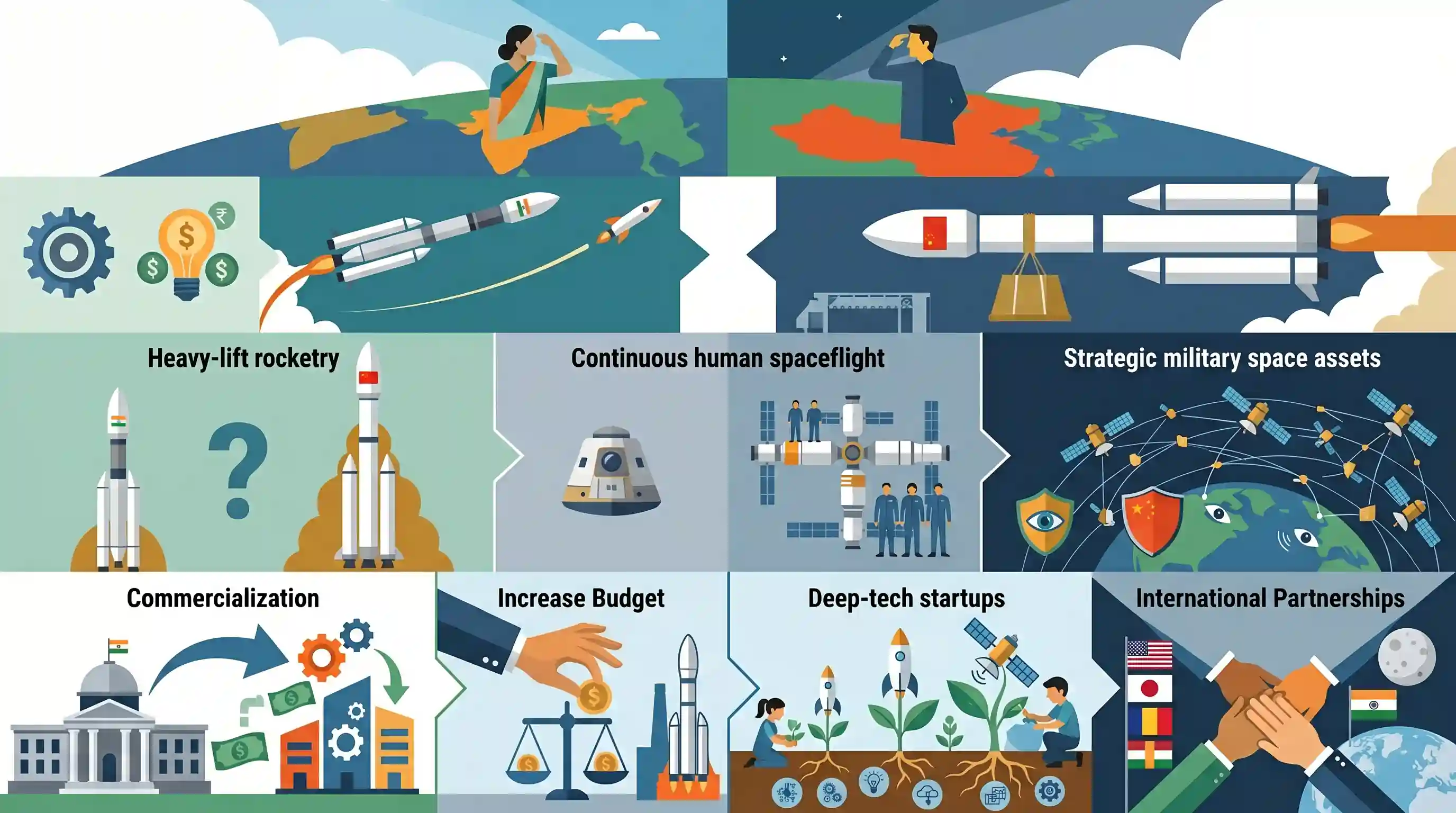
The article analyzes India's standing as a global space power relative to China's rapidly expanding space capabilities. While acknowledging the Indian Space Research Organisation's (ISRO) remarkable legacy of cost-effective and successful missions, it highlights a widening gap in critical areas such as heavy-lift rocketry, continuous human spaceflight presence, and strategic military space assets. The author emphasizes that to remain competitive in the increasingly contested domain of outer space, India must accelerate the commercialization of its space sector, increase budgetary allocations, aggressively foster deep-tech private startups, and leverage international partnerships like the Artemis Accords.
Key Points
- India has an admirable record in space exploration, marked by cost-effective and highly successful missions such as Chandrayaan and the Mars Orbiter Mission.
- A significant capability gap exists between India and China, with China rapidly advancing in heavy-lift launch vehicles, its own Tiangong space station, and ambitious lunar missions.
- The strategic dimension of space is intensifying, driven by the militarisation of space and the deployment of dual-use capabilities, necessitating India to bolster its space security infrastructure.
- To bridge the gap, India is implementing structural reforms like the Indian Space Policy 2023, empowering IN-SPACe and NSIL to boost private sector participation and commercialization.
- Deepening international collaborations, such as India's participation in the US-led Artemis Accords, is critical for technological exchange and balancing China's growing footprint in the space domain.
Important Terms
Indian Space Policy 2023

Comprehensive 2023 framework aiming to increase India's global space market share to 10% by 2030 by institutionalizing private sector participation and delineating roles between ISRO, NSIL, and IN-SPACe.
UPSC context
GS Paper III (S&T/Economy); tests understanding of space sector reforms, privatization, and the transition toward a commercial space economy.
Artemis Accords
A US-led non-binding set of principles for peaceful, transparent, and sustainable lunar and deep-space exploration, which India signed in 2023 to enhance international collaboration and technology sharing.
UPSC context
GS Paper II (International Relations); crucial for India-US strategic ties and global space governance debates.
IN-SPACe
An autonomous nodal agency under the Department of Space that facilitates private sector participation in India's space activities by providing a single-window interface for authorization and infrastructure usage.
UPSC context
GS Paper III (S&T); vital for questions on regulatory frameworks and the "level playing field" for Indian space startups.
NewSpace India Limited (NSIL)
The commercial arm of ISRO (established 2019) tasked with transferring space technologies to industry, manufacturing satellites, and providing commercial launch services through a demand-driven model.
UPSC context
GS Paper III (S&T/Economy); tests knowledge of the institutional mechanisms driving the commercialization of indigenous space technology.
ISRO
India's primary space agency, now focusing on advanced research, development, and planetary exploration, while transferring routine operational activities to the commercial and private sectors.
UPSC context
GS Paper III (S&T); core to topics regarding indigenization of technology and India's achievements in science.
China National Space Administration (CNSA)
The government body responsible for China's civil space program, currently leading in heavy-lift rocketry and permanent orbital presence, serving as the benchmark for India's regional space competition.
UPSC context
GS Paper II (IR); important for comparative analysis of neighborhood relations and strategic space capabilities.
Prelims Trap
"IN-SPACe is the commercial arm of ISRO, while NSIL is the regulatory body for private space companies."
This reverses their roles. NSIL is the commercial arm under the Department of Space, whereas IN-SPACe is the independent nodal agency regulating and authorizing private sector space activities.
Static Concepts Connected
What are the specific institutional roles defined under the Indian Space Policy 2023?
- ISRO: Transitions out of routine manufacturing to focus primarily on advanced research and development, deep space missions, and developing new technologies.
- NSIL: Acts as the commercial arm, responsible for undertaking commercial satellite launches, demand-driven space activities, and commercializing ISRO's technologies.
- IN-SPACe: Functions as an independent single-window regulator to authorize, promote, and guide non-governmental entities (NGEs) in space activities.
What are the payload capacities of India's Launch Vehicle Mark-3 (LVM3/GSLV Mk III)?
- GTO Payload: LVM3 is capable of placing a 4-tonne class payload into Geosynchronous Transfer Orbit (GTO).
- LEO Payload: It can place payloads of up to 8 tonnes into Low Earth Orbit (LEO), crucial for modules like the Bharatiya Antariksha Station.
- Stage Configuration: It is a three-stage vehicle featuring solid strap-on motors, a liquid core stage, and a high-thrust cryogenic upper stage.
Cross-Topic Patterns
Artemis Accords & Geopolitical Balancing
Joining the US-led Artemis Accords strategically positions India against the China-Russia proposed International Lunar Research Station (ILRS), weaving civil space exploration into broader Indo-Pacific and Quad geopolitical balancing.
Private Sector & Dual-Use Tech Indigenization
The transition from ISRO's state monopoly to private deep-tech startups parallels India's defense indigenization strategy (like iDEX), aiming to build a robust domestic ecosystem for dual-use technologies.

Expect a Prelims question differentiating IN-SPACe vs NSIL roles, or a Mains GS3 question on bridging the space capability gap with China.
Linked PYQs · 5
Linked PYQs · 5
- 2016MainsGS3
Discuss India's achievements in the field of Space Science and Technology. How the application of this technology has helped India in its socio-economic development?
- 2023MainsGS3
What is the main task of India's third moon mission which could not be achieved in its earlier mission? List the countries that have achieved this task. Introduce the subsystems in the spacecraft launched and explain the role of the Virtual Launch Control Centre' at the Vikram Sarabhai Space Centre which contributed to the successful launch from Sriharikota.
- 2017MainsGS3
India has achieved remarkable successes in unmanned space missions including the Chandrayaan and Mars Orbitter Mission, but has not ventured into manned space missions. What are the main obstacles to launching a manned space mission, both in terms of technology and logistics? Examine critically.
- 2018PrelimsGS1
With reference to India's satellite launch vehicles, consider the following statements: 1. PSLVs launch the satellites useful for Earth resources monitoring whereas GSLVs are designed mainly to launch communication satellites. 2. Satellites launched by PSLV appear to remain permanently fixed in the same position in the sky, as viewed from a particular location on Earth. 3. GSLV Mk III is a four-staged launch vehicle with the first and third stages using solid rocket motors; and the second and fourth stages using liquid rocket engines. Which of the statements given above is/are correct?
- 2016PrelimsGS1
Consider the following statements: The Mangalyaan launched by ISRO 1. is also called the Mars Orbiter Mission 2. made India the second country to have a spacecraft orbit the Mars after USA 3. made India the only country to be successful in making its spacecraft orbit the Mars in its very first attempt Which of the statements given above is/are correct?
