US tariff rulings and trade volatility impact India economic diplomacy
Source:Indian Express ↗
Why It Matters
The article underscores the direct impact of US domestic legal and executive actions on global trade stability. For UPSC aspirants, it illustrates the contemporary challenges of protectionism (GS3) and the importance of agile economic diplomacy and bilateral negotiations (GS2) in safeguarding India's strategic and commercial interests.
Summary
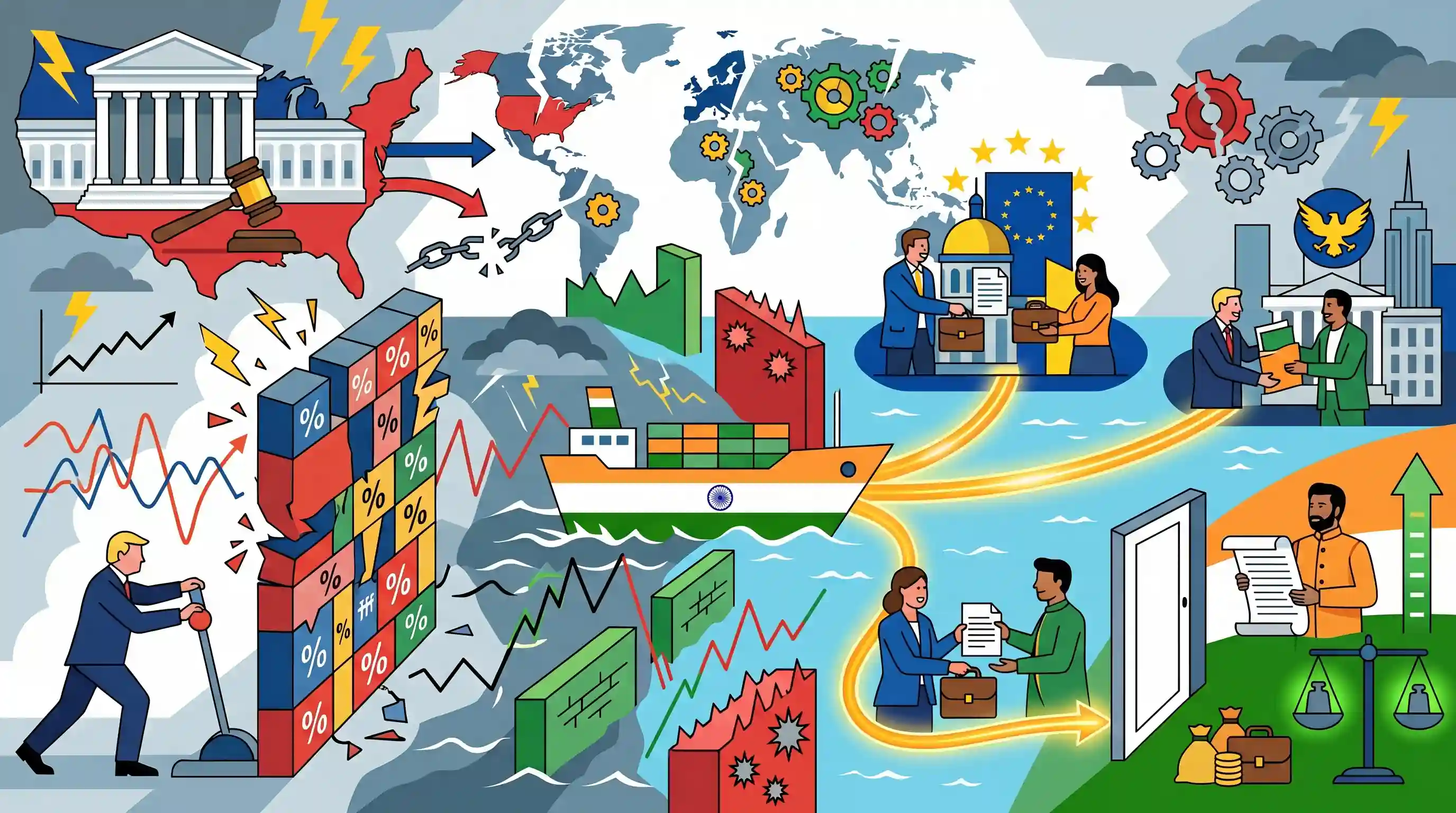
The US Supreme Court recently ruled that President Donald Trump’s utilization of the International Emergency Economic Powers Act (IEEPA) to impose global tariffs was unlawful. While checking executive overreach, the decision and Trump's subsequent imposition of a 15% global tariff have injected massive uncertainty into international trade. India has faced severe tariff volatility, navigating fluctuating rates ranging from MFN status to high reciprocal levies and specific penalties. Amidst this fragmented global order, India's successful trade negotiations with the EU and its proactive engagement with Washington demonstrate effective economic diplomacy. The ongoing judicial and policy chaos in the US may ultimately offer New Delhi greater strategic room to negotiate favorable terms in its final trade pact with the Trump administration.
Key Points
- The US Supreme Court ruled President Donald Trump's use of the IEEPA to impose global tariffs as unlawful, curbing executive overreach but sparking global trade uncertainty.
- In response to the ruling, the Trump administration instituted a temporary 15% global tariff for 150 days, making stable, low-tariff environments highly improbable.
- India's exports have endured extreme tariff volatility, shifting from MFN rates to high reciprocal tariffs, penalties on Russian oil, and an 18% rate post-trade deal.
- Despite a fragmented global order, India has successfully concluded trade talks with the EU and reached an agreement with Washington, adapting to changing cost-benefit dynamics.
- The US judicial pushback against sudden tariffs provides India with potential leverage and greater negotiating room as it finalizes its trade deal with the US.
Important Terms
International Emergency Economic Powers Act (IEEPA)

A 1977 US law authorizing the President to regulate international commerce and impose sanctions during a declared national emergency originating from a foreign threat.
UPSC context
GS-II (International Relations); critical for understanding unilateral trade actions by major powers and their impact on India's strategic autonomy and export stability.
Most Favoured Nation (MFN)
A core WTO principle requiring a member country to extend the same trade concessions and advantages to all other member nations without discrimination.
UPSC context
GS-III (Indian Economy); fundamental for questions regarding WTO obligations, non-discriminatory trade regimes, and India's bilateral trade status with partners.
Reciprocal Tariff
A "tit-for-tat" trade policy where a country imposes import duties on another nation at rates that mirror the tariffs faced by its own exports.
UPSC context
GS-III (Economy); relevant for analyzing trade wars, protectionist trends, and the shift from multilateralism to transactional bilateralism in global trade.
Economic Diplomacy
The strategic use of diplomatic tools and foreign policy to promote national economic interests, including trade negotiations, investment promotion, and technological cooperation.
UPSC context
GS-II (IR); essential for analyzing India's proactive engagement in trade pacts with the EU and US to secure favorable economic terms.
Protectionism
Economic policies aimed at restricting imports to protect domestic industries from foreign competition using tools like high tariffs, import quotas, and subsidies.
UPSC context
GS-III (Economy); tests knowledge of global de-globalization trends and their effect on India's manufacturing (Make in India) and export-led growth.
Prelims Trap
"Most Favoured Nation (MFN) status means a country grants exclusive, lower tariffs to its most preferred strategic partner."
MFN actually mandates non-discrimination among WTO members (treating all equally). Special lower tariffs are exceptions (FTAs/GSP), not the MFN rule itself.
Static Concepts Connected
What are the key permitted exceptions to the WTO's MFN principle?
- FTAs and RTAs: Countries can grant preferential tariff rates within Free Trade Agreements or Customs Unions (like the India-EU FTA).
- GSP Framework: Developed nations can offer non-reciprocal preferential tariff treatment to developing countries to boost their exports.
- Security Exception: Article XXI allows members to breach MFN to protect their essential national security interests.
What is the difference between Countervailing and Safeguard duties?
- Countervailing Duty: Imposed specifically to neutralize negative effects of unfair subsidies provided by an exporting country's government.
- Safeguard Duty: A temporary measure applied when a sudden, unexpected import surge threatens serious injury to a domestic industry.
Cross-Topic Patterns
Secondary Sanctions & Energy Security
US punitive tariffs on Russian oil clash with India's energy security needs, frequently testing New Delhi's strategic autonomy and multi-aligned economic diplomacy.
Executive Power vs Trade Pacts
The US Supreme Court curbing the President's IEEPA usage highlights constitutional limits on executive overreach, offering a comparative polity angle on treaty-making powers.

Expect a Prelims question contrasting WTO principles (MFN, National Treatment) with unilateral mechanisms like national security tariffs.
Linked PYQs · 4
Linked PYQs · 4
- 2025MainsGS3
What are the challenges before the Indian economy when the world is moving away from free trade and multilateralism to protectionism and bilateralism? How can these challenges be met?
- 2018MainsGS3
How would the recent phenomena of protectionism and currency manipulations in world trade affect macroeconomic stability of India?
- 2012MainsGS2
Discuss the likely negative impact of the protectionist measures proposed by the US on India's software industry.
- 2019MainsGS2
‘What introduces friction into the ties between India and the United States is that Washington is still unable to find for India a position in its global strategy, which would satisfy India's national self-esteem and ambitions.’ Explain with suitable examples.
