AIIMS and ISRO Collaboration for Astronaut Health and Training
Source:Indian Express ↗
Why It Matters
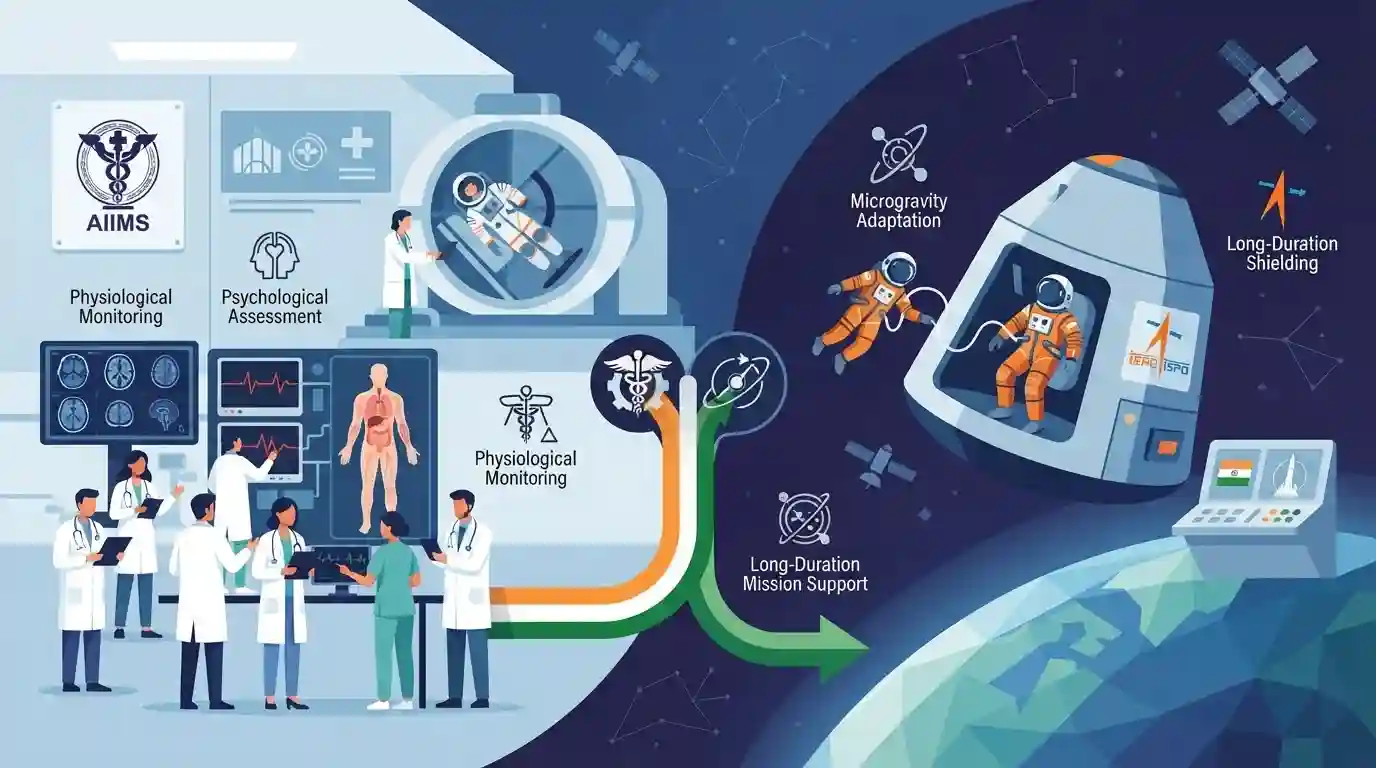
This partnership bridges medical research and space technology, highlighting India's capacity building for human spaceflight missions like Gaganyaan and advancing aerospace medicine.
Summary
AIIMS Delhi and ISRO have joined forces to train astronauts and study the physiological and psychological impacts of space travel on human health. This collaboration supports India's human spaceflight program, Gaganyaan, by leveraging medical expertise to address challenges like microgravity, radiation, and psychological stress encountered during long-duration space missions.
Key Points
- AIIMS Delhi and ISRO have partnered to study the physiological and psychological impacts of space travel on astronauts.
- The initiative involves specialized medical training and research programs to prepare candidates for India's upcoming human spaceflight mission, Gaganyaan.
- Spaceflight exposes human bodies to microgravity, radiation, and confinement, leading to cardiovascular, muscular, and neurological changes.
- Collaborative frameworks between premier medical institutes and space agencies are crucial for advanced aerospace medicine and human space exploration.
Important Terms
Gaganyaan

India's premier human spaceflight mission by ISRO, designed to carry a crew of astronauts into low Earth orbit and demonstrate indigenous capability for crewed space travel.
UPSC context
UPSC GS Paper III (Space Technology, Science and Technology): Tests understanding of India's flagship space missions and technological self-reliance.
ISRO
India's national space agency responsible for planning, executing, and managing space exploration, satellite launches, and the human spaceflight program.
UPSC context
UPSC GS Paper III (Space Technology): Tests knowledge of institutional frameworks driving India's space program and scientific achievements.
AIIMS Delhi
India's premier medical research and tertiary care hospital, collaborating with ISRO to research space medicine, astronaut training, and physiological impacts of spaceflight.
UPSC context
UPSC GS Paper II / III (Health and Institutional Collaboration): Tests inter-agency cooperation in advanced scientific domains like space medicine.
Prelims Trap
ISRO solely manages all astronaut selection, medical training, and physiological research through its internal establishments without external institutional tie-ups.
Aspirants often assume ISRO handles astronaut training entirely in-house without institutional medical partnerships like AIIMS Delhi or IAM Bengaluru.
Static Concepts Connected
What are the major physiological impacts of long-duration spaceflight on the human body?
- Fluid Shifts: Fluid redistribution toward the upper body causes facial puffiness and decreased circulating blood volume.
- Musculoskeletal Atrophy: Prolonged unloading of bones and muscles leads to significant calcium loss and skeletal muscle atrophy.
- Radiation Exposure: Earth's magnetic shield protection is lost, exposing astronauts to galactic cosmic rays and solar particle events.
- Behavioral Stress: Isolation, confinement, and altered circadian rhythms trigger sleep disorders and elevated psychological stress.
Cross-Topic Patterns
Space Medicine and High-Altitude Defence Research
Space medicine research at AIIMS mirrors defense institutes like INMAS, creating dual-use physiological data critical for both orbital flight and high-altitude warfare survival in Ladakh.
Aerospace Spin-offs and Public Healthcare Integration
Spin-off technologies from microgravity bone density studies directly feed into National Health Mission targets for tackling geriatric osteoporosis in rural India.

Expect a multi-statement Prelims question pairing ISRO's HSFC mandate with AIIMS's role in microgravity ground simulations like bed-rest trials.
Linked PYQs · 3
Linked PYQs · 3
- 2019MainsGS3
What is India's plan to have its own space station and how will it benefit our space programme?
- 2025PrelimsGS1
Consider the following space missions : I. Axiom-4 II. SpaDeX III. Gaganyaan How many of the space missions given above encourage and support micro-gravity research?
- 2016MainsGS3
Discuss India's achievements in the field of Space Science and Technology. How the application of this technology has helped India in its socio-economic development?
