Bhopal Regional Science Centre Space Exploration Gallery Launch
Source:newsonair ↗
Why It Matters
This development highlights the push to integrate space science into regional educational infrastructure. It also marks Madhya Pradesh as a pioneer in introducing its own state-level Space Policy, demonstrating how states are taking active policy measures to aligned with national space-tech and satellite-based developmental goals.
Summary
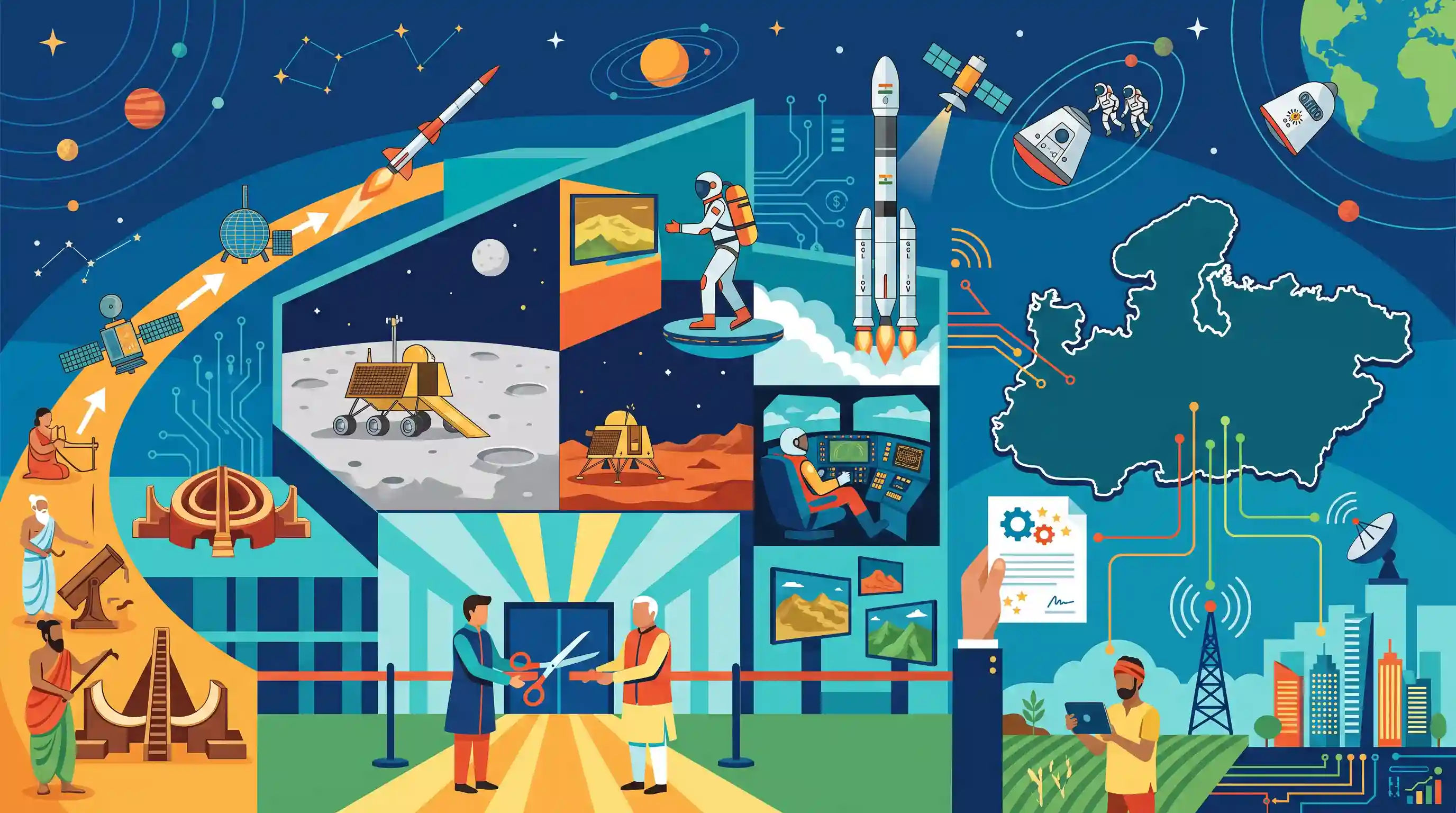
Union Minister Gajendra Singh Shekhawat and Madhya Pradesh Chief Minister Dr. Mohan Yadav inaugurated India's first-of-its-kind Space Exploration Gallery at the Regional Science Centre in Bhopal. Built by the National Council of Science Museums (NCSM) with technical backing from the Nehru Science Centre, Mumbai, the gallery seeks to promote scientific inquiry and space education. It features interactive technologies like space walk simulators, flight simulators, and 3D lunar and Martian terrains, mapping India's space journey from ancient science traditions to missions like Aryabhatta, Chandrayaan, and Gaganyaan. During the launch, it was highlighted that MP has actively formulated its own state Space Policy to foster space-tech adoption.
Key Points
- On July 14, 2026, India's first-of-its-kind 'Space Exploration Gallery' was inaugurated at the Regional Science Centre in Bhopal, Madhya Pradesh.
- The gallery was jointly inaugurated by Union Culture and Tourism Minister Gajendra Singh Shekhawat and MP Chief Minister Dr. Mohan Yadav.
- Madhya Pradesh has formulated its own state 'Space Policy', credited to the initiative of CM Dr. Mohan Yadav.
- The gallery was developed by the National Council of Science Museums (NCSM) with technical collaboration from the Nehru Science Centre in Mumbai.
- Exhibits include ancient Indian astronomy alongside modern Indian milestones like Aryabhatta, Chandrayaan, and Gaganyaan, coupled with interactive tools like flight simulators, space walks, and 3D surfaces of Moon and Mars.
Important Terms
National Council of Science Museums

An autonomous scientific organization under India's Ministry of Culture, formed in 1978. It coordinates informal science communication and administers the world's largest administrative network of science centers and museums.
UPSC context
GS Paper II/III: Governance and S&T. Tests knowledge of public institutions driving scientific awareness.
Madhya Pradesh SpaceTech Policy 2026
A strategic policy approved by the Madhya Pradesh cabinet in January 2026 to foster space technology innovation, electronics, and defense manufacturing, aiming to attract ₹1,000 crore investment over five years.
UPSC context
GS Paper III: Space Technology. Tests understanding of state-level tech ecosystems and regional industrial policies.
Indian Space Research Organisation
The premier national space agency of India, established in 1969 under the Department of Space. It spearheads space research, satellite launch systems, planetary exploration, and socio-economic space applications.
UPSC context
GS Paper III: S&T Achievements. Tests knowledge of institutional frameworks and national space achievements.
Nehru Science Centre
Located in Mumbai, it is India's largest interactive science center. Operating under the National Council of Science Museums, it popularizes science and portrays India's technological growth.
UPSC context
GS Paper III: S&T. Tests awareness of infrastructure supporting public education and scientific temper.
Prelims Trap
The National Council of Science Museums (NCSM) is an autonomous organization under the Ministry of Science and Technology.
NCSM is actually an autonomous society under the Ministry of Culture, despite its focus on science education and science center administration.
Static Concepts Connected
What is IN-SPACe and what is its role in India's space ecosystem?
- Status: It is an autonomous, single-window nodal agency under the Department of Space (DoS) to promote, authorize, and supervise space activities.
- Mandate: Acts as an interface between ISRO and Non-Governmental Entities (NGEs) to share ISRO's facilities and technical expertise.
- Regulatory Role: Authorizes space launches, satellite operations, and the establishment of private space infrastructure in India.
How does the Indian Constitution address the promotion of 'scientific temper'?
- Article 51A(h): Introduced by the 42nd Amendment in 1976, it lists the development of scientific temper, humanism, and spirit of inquiry as a Fundamental Duty.
- Enforceability: While non-justiciable in courts, it serves as a guiding light for executive policies aimed at establishing science museums and galleries.
Cross-Topic Patterns
Sub-National Space Policies + Federalism
Madhya Pradesh's SpaceTech Policy highlights a shift where Indian states actively compete to attract private space tech investments under the Indian Space Policy 2023.
Scientific Temper + Public Heritage
The Ministry of Culture's NCSM leverages space heritage galleries to project India's scientific lineage, linking the Fundamental Duty of scientific temper with cultural pride.

The decentralized role of IN-SPACe in enabling sub-national space policies and private-sector space infrastructure will be tested in 2026.
Linked PYQs · 3
Linked PYQs · 3
- 2021MPPSC_PRELIMSGS1
What is the full name of ISRO?
- 2008MPPSC_PRELIMSGS1
Name of the spacecraft for India's Mission moon is:
- 2020MPPSC_PRELIMSGS1
In which city Madhya Pradesh Tribal Museum is situated?
