SP Global Ratings Upgrades India FY26 GDP Growth Forecast
Source:The Hindu ↗
Why It Matters
The article highlights the delicate balance between domestic growth drivers and external macroeconomic risks. It is crucial for UPSC aspirants to understand how geopolitical tensions in the Middle East directly impact India's energy security, current account deficit, and inflation, thereby influencing GDP projections and monetary policy decisions.
Summary
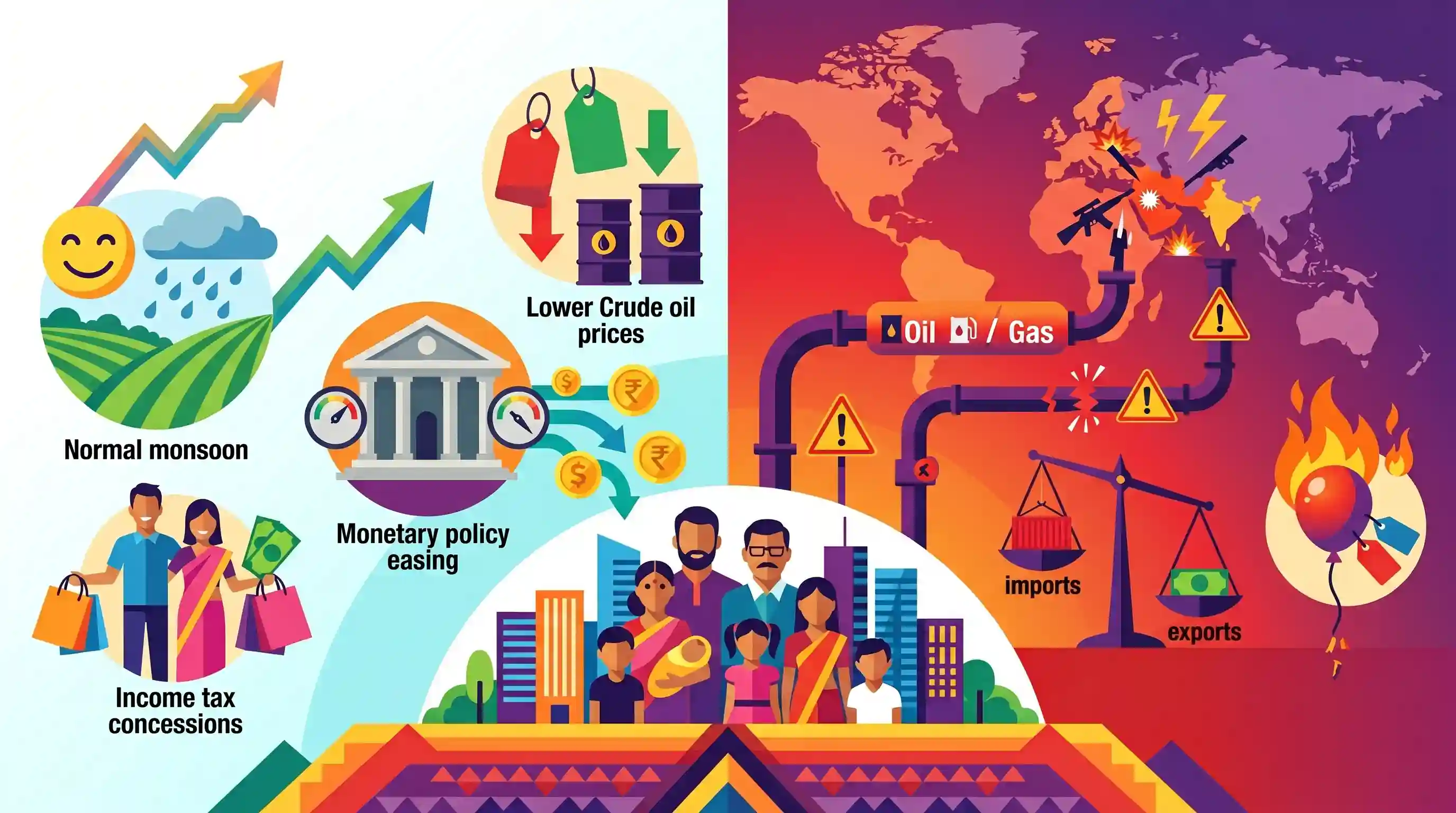
S&P Global Ratings has raised India's FY26 GDP growth forecast to 6.5%, matching projections by the Reserve Bank of India. The optimistic outlook is driven by factors such as a normal monsoon, lower crude oil prices, expected monetary policy easing, and income tax concessions that stimulate domestic demand. However, significant geopolitical risks persist, notably the possibility of escalating conflicts in the Middle East involving Israel, Iran, and the U.S. Given India's heavy reliance on imported crude oil (90%) and natural gas (50%), any disruption to Middle Eastern energy supplies could threaten macroeconomic stability by widening the current account deficit and fueling inflation. Despite these external vulnerabilities, India's robust domestic consumption provides a strong buffer against global economic downturns.
Key Points
- S&P Global Ratings upgraded India's FY26 GDP growth projection to 6.5%, aligning with the RBI's recent forecast.
- Growth drivers include a normal monsoon, lower crude oil prices, anticipated monetary easing, and income-tax concessions supporting domestic consumption.
- Escalating Middle East tensions, particularly potential U.S. or Israeli strikes on Iran, pose a significant downside risk due to potential oil price spikes.
- India is highly vulnerable to energy shocks, importing 90% of its crude oil and 50% of its natural gas, which directly impacts inflation and the current account deficit.
- Strong domestic demand resilience shields India's economy from broader global slowdowns that affect export-dependent nations.
Important Terms
Gross Domestic Product (GDP)

The total market value of all final goods and services produced within a country's borders during a specific period; a primary indicator of economic health and growth.
UPSC context
Relevant for GS III (Economy); tests understanding of growth metrics, resource mobilization, and developmental planning.
Current Account Deficit (CAD)
A condition where a country's total imports of goods, services, and transfers exceed its exports, indicating that the nation is a net borrower from the rest of the world.
UPSC context
Crucial for GS III (External Sector); tests knowledge of Balance of Payments (BoP) and currency stability.
Monetary Policy Easing
A central bank strategy to stimulate growth by increasing money supply and lowering interest rates, such as the Repo Rate, to encourage borrowing and spending.
UPSC context
Key for GS III (Monetary Policy); tests understanding of RBI's role in balancing growth and inflation.
Energy Security
The uninterrupted availability of energy sources at an affordable price, involving the mitigation of risks related to high import dependency and geopolitical supply disruptions.
UPSC context
Relevant for GS III (Infrastructure & Energy); tests strategic planning and resource security in a globalized economy.
Macroeconomic Stability
A state where an economy minimizes vulnerability to external shocks, typically measured by stable inflation, sustainable deficits, and consistent output growth.
UPSC context
Core topic for GS III (Economic Development); tests ability to analyze the impact of global shocks on domestic stability.
Credit Rating Agencies (CRAs)
Independent firms that assess the creditworthiness of debt issuers, including sovereign governments, influencing global investor confidence and foreign capital inflows.
UPSC context
Significant for GS III (Investment Models); tests knowledge of external factors affecting India's fiscal credibility and FPI/FDI.
Prelims Trap
"India's resilience against global economic downturns is primarily driven by its highly diversified export basket."
While export diversification is a policy goal, India's actual structural buffer against global slowdowns is its robust domestic consumption, not its exports.
Static Concepts Connected
What is 'Imported Inflation' and how does crude oil impact it?
- Mechanism: Occurs when global prices of crucial inputs (like crude oil) rise, directly increasing domestic production and transport costs.
- CAD impact: Higher oil import bills widen the Current Account Deficit (CAD), putting downward pressure on the Rupee.
- Rupee depreciation: A weaker Rupee further exacerbates imported inflation by making all other imported goods more expensive.
What macro factors influence a country's Sovereign Credit Rating?
- Economic Growth: High, sustainable GDP growth projections and robust domestic demand improve overall creditworthiness.
- Fiscal Health: Low fiscal deficit and manageable public debt-to-GDP ratios are critical metrics for rating agencies.
- External Balances: A stable CAD and high foreign exchange reserves provide a structural buffer against external shocks.
Cross-Topic Patterns
West Asia conflict & India's oil vulnerability
Escalations involving Iran or Israel directly threaten the Strait of Hormuz. UPSC often links regional geopolitics to India's strategic petroleum reserves and macroeconomic stability.
Domestic consumption vs Export-led growth
India's reliance on domestic demand contrasts with the East Asian export-led model. This ties into demographic dividend and rising middle-class consumption themes for Mains GS3.

Expect a multi-statement Prelims question in 2026 linking West Asian geopolitical chokepoints directly to India's CAD and imported inflation.
Linked PYQs · 3
Linked PYQs · 3
- 2025MainsGS2
"Energy security constitutes the dominant kingpin of India's foreign policy, and is linked with India's overarching influence in Middle Eastern countries.” How would you integrate energy security with India's foreign policy trajectories in the coming years?
- 2019MainsGS3
Do you agree with the view that steady GDP growth and low inflation have left the Indian economy in good shape? Give reasons in support of your arguments.
- 2020MainsGS3
Define potential GDP and explain its determinants. What are the factors that have been inhibiting India from realizing its potential GDP?
