Samajwadi Party Legislative Protests and Assembly Session Dynamics
Source:The Hindu ↗
Why It Matters
Understanding the dynamics of State Legislative Assemblies, the tools used by the opposition to enforce executive accountability, and legislative measures addressing current governance challenges (like exam paper leaks and supplementary budgets) is crucial for UPPSC aspirants.
Summary
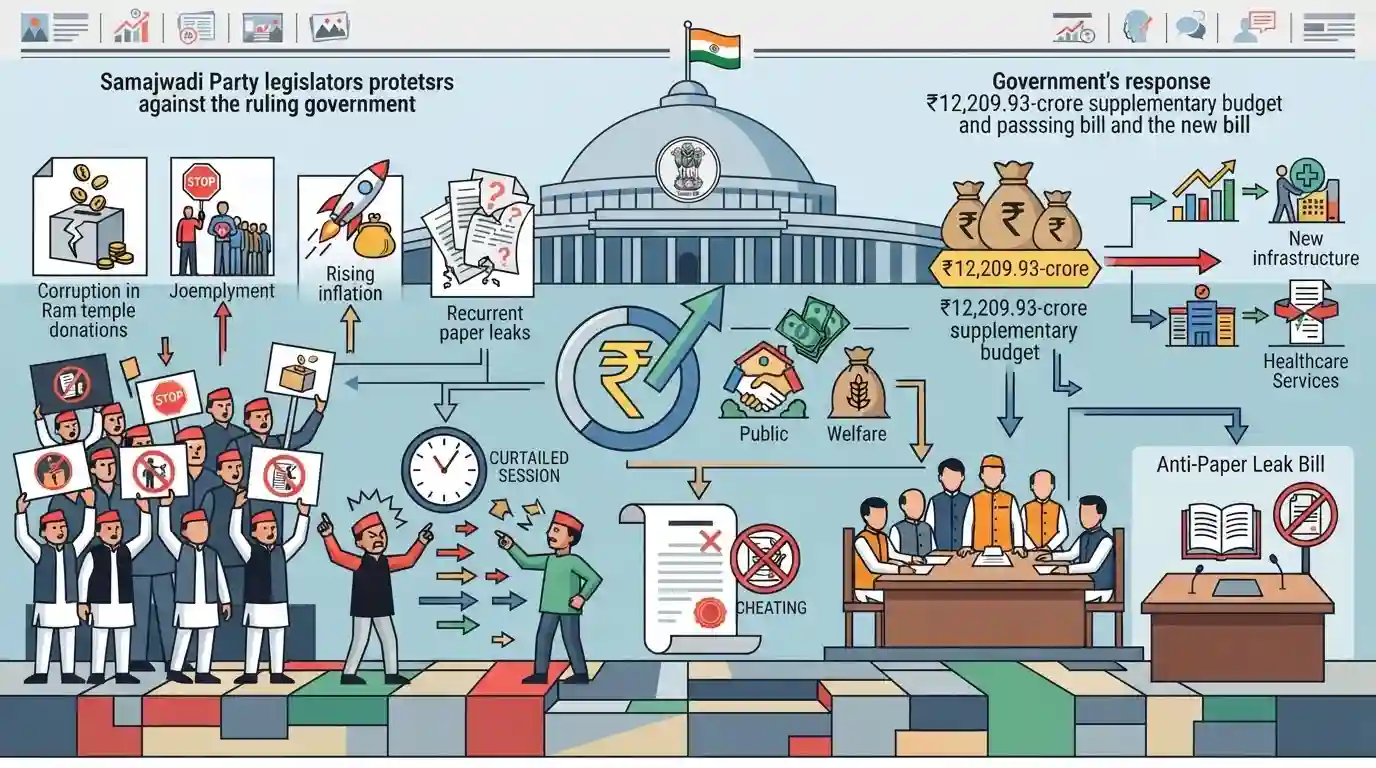
The Uttar Pradesh Assembly's Monsoon session witnessed intense protests led by Samajwadi Party (SP) legislators against the ruling BJP government. The primary issues raised included alleged corruption in Ram temple donations, persistent unemployment, rising inflation, and recurrent competitive exam paper leaks. The opposition also strongly criticized the government's decision to curtail the legislative session, limiting democratic debate. Simultaneously, the state government introduced a ₹12,209.93-crore supplementary budget focused on public welfare and tabled a new bill aimed at preventing unfair means in public examinations, attempting to address the governance concerns raised.
Key Points
- Samajwadi Party legislators held protests in the Uttar Pradesh Assembly over allegations of theft concerning Ram temple donations in Ayodhya.
- The opposition criticized the BJP government for failing to address widespread issues such as unemployment, inflation, agricultural distress, and recent competitive exam paper leaks (including NEET).
- The UP government was strongly condemned by the opposition for abruptly curtailing the duration of the Monsoon legislative session, raising concerns about legislative accountability.
- In the same session, the state government tabled a supplementary budget worth ₹12,209.93 crore and introduced a rigorous anti-paper leak bill to address examination irregularities.
Important Terms
Supplementary Budget

A request for additional funds under Article 205 (States) or Article 115 (Union) of the Constitution when authorized grants fall short or new services arise during the ongoing financial year.
UPSC context
GS Paper 2 (Polity) — Tests knowledge of legislative financial controls and constitutional mechanisms for excess public expenditure.
Uttar Pradesh Public Examination (Prevention of Unfair Means) Bill
A 2024 state bill introducing strict penalties, including life imprisonment and up to ₹1 crore fines, to curb paper leaks and organized solver gangs in competitive public examinations.
UPSC context
GS Paper 2 (Governance) — Relevant for accountability, transparency, and administrative reforms addressing systemic failures in public recruitment.
Uttar Pradesh Assembly
The lower house (Vidhan Sabha) of Uttar Pradesh's bicameral state legislature, functioning as the primary democratic forum for debating state laws, passing budgets, and ensuring executive accountability.
UPSC context
GS Paper 2 (Polity) — Covers the structure, organization, and functioning of the State Legislature.
Samajwadi Party
A prominent regional political party based primarily in Uttar Pradesh. It currently serves as the principal opposition in the state assembly, holding the ruling government accountable on governance issues.
UPSC context
GS Paper 2 (Polity) — Important for understanding the role of regional political parties and the opposition in parliamentary democracy.
Bharatiya Janata Party (BJP)
A major national political party in India. It is currently the ruling party at both the central level and in Uttar Pradesh, shaping legislative agendas and state governance.
UPSC context
GS Paper 2 (Polity) — Relevant for studying the Indian national party system, government functioning, and policy formulation.
Prelims Trap
"The Governor exercises discretionary power under Article 174 to summon or prorogue the State Legislature."
Summoning and proroguing the House is done on the aid and advice of the Council of Ministers, not at the Governor's sole discretion.
Static Concepts Connected
What is the constitutional process for Supplementary Grants in States?
- Article 205: Empowers the Governor to lay a statement before the legislature if authorized funds for a service are insufficient or a new need arises.
- Legislative Approval: The state legislature must pass these grants through an appropriation act before the end of the financial year.
- Guillotine Procedure: Abruptly curtailed sessions often force the passing of undiscussed supplementary grants at once, bypassing detailed legislative scrutiny.
How do Adjournment and Prorogation differ in State Legislatures?
- Adjournment: Terminates a sitting (or postpones it to a specified time) and is declared by the Presiding Officer (Speaker/Chairman).
- Prorogation: Terminates the entire session of the House. It is declared by the Governor under Article 174.
- Impact on Assembly: Unlike dissolution, neither adjournment nor prorogation terminates the life of the Legislative Assembly itself.
Cross-Topic Patterns
Session curtailment & the Guillotine
The frequent curtailment of legislative sessions bypasses standing committees and normalizes the 'Guillotine' procedure, directly undermining the executive's financial accountability to the legislature.
Federal response to exam irregularities
States introducing anti-paper leak bills mirror the Centre’s Public Examinations Act, 2024, highlighting federal synchronization to address a systemic crisis in youth employment and recruitment integrity.

Expect a multi-statement Prelims question on the Governor's powers under Art 174 vs the Speaker's powers of adjournment in 2026.
Linked PYQs · 2
Linked PYQs · 2
- 2021UPPSC_PRELIMSGS1
The functions of the State Public Service Commission of Uttar Pradesh can be extended by
- 2020UPPSC_PRELIMSGS1
Which of the following cities of Uttar Pradesh is/are covered under the 'Heritage City Development and Augmentation Yojana (HRIDAY)' ? 1. Varanasi 2. Mathura 3. Prayagraj 4. Ayodhya Select the correct answer from the codes given below.
