Rajasthan leads agricultural solarisation under PM-KUSUM scheme
Source:The Hindu ↗
Why It Matters
The solarisation of agriculture is a critical policy initiative intersecting rural economy, energy security, and environmental sustainability. It is a recurring theme in the RPSC RAS Prelims, specifically concerning the PM-KUSUM scheme and Rajasthan's leading role in renewable energy generation.
Summary
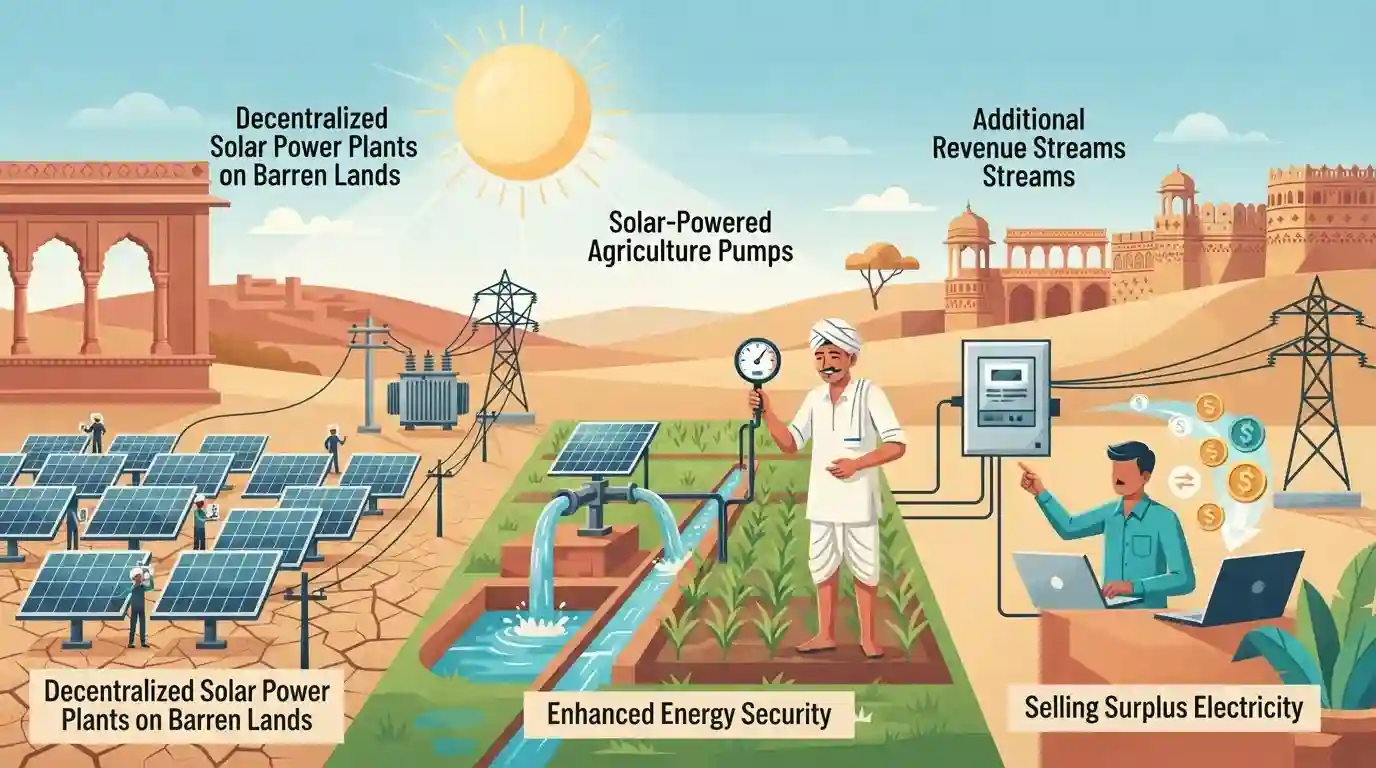
The article discusses the impact and progress of solar power interventions in Rajasthan's agricultural sector, particularly through the implementation of the PM-KUSUM scheme. By setting up decentralized solar power plants on barren lands and installing solar-powered agriculture pumps, the initiative aims to enhance energy security for farmers, reduce their dependence on expensive diesel, and create additional revenue streams by selling surplus electricity to the grid. Rajasthan, spearheaded by the Rajasthan Renewable Energy Corporation Limited (RRECL), continues to be a pioneer in integrating renewable energy into rural agriculture.
Key Points
- Rajasthan has emerged as a leader in the implementation of the PM-KUSUM scheme, aimed at solarising the agricultural sector and reducing reliance on diesel pumps.
- Component-A of the PM-KUSUM scheme allows farmers to set up decentralized grid-connected solar power plants (0.5 to 2 MW) on barren/uncultivable land, providing them with an additional source of income.
- Component-B involves the installation of standalone solar-powered agriculture pumps, and Component-C deals with the solarisation of existing grid-connected agriculture pumps.
- The Rajasthan Renewable Energy Corporation Limited (RRECL) is the nodal agency for implementing the PM-KUSUM scheme in the state.
- Solar power interventions in agriculture improve energy security, lower input costs for irrigation, and contribute significantly to India\'s renewable energy targets.
Important Terms
Pradhan Mantri Kisan Urja Suraksha evam Utthaan Mahabhiyan (PM-KUSUM)

A flagship MNRE scheme providing farmers with standalone solar pumps, decentralized solar power plants, and grid-connected pump solarization. It aims to de-dieselize agriculture, ensure energy security, and create extra income streams.
UPSC context
Highly relevant for RPSC RAS GS Paper 3 (Indian & Rajasthan Economy) covering rural infrastructure and agriculture.
Rajasthan Renewable Energy Corporation Limited (RRECL)
Formed in 2002 by merging REDA and RSPCL, RRECL is Rajasthan's nodal agency for developing non-conventional energy sources. It spearheads the state-level execution of renewable schemes like PM-KUSUM.
UPSC context
Directly tested in RPSC Prelims and RAS Mains GS Paper 3 (Economy of Rajasthan) under energy resources and institutional frameworks.
Ministry of New and Renewable Energy (MNRE)
The central nodal ministry responsible for India's transition to clean energy. It formulates policies, allocates funds, and sets national targets for initiatives like PM-KUSUM, driving the country's renewable energy deployment.
UPSC context
Essential for understanding the administrative framework and funding mechanisms of national clean energy programs in RAS GS Paper 2.
Feeder-Level Solarization
A model under PM-KUSUM's Component-C where decentralized solar plants (up to 5 MW) are established near substations to supply clean daytime power directly to agricultural feeders, minimizing transmission losses.
UPSC context
Tests in-depth knowledge of power sector reforms and rural agricultural interventions in RPSC RAS GS Paper 3.
Prelims Trap
"PM-KUSUM allows farmers to set up grid-connected solar plants on any of their agricultural land."
Component-A explicitly restricts the establishment of decentralized solar power plants to barren or uncultivable land. It prevents the diversion of productive land away from food security.
Static Concepts Connected
What are the three specific components of the PM-KUSUM scheme?
- Component A: Setting up of 10,000 MW of decentralized grid-connected solar power plants (0.5 to 2 MW) on barren/uncultivable land.
- Component B: Installation of standalone off-grid solar-powered agriculture pumps to replace expensive diesel pumps.
- Component C: Solarisation of existing grid-connected agriculture pumps, allowing farmers to sell surplus power to DISCOMs.
What is the primary nodal agency for renewable energy in Rajasthan?
- RRECL: Rajasthan Renewable Energy Corporation Limited (RRECL) is the state nodal agency for implementing PM-KUSUM and other renewable energy policies.
- Formation: It was formed in 2002 by merging the Rajasthan Energy Development Agency (REDA) and Rajasthan State Power Corporation Ltd.
Cross-Topic Patterns
Water-Energy Nexus in Agriculture
Solar pumps reduce diesel costs but risk severe groundwater over-extraction because solar power is effectively 'free' during daytime, linking PM-KUSUM directly to Rajasthan's dark zone water crisis.
Wasteland Monetization & Doubling Income
Component A bridges climate targets with rural income by transforming Rajasthan's vast tracts of uncultivable arid land into grid-connected, revenue-generating assets, linking agriculture with energy security.

Expect a multi-statement question on PM-KUSUM mixing its A/B/C components with Rajasthan's specific milestone (first plant in Bhaloji).
Linked PYQs · 2
Linked PYQs · 2
- 2023RPSC_PRELIMSGS1
Which agency has been given the responsibility of implementing the PM-KUSUM scheme (Component A) in Rajasthan, which involves the establishment of solar power plants with a capacity of 0.5 MW to 2 MW?
- 2021RPSC_PRELIMSGS1
In which village of Rajasthan was India's first agriculture-based “KUSUM” solar energy plant project launched?
