Southwest monsoon intensifies over Kerala with red alerts issued
Source:The Hindu ↗
Why It Matters
The onset and performance of the southwest monsoon dictate India's agricultural and economic health, while its extremes necessitate robust disaster management. Understanding the mechanism of the monsoon and the IMD's early warning framework (like colour-coded alerts) is highly recurrent in both UPSC Prelims and Mains.
Summary
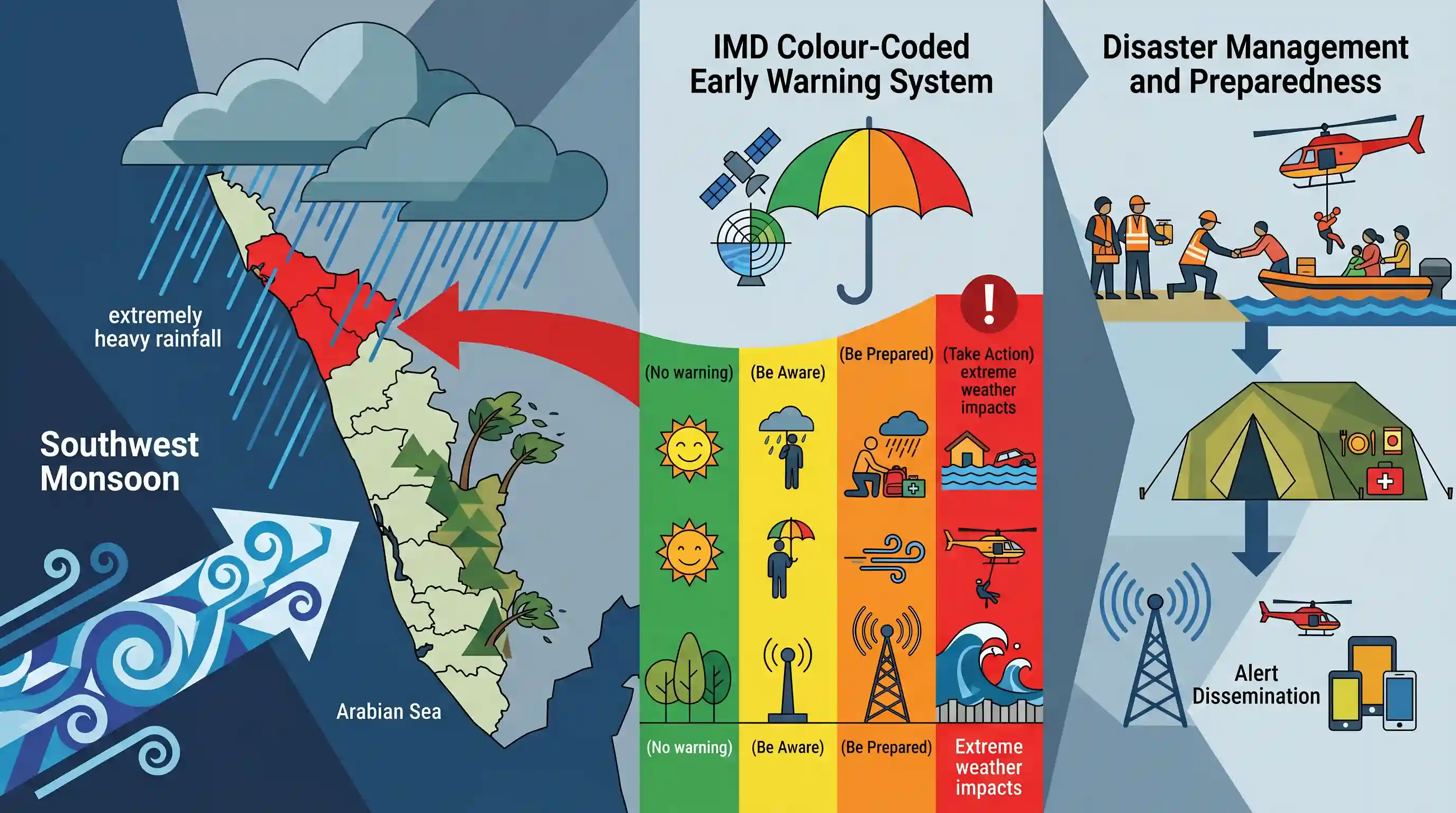
The southwest monsoon has intensified over Kerala, prompting the India Meteorological Department (IMD) to issue red alerts for multiple northern districts due to extremely heavy rainfall. With warnings of potential flooding, sea surges, and squally winds over the Arabian Sea, the state is bracing for severe weather impacts. The event underscores the critical role of IMD's early warning systems and colour-coded alerts in disaster preparedness.
Key Points
- The southwest monsoon has significantly intensified over Kerala, causing heavy to extremely heavy rainfall across several districts.
- The India Meteorological Department (IMD) issued a 'red alert' for five northern districts (Malappuram, Kozhikode, Wayanad, Kannur, and Kasaragod) and an 'orange alert' for six others.
- Authorities warned of squally weather, sea surges, and potential flooding, advising fishermen against venturing into the southeast Arabian Sea and along the Kerala coast.
- The situation highlights the importance of the IMD's colour-coded early warning system in enabling state-level disaster preparedness and mitigation.
Important Terms
Southwest Monsoon

Periodic seasonal winds blowing from the Indian Ocean to the subcontinent between June and September, providing approximately 75-80% of India's annual rainfall.
UPSC context
Essential for GS Paper 1 (Climatology) and GS Paper 3 (Agricultural Economy).
India Meteorological Department (IMD)
India's nodal agency under the Ministry of Earth Sciences responsible for meteorological observations, weather forecasting, and providing early warnings for severe weather events.
UPSC context
Critical for GS Paper 3 (Disaster Management) and GS Paper 1 (Geography).
Color-coded Weather Alerts
A four-tier system (Green, Yellow, Orange, Red) used by the IMD to signify weather severity. Red alert indicates extreme conditions requiring immediate public and administrative action.
UPSC context
Tests knowledge of disaster preparedness and response mechanisms in GS Paper 3.
Storm Surge / Sea Surge
An abnormal rise of seawater above the normal tide level, caused by strong winds and low atmospheric pressure associated with severe storms or depressions.
UPSC context
Relevant for GS Paper 1 (Coastal Geography) and GS Paper 3 (Disaster Mitigation).
Early Warning System (EWS)
An integrated system of hazard monitoring and communication designed to enable individuals and communities to take timely action against impending disasters.
UPSC context
Fundamental concept in GS Paper 3 (Disaster Management and Sendai Framework).
Prelims Trap
The IMD has the statutory authority to order evacuations when issuing a 'Red Alert' for extreme rainfall.
IMD is strictly a forecasting agency issuing meteorological advisories. Issuing evacuation orders and managing on-ground disaster response is the statutory mandate of the State Disaster Management Authority (SDMA).
Static Concepts Connected
What are the four colour codes used by the IMD for weather warnings?
- Green: No action required; indicates normal weather conditions with no immediate threat to the region.
- Yellow: Be updated; signifies potentially bad weather that could progressively worsen over the coming days.
- Orange: Be prepared; warns of extremely bad weather with the potential for transport and infrastructural disruptions.
- Red: Take action; extremely severe weather (often >204.4 mm rainfall in 24h) threatening life and property.
How do the Western Ghats influence Kerala's Southwest Monsoon rainfall?
- Orographic lifting: The towering Western Ghats intercept the moisture-laden Arabian Sea branch of the monsoon, forcing the air upward.
- Windward precipitation: As the air rises, it cools and condenses rapidly, causing extremely heavy downpours on the western coastal plains and slopes.
- Rain shadow effect: After crossing the peaks, descending air warms and holds moisture, leaving the eastern regions relatively dry.
Cross-Topic Patterns
Sendai Framework Target G
IMD's colour-coded alerts act as a critical non-structural disaster measure, directly aligning with the Sendai Framework's Target G to substantially increase global access to multi-hazard early warning systems.
Monsoon anomalies & IOD
While the Western Ghats provide the physical barrier for orographic rain, the intensity of seasonal moisture transport is heavily modulated by broader oceanic anomalies like the Indian Ocean Dipole and ENSO.

Expect a multi-statement Prelims question mixing IMD's specific rainfall thresholds for 'Red Alerts' with the statutory roles of SDMAs.
Linked PYQs · 3
Linked PYQs · 3
- 2022MainsGS1
Discuss the meaning of colour-coded weather warnings for cyclone prone areas given by India Meteorological Department.
- 1996PrelimsGS1
High temperature and low pressure over the Indian Subcontinent during the summer season, draws air from the Indian Ocean leading to the in blowing of the
- 2017PrelimsGS1
With reference to 'Indian Ocean Dipole (IOD)' sometimes mentioned in the news while forecasting Indian monsoon, which of the following statements is/are correct? 1. IOD phenomenon is characterised by a difference in sea surface temperature between tropical Western Indian Ocean and tropical Eastern Pacific Ocean. 2. An IOD phenomenon can influence an El Nino's impact on the monsoon. Select the correct answer using the code given below:
