IMD Monsoon Onset Forecast and El Nino Impact on Kerala
Source:The Hindu ↗
Why It Matters
The criteria for declaring the monsoon onset, the mechanics of its progression, and the influence of phenomena like El Niño are core to UPSC's physical geography syllabus. Understanding these factors is crucial for analyzing India's agricultural output, water resource management, and overall economic stability.
Summary
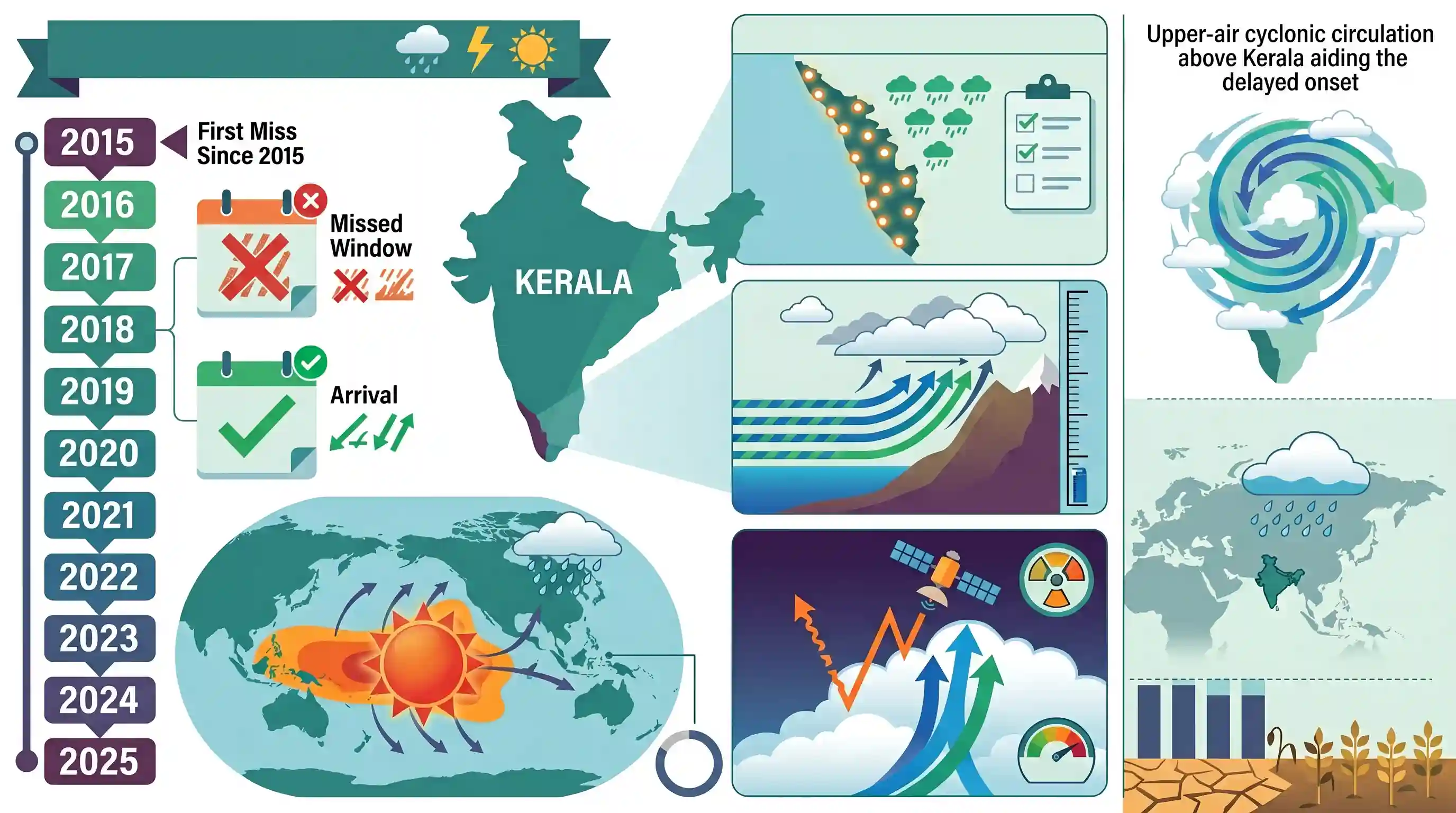
The India Meteorological Department (IMD) has revised the arrival date of the southwest monsoon over Kerala to around June 4, 2026. This delay means the IMD has missed its initial forecast window (May 26 ± 4 days) for the first time since 2015. The IMD uses strict criteria to declare the onset, including rainfall spread across 14 designated stations, the depth of westerly winds over the Arabian Sea, and specific Outgoing Longwave Radiation (OLR) levels indicating deep convection. The delayed onset, aided by an upper-air cyclonic circulation, comes alongside a broader forecast predicting below-normal seasonal rainfall (90% of the long-period average) due to a developing El Niño.
Key Points
- The IMD revised the 2026 southwest monsoon onset date for Kerala to June 4, marking its first incorrect onset forecast since 2015 after missing its initial May 26 prediction window.
- Monsoon onset declaration requires three specific criteria: at least 60% of 14 designated stations recording 2.5 mm+ rain for two consecutive days, westerly winds extending up to 600 hPa, and Outgoing Longwave Radiation dropping below 200 W/m².
- The monsoon system stalled short of the coast rather than weakening, with an upper-air cyclonic circulation off the south Kerala coast expected to aid its final advance.
- The overall monsoon rainfall for the season is forecast to be below normal at 90% of the long-period average, attributed to a building El Niño.
Important Terms
El Niño

A climate pattern involving unusual warming of surface waters in the central and eastern equatorial Pacific. In India, it is typically associated with weakened monsoon winds and deficient seasonal rainfall.
UPSC context
GS Paper I (Geography); critical for understanding global teleconnections and their impact on Indian agriculture and food security.
Long Period Average (LPA)
The average rainfall recorded over a particular region for a long interval (currently 1971-2020). It serves as the standard benchmark to categorize annual monsoon performance as normal, below-normal, or deficient.
UPSC context
GS Paper III (Economy/Agriculture); tests knowledge of statistical standards used to evaluate water resources and economic health.
Outgoing Longwave Radiation (OLR)
Energy emitted from Earth's atmosphere to space. In meteorology, values below 200 W/m² indicate high cloud density and deep convection, a technical requirement for the IMD to declare the monsoon's arrival.
UPSC context
GS Paper I (Physical Geography); focuses on the radiation balance and technical criteria for climatological forecasting.
India Meteorological Department (IMD)
India's nodal agency for meteorological observations and weather forecasting. It provides the official seasonal forecasts and technical declarations regarding monsoon onset, crucial for agricultural planning and disaster management.
UPSC context
GS Paper I and III; nodal agency for weather-related disaster management and geography-based questions.
Monsoon Onset
The official start of the four-month rainy season in India. Declaration requires meeting strict simultaneous criteria: specific rainfall spread across Kerala, established westerly wind depth, and low radiation levels.
UPSC context
GS Paper I (Geography of India); essential for understanding the timing and mechanism of the Indian monsoon system.
Upper-Air Cyclonic Circulation
A rotating wind pattern in the higher levels of the troposphere. These systems can draw in warm, moist air and act as atmospheric triggers that facilitate the arrival and spread of the monsoon.
UPSC context
GS Paper I (Physical Geography); relates to atmospheric dynamics and synoptic features that influence seasonal weather.
Prelims Trap
"The onset of the southwest monsoon is declared by IMD solely based on continuous rainfall over Kerala."
The IMD requires three strict criteria for onset: rainfall spread across 14 stations, westerly wind depth up to 600 hPa, and Outgoing Longwave Radiation (OLR) under 200 W/m². It is never just rainfall.
Static Concepts Connected
What are the 3 IMD criteria to declare the southwest monsoon onset?
- Rainfall Spread: At least 60% of 14 designated stations along the west coast must record 2.5 mm or more rainfall for two consecutive days.
- Wind Depth: Westerly winds must extend up to the 600 hPa atmospheric level over the Arabian Sea, confirming established moisture flow.
- OLR Levels: Outgoing Longwave Radiation must drop below 200 W/m², indicating deep, cold cloud tops and strong convective atmospheric activity.
How does El Niño lead to a 'below normal' Indian monsoon?
- Walker Circulation Shift: Warming of the eastern Pacific Ocean shifts the Walker cell, causing anomalous descending air (subsidence) over the Indian subcontinent which suppresses cloud formation.
- Weakened Westerlies: The altered thermal gradient reduces the strength of the cross-equatorial south-westerly winds that carry vital moisture from the ocean to India.
Cross-Topic Patterns
Below-normal monsoon and RBI monetary policy
A forecast of 90% LPA due to El Niño threatens Kharif crop yields. This links physical geography directly to food inflation, complicating the RBI's inflation-targeting mandate and monetary policy.
Satellite technology for OLR measurement
Tracking Outgoing Longwave Radiation (OLR) to declare the monsoon onset relies on ISRO's meteorological satellites like INSAT-3D, bridging atmospheric climatology with the Science & Tech space syllabus.

Expect a multi-statement Prelims question testing exact IMD numerical criteria (OLR < 200 W/m², 600 hPa) alongside El Niño's mechanics.
Linked PYQs · 3
Linked PYQs · 3
- 2017PrelimsGS1
With reference to 'Indian Ocean Dipole (IOD)' sometimes mentioned in the news while forecasting Indian monsoon, which of the following statements is/are correct? 1. IOD phenomenon is characterised by a difference in sea surface temperature between tropical Western Indian Ocean and tropical Eastern Pacific Ocean. 2. An IOD phenomenon can influence an El Nino's impact on the monsoon. Select the correct answer using the code given below:
- 2014MainsGS1
Most of the unusual climatic happenings are explained as an outcome of the El-Nino effect. Do you agree?
- 2015MainsGS1
How far do you agree that the behaviour of the Indian monsoon has been changing due to humanizing landscapes? Discuss.
