Southern Zonal Council Meeting Debates Fiscal Federalism and Equity
Source:The Hindu ↗
हे का महत्त्वाचे आहे
This article touches upon key pillars of Indian federalism: the functioning of statutory inter-state bodies (Zonal Councils), the ongoing debate over equity vs. performance in financial devolution (Finance Commission), the post-GST erosion of state fiscal autonomy, and inter-state river water sharing, all of which are highly recurring themes in both UPSC Prelims and Mains (GS Paper II and III).
सारांश
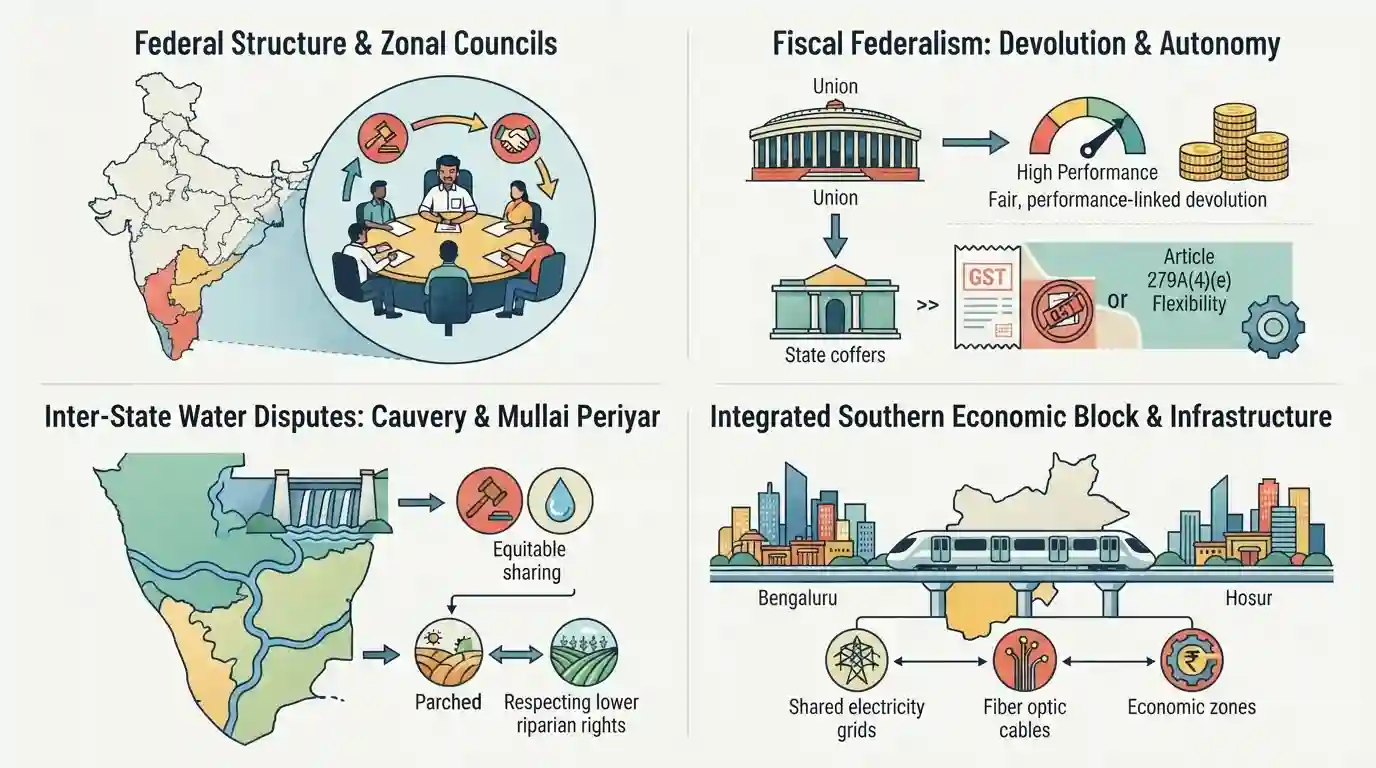
At the 31st Southern Zonal Council meeting in Mamallapuram, Tamil Nadu Chief Minister C. Joseph Vijay advocated for fair, performance-linked fiscal devolution from the Centre. He expressed concern over states' shrinking fiscal autonomy post-GST, urged cooperation to reclaim tax flexibility under Article 279A(4)(e), and emphasized the need to respect lower riparian rights in inter-state river disputes like Cauvery and Mullai Periyar. He also pitched for treating the southern states as an integrated economic block with cross-border infrastructure such as the Bengaluru-Hosur metro.
मुख्य मुद्दे
- The 31st Southern Zonal Council meeting was held in Mamallapuram, chaired by Union Home Minister Amit Shah, where southern states highlighted their contribution of over 30% of India's GDP.
- Tamil Nadu CM C. Joseph Vijay argued that the next Finance Commission must balance equity with performance, ensuring states that successfully manage demographic transitions and maintain fiscal discipline are not penalized in devolution.
- CM Vijay highlighted that post-GST, states lack flexible revenue options outside of alcohol and petroleum, urging them to utilize Article 279A(4)(e) of the Constitution to reclaim tax rate flexibility via floor rates with bands.
- On inter-state water disputes, the TN CM emphasized protecting lower riparian rights and implementing Supreme Court and tribunal rulings in letter and spirit, specifically concerning the Cauvery and Mullai Periyar rivers.
- Proposals for regional integration included developing common logistics and economic clusters, using the cross-border Bengaluru-to-Hosur metro extension as a cooperative model, and unlocking the potential of the Blue Economy.
महत्त्वाच्या संज्ञा
Southern Zonal Council

A statutory advisory body established under the States Reorganisation Act, 1956, comprising southern states and UTs, functioning under the Union Home Minister to foster regional cooperation.
UPSC context
GS Paper II: Polity & Governance. Tests statutory bodies, federal coordination, and regional integration mechanisms.
States Reorganisation Act 1956
A landmark Indian legislation that redefined state boundaries on linguistic lines and established the framework for advisory Zonal Councils to promote regional cooperative working.
UPSC context
GS Paper I & II: Post-Independence India, Polity. Tests evolution of states and statutory federal structures.
Article 279A
A constitutional provision inserted via the 101st Amendment Act, 2016, which mandates the President to constitute the joint federal forum known as the GST Council.
UPSC context
GS Paper II: Indian Constitution. Tests landmark amendments, division of powers, and constitutional bodies.
GST Council
A constitutional joint forum of the Centre and States under Article 279A that recommends tax rates, exemptions, and administrative regulations for India's unified indirect tax system.
UPSC context
GS Paper III: Indian Economy. Tests fiscal federalism, tax administration, and cooperative policy-making.
Cauvery Water Management Authority
A statutory, quasi-judicial body notified under the Inter-State River Water Disputes Act, 1956, to regulate, monitor, and enforce water-sharing allocations among the riparian states of the Cauvery basin.
UPSC context
GS Paper II: Polity & Governance. Tests Article 262, inter-state water disputes, and statutory resolution mechanisms.
पूर्वपरीक्षा सापळा
Zonal Councils are constitutional bodies established under Article 263 of the Constitution and are chaired by the Prime Minister.
Zonal Councils are statutory bodies (States Reorganisation Act 1956) chaired by the Union Home Minister. Aspirants confuse them with the constitutional Inter-State Council (Art 263) chaired by the PM.
संबंधित स्थिर संकल्पना
What is the constitutional mechanism for resolving inter-state water disputes?
- Article 262: Empowers Parliament to legislate on the adjudication of disputes relating to the waters of inter-state rivers or river valleys.
- Statutory Acts: Enables the Union to set up ad-hoc tribunals; explicitly bars Supreme Court jurisdiction under Article 131, though appeals lie via Special Leave.
How does the Finance Commission balance demographic performance in tax devolution?
- 2011 Census Shift: The 15th Finance Commission used the 2011 Census, causing concern among states with successful population control who feared a lower fiscal share.
- Demographic Performance: A 12.5% weight was introduced for demographic performance to reward states that managed lower Total Fertility Rates (TFR).
आंतर-विषय नमुने
Blue Economy + Competitive Federalism
Joint maritime infrastructure and port-led development among Southern states can unlock the Sagarmala project's potential while bypassing traditional land-centric resource conflicts.
Article 279A(4)(e) + Fiscal Space
Enabling floor rates with bands under GST can set a precedent where cooperative federalism adapts to preserve states' independent revenue-mobilization powers.

Expect a multi-statement question comparing statutory Zonal Councils and the constitutional Inter-State Council on composition and mandate.
संबंधित PYQ · 3
संबंधित PYQ · 3
- 2025PrelimsGS1
With reference to India, consider the following: I. The Inter-State Council II. The National Security Council III. Zonal Councils How many of the above were established as per the provisions of the Constitution of India?
- 2025MainsGS2
Examine the evolving pattern of Centre-State financial relations in the context of planned development in India. How far have the recent reforms impacted the fiscal federalism in India?
- 2015MainsGS2
The concept of cooperative federalism has been increasingly emphasized in recent years. Highlight the drawbacks in the existing structure and the extent to which cooperative federalism would answer the shortcomings.
