Southern Ocean carbon anomaly exposes limits in climate models
Source:The Hindu ↗
Why It Matters
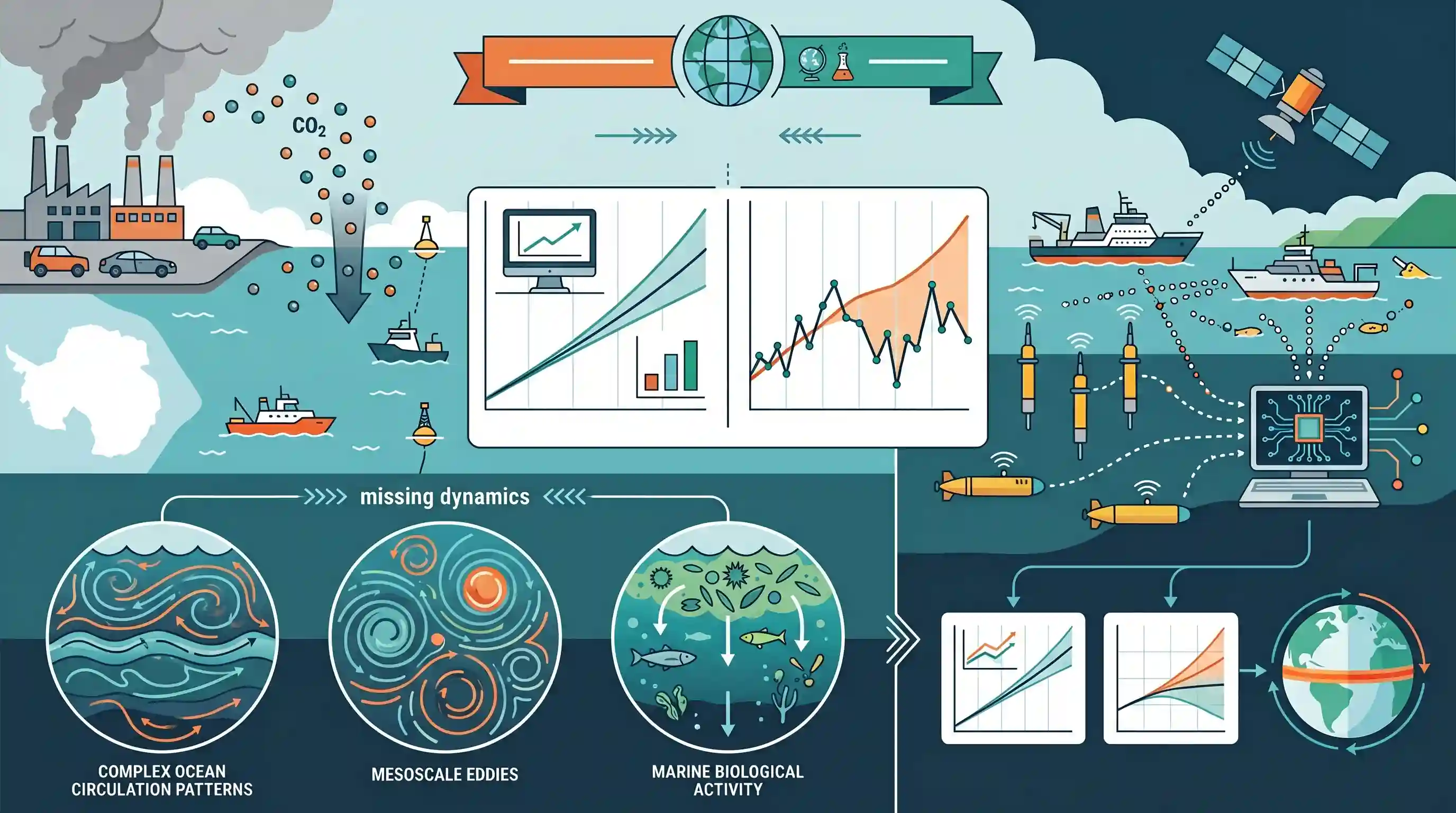
The Southern Ocean's capacity to absorb carbon is a key variable in global climate change calculations. If models incorrectly estimate this carbon sink, it could lead to inaccurate climate forecasts and misinformed mitigation strategies, directly impacting global climate targets like the Paris Agreement.
Summary
Recent observational data from the Southern Ocean has revealed a carbon 'anomaly,' highlighting a discrepancy between actual oceanic carbon absorption and the predictions generated by Earth System Models. As one of the world's most vital carbon sinks, the Southern Ocean plays a central role in mitigating global warming by absorbing human-made CO2. The observed anomaly indicates that current climate models may be missing crucial regional dynamics, such as complex ocean circulation patterns, mesoscale eddies, and variations in marine biological activity. This discovery underscores the critical need for enhanced observational infrastructure in remote marine environments to refine climate models, thereby improving the accuracy of global carbon cycle predictions and future climate change trajectories.
Key Points
- The Southern Ocean is a critical global carbon sink, absorbing a significant portion of anthropogenic carbon dioxide emissions.
- Recent observations have identified a carbon flux 'anomaly' where actual carbon absorption differs from the predictions of current Earth System Models (ESMs).
- This discrepancy suggests that existing climate models may fail to capture complex, localized processes such as sub-mesoscale ocean eddies, wintertime carbon outgassing, and specific biological pump dynamics.
- Addressing these modeling gaps is essential for accurate climate forecasting, refining the global carbon budget, and informing international climate mitigation policies.
Prelims Trap
Melting of Antarctic ice sheets directly reduces the Southern Ocean's carbon absorption capacity.
Aspirants assume melting ice limits sink capacity. Instead, freshwater creates a stratified 'lid' that traps deep carbon-rich water, preventing outgassing and temporarily increasing net absorption.
Static Concepts Connected
How do the Biological and Solubility Pumps sequester oceanic carbon?
- Biological Pump: Phytoplankton absorb CO2 for photosynthesis. Dead organisms sink as 'marine snow', sequestering carbon in the deep ocean for centuries.
- Solubility Pump: Cold surface waters dissolve more atmospheric CO2. Downwelling currents then transport this carbon-dense water into the deep ocean.
- Carbon Outgassing: Wind-driven upwelling forces deep, carbon-rich waters to the surface. As the water warms, it releases stored CO2 back into the atmosphere.
What is ocean stratification and how does freshwater influx impact it?
- Density Barrier: Variations in water temperature (thermocline) and salinity (halocline) create distinct density layers, resisting vertical mixing of ocean waters.
- Freshwater Lid: Melting ice sheets add buoyant freshwater to the surface, intensely stratifying the ocean. This acts as a lid, trapping deep circumpolar waters below.
- Nutrient Block: While it may temporarily block carbon outgassing, stratification inhibits the upwelling of essential nutrients, threatening surface marine ecosystems and phytoplankton.
Cross-Topic Patterns
Polar melt + Global circulation
Freshwater influx stratifies the Southern Ocean, mirroring how Greenland ice melt disrupts the Atlantic Meridional Overturning Circulation (AMOC). UPSC often links these polar circulation disruptions in Geography questions.
Climate Modeling limits + IPCC
The inability of Earth System Models to capture localized 'mesoscale eddies' is a recurring theme in IPCC critiques, directly impacting the accuracy of global carbon budget negotiations.

Expect a multi-statement question in 2026 linking Antarctic ice melt, ocean stratification, and paradoxical increases in carbon sinks.
Linked PYQs · 5
Linked PYQs · 5
- 2023PrelimsGS1
Consider the following activities: 1. Spreading finely ground basalt rock on farmlands extensively 2. Increasing the alkalinity of oceans by adding lime 3. Capturing carbon dioxide released by various industries and pumping it into abandoned subterranean mines in the form of carbonated waters How many of the above activities are often considered and discussed for carbon capture and sequestration?
- 2018PrelimsGS1
Which of the following statements best describes "carbon fertilization"?
- 2025MainsGS3
What is Carbon Capture, Utilization and Storage (CCUS)? What is the potential role of CCUS in tackling climate change?
- 2019MainsGS1
How do ocean currents and water masses differ in their impacts on marine life and coastal environment? Give suitable examples.
- 2015MainsGS1
Explain the factors responsible for the origin of ocean currents. How do they influence regional climates, fishing and navigation?
