Rainfall Trends and Climate Shifts in Southern India
Source:The Hindu ↗
Why It Matters
Understanding long-term regional shifts in rainfall patterns and monsoon dynamics is vital for analyzing climate change impacts, agricultural planning, and disaster management in peninsular India.
Summary
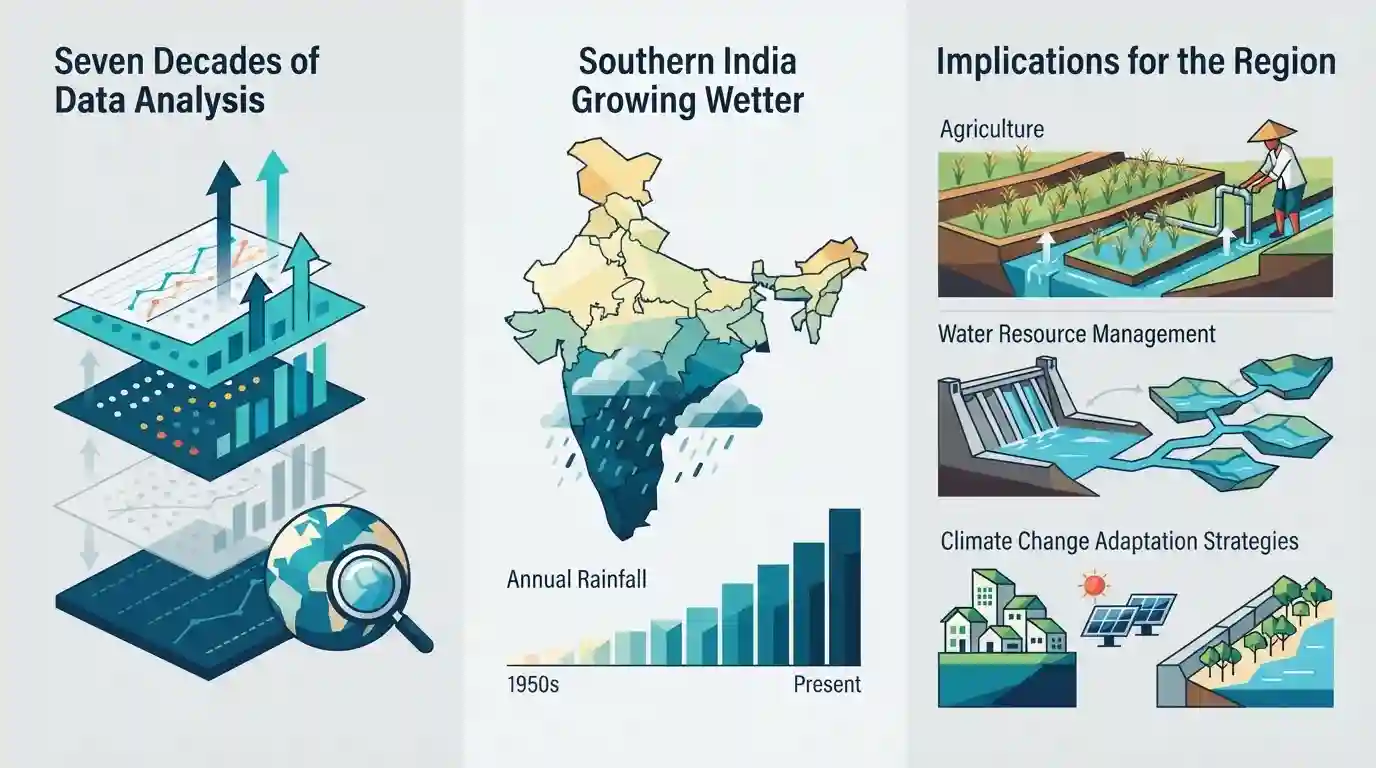
A recent study by the India Meteorological Department (IMD) analyzing seven decades of data has found that southern India has grown increasingly wetter. The shift underscores changing regional climate patterns, carrying significant implications for agriculture, water resource management, and climate change adaptation strategies in the peninsular region.
Key Points
- An IMD study covering seven decades reveals that Southern India has experienced a significant long-term increase in wetter conditions and rainfall variability.
- The findings highlight shifts in regional climate dynamics, challenging traditional assumptions about uniform or stable monsoon patterns across peninsular India.
- Such long-term meteorological analyses are crucial for adapting agricultural planning, water resource management, and disaster resilience in southern states.
Important Terms
India Meteorological Department (IMD)

India's national meteorological service operating under the Ministry of Earth Sciences, responsible for meteorological observations, weather forecasting, seismology, and issuing early warnings for natural disasters.
UPSC context
GS Paper 1 (Geography - Climatology) and GS Paper 3 (Disaster Management); tests knowledge of official weather agencies and climate monitoring institutions.
Tropical Savannah Climate
A tropical climate type characterized by distinct wet and dry seasons with high year-round temperatures, covering a major share of peninsular India following recent climate shifts.
UPSC context
GS Paper 1 (Geography - Climatic Regions of India); tests understanding of Köppen climate classifications and long-term shifts in Indian climate zones.
Hot Semi-Arid Climate
A dry climate regime characterized by low precipitation and high evaporation rates, which has notably shrunk across peninsular India over the past seven decades due to increasing wetness.
UPSC context
GS Paper 1 (Geography - Climatology and Regional Variations); tests understanding of micro-climatic shifts and arid zone dynamics in India.
Prelims Trap
Climate change causes uniform drying or drought conditions across all of peninsular India without exception.
Aspirants often assume climate change uniformly decreases rainfall across peninsular India, overlooking regional and sub-basin wetting trends documented by IMD.
Static Concepts Connected
What are the primary factors driving regional rainfall variability and monsoon shifts in the Indian subcontinent?
- Ocean Warming: Warming of the Arabian Sea and Indian Ocean increases moisture retention capacity, fueling heavier localized precipitation events.
- Urbanization: Urban heat island effects alter local thermal profiles, modifying convective cloud formation and downwind rainfall distribution.
- Monsoon Trough: Shifts in the position and intensity of the monsoon trough influence the spatial distribution of seasonal rainfall.
Cross-Topic Patterns
Monsoon Shifts + Peninsular Irrigation Security
Changing precipitation trends directly impact the irrigation viability of tank-fed systems and reservoir storage capacities across southern states.
Climatology + State Action Plans on Climate Change
Altered rainfall patterns necessitate local climate action plans and updated crop-zoning under National Action Plan on Climate Change (NAPCC).

IMD decadal trends + peninsular rainfall shifts likely to feature in GS-1 Geography as a statement-based question.
Linked PYQs · 2
Linked PYQs · 2
- 2020PrelimsGS1
With reference to Ocean Mean Temperature (OMT), which of the following statements is/are correct? 1. OMT is measured up to a depth of 26°C isotherm which is 129 meters in the south-western Indian Ocean during January - March. 2. OMT collected during January - March can be used in assessing whether the amount of rainfall in monsoon will be less or more than a certain long-term mean. Select the correct answer using the code given below:
- 2017MainsGS3
'Climate change' is a global problem. How India will be affected by climate change? How Himalayan and coastal states of India will be affected by climate change?
