Southern Army Commander reviews operational readiness in Kutch sector
Source:Indian Express ↗
Why It Matters
Provides practical examples for GS-3 answers on border management in difficult terrains (marshlands/creeks) and the dual role of the Armed Forces in maintaining operational readiness (joint exercises) and conducting civic action (health camps) to secure border populations.
Summary
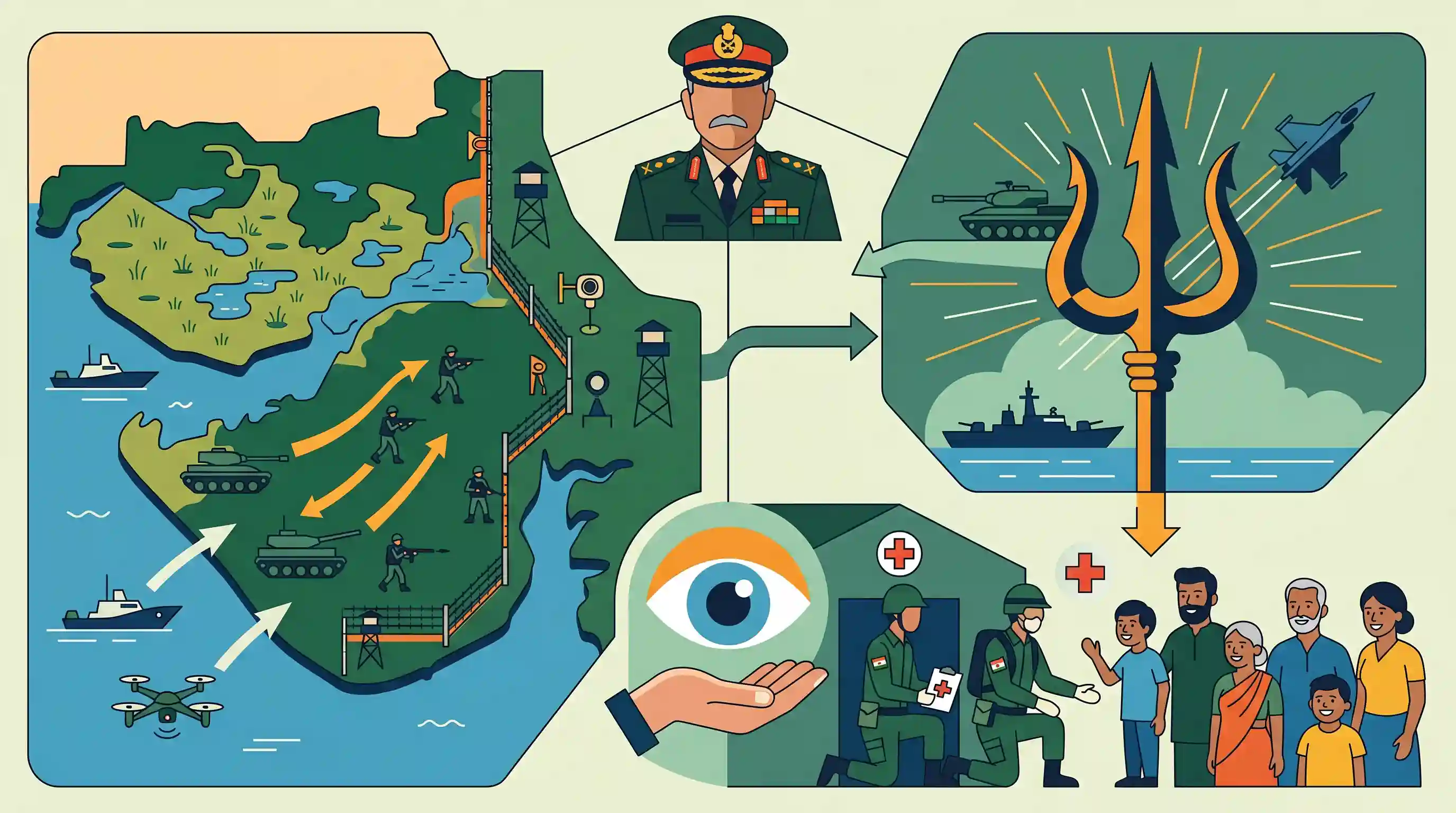
Southern Army Commander Lt Gen Dhiraj Seth conducted a comprehensive operational review of the strategically critical Creek and Kutch sectors in Gujarat, overseeing the multi-agency 'Defence of Gujarat Exercise'. This exercise validated rapid response and coordination in the challenging marshy terrain of the Rann of Kutch and Sir Creek, areas prone to infiltration. Alongside military readiness, the Army reinforced its commitment to border communities by organizing a mega surgical eye camp at Bhuj Military Station. The review underscored the Armed Forces' comprehensive approach to border management, balancing multi-domain operational readiness—as demonstrated in last year's tri-services 'Exercise Trishul'—with targeted civic action to win local support.
Key Points
- Southern Army Commander Lt Gen Dhiraj Seth reviewed operational readiness in Gujarat's Creek and Kutch sectors, overseeing the multi-agency 'Defence of Gujarat Exercise'.
- The Army organized a mega surgical eye camp at Bhuj Military Station for remote villages, emphasizing its civic action and welfare role in border areas.
- The marshy terrain and tidal creeks of the Rann of Kutch and Sir Creek pose significant border management challenges and increase infiltration risks.
- The event recalls the prior 'Exercise Trishul', which validated full-spectrum land-sea-air integration, cyber, drone, and amphibious combat capabilities.
Important Terms
Exercise Trishul

A massive tri-services military exercise conducted in the Kutch and Creek sectors to validate joint operations, multi-domain readiness, and inter-service coordination across land, sea, air, and cyber domains.
UPSC context
Relevant for GS Paper III (Internal Security/Security Forces); tests knowledge of jointness and integrated theater commands in the Indian Armed Forces.
Sir Creek
A 96-km long tidal estuary in the Rann of Kutch between India and Pakistan; its unresolved maritime boundary is a major strategic and security flashpoint prone to infiltration.
UPSC context
Critical for GS Paper II (International Relations) and III (Internal Security); involves the 'Thalweg Principle' and maritime boundary disputes.
Southern Command
One of the seven commands of the Indian Army, headquartered in Pune; it is responsible for the security of India’s southern and western land borders, including Gujarat and Rajasthan.
UPSC context
GS Paper III (Security Forces); tests understanding of the geographical jurisdiction and operational roles of the Indian Army's command structure.
Defence of Gujarat Exercise
A multi-agency domestic exercise designed to validate rapid response, inter-departmental coordination, and operational readiness specifically within the diverse and challenging marshy terrains of Gujarat.
UPSC context
GS Paper III (Internal Security); relates to border management and the integration of civil-military agencies for territorial integrity.
Civic Action Programmes
Strategies used by the military to improve relations with local populations in sensitive border areas through community outreach, such as medical camps, to counter insurgency and infiltration.
UPSC context
GS Paper III (Border Management); essential for the 'Winning Hearts and Minds' (WHAM) strategy and internal security stability.
Army Hospital (Research and Referral)
The premier multi-specialty research and referral hospital of the Indian Armed Forces in New Delhi, providing specialized tertiary care and support for high-end medical outreach.
UPSC context
GS Paper III; represents the apex of the Indian Army’s medical services and its role in humanitarian assistance and disaster relief.
Prelims Trap
The Thalweg doctrine grants the entire navigable water body of a border estuary to the state on its eastern bank.
The Thalweg doctrine actually dictates that a boundary follows the mid-channel of a navigable water body. This is India's stance, dividing Sir Creek, not giving it entirely to one side.
Static Concepts Connected
What is the core contention in the Sir Creek dispute and the Thalweg Principle?
- Disputed Estuary: A 96-km tidal estuary in the Rann of Kutch where India and Pakistan contest the maritime and land boundary alignment.
- Thalweg Doctrine: An international law principle stating river boundaries are drawn at the mid-channel. India relies on this to claim a mid-channel boundary in the creek.
- Historical Maps: Pakistan cites a 1914 resolution (claiming the eastern bank), while India cites a 1925 map depicting mid-channel boundary pillars.
What are the structural challenges of border management in the Kutch sector?
- Topographical Hurdles: Shifting sandbanks, extreme tidal variations, and marshy terrain make conventional physical fencing and round-the-clock foot patrolling practically impossible.
- Multi-agency Overlap: Securing this porous region requires coordination across the BSF (creeks), Coast Guard (coastal), Marine Police, and Indian Navy, which can complicate command structures.
- Civic Action Integration: Military welfare initiatives build local trust, effectively integrating border communities into the intelligence network to detect and prevent cross-border infiltration.
Cross-Topic Patterns
Joint exercises & Theatre Commands
Multi-domain drills like 'Exercise Trishul' validate tri-service interoperability, laying the practical groundwork for India's transition to Integrated Theatre Commands as recommended by the Shekatkar Committee.
Civic Action & Vibrant Villages
Military civic action camps mirror the strategic goals of the Vibrant Villages Programme: improving border services to prevent out-migration and securing local populations as the 'first line of defense'.

Expect a Prelims 2026 mapping question matching the 'Thalweg principle' of Sir Creek with other contested global riverine borders.
Linked PYQs · 5
Linked PYQs · 5
- 2016MainsGS3
Border management is a complex task due to difficult terrain and hostile relations with some countries. Elucidate the challenges and strategies for effective border management.
- 2020MainsGS3
For effective border area management, discuss the steps required to be taken to deny local support to militants and also suggest ways to manage favourable perception among locals.
- 2024MainsGS3
India has a long and troubled border with China and Pakistan fraught with contentious issues. Examine the conflicting issues and security challenges along the border. Also give out the development being undertaken in these areas under the Border Area Development Programme (BADP) and Border Infrastructure and Management (BIM) Scheme.
- 2020MainsGS3
Analyze internal security threats and transborder crimes along Myanmar, Bangladesh and Pakistan borders including Line of Control (LoC). Also discuss the role played by various security forces in this regard.
- 2023MainsGS3
The use of unmanned aerial vehicles (UAVs) by our adversaries across the borders to ferry arms/ammunitions, drugs, etc., is a serious threat to the internal security. Comment on the measures being taken to tackle this threat.
