ASEAN Summit Myanmar Crisis and Regional Diplomacy
Source:The Hindu ↗
Why It Matters
Crucial for understanding India's neighborhood policy, regional security architectures, and the efficacy of multilateral groupings like ASEAN in handling internal state conflicts.
Summary
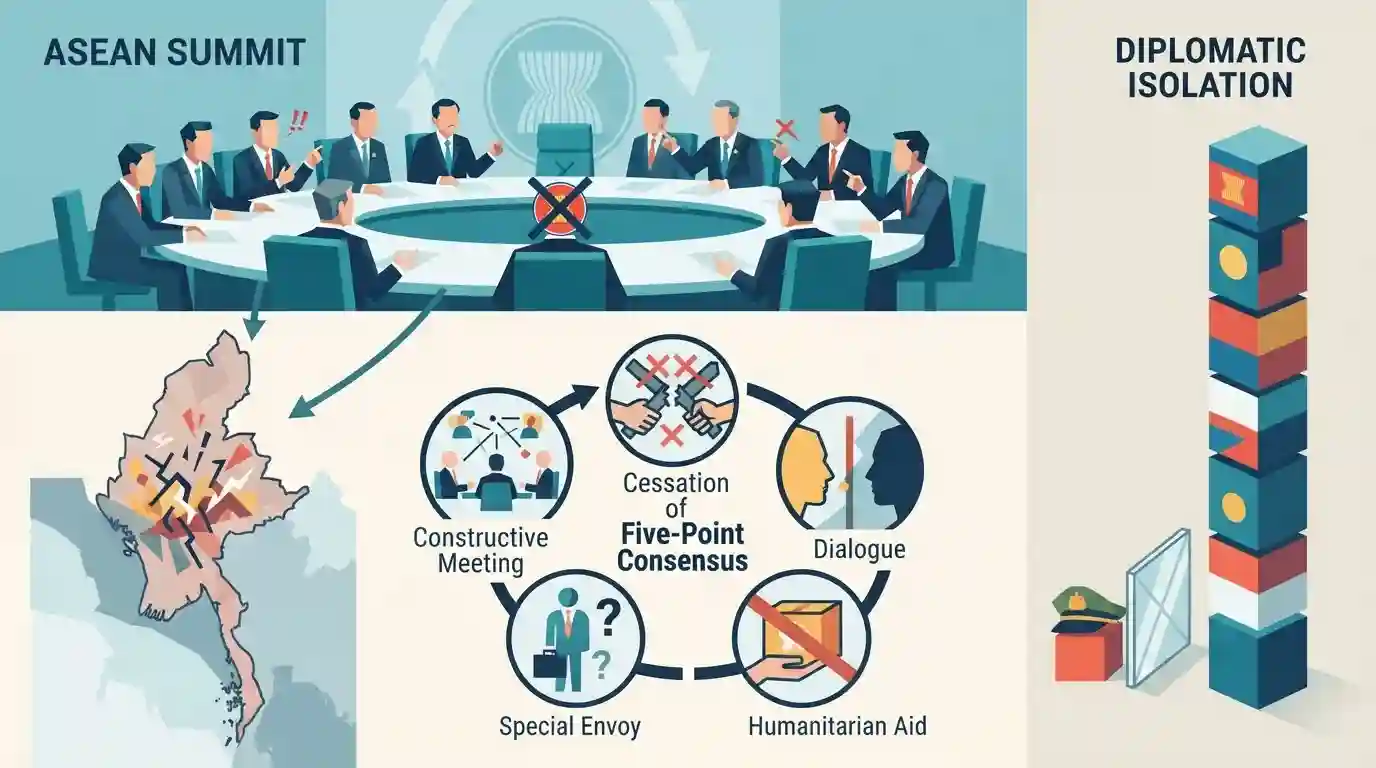
Southeast Asian leaders at an ASEAN summit strongly denounced the ongoing violence in Myanmar and decided to extend the ban on the participation of the nation's military leader. The regional bloc continues to grapple with the political and humanitarian crisis following the 2021 military coup, insisting on the stalled Five-Point Consensus peace plan while maintaining diplomatic isolation of the junta.
Key Points
- Southeast Asian leaders denounced ongoing violence in Myanmar and extended the ban on its military junta leader from high-level summits.
- ASEAN maintains its firm stance over the implementation of the Five-Point Consensus to resolve the political crisis in Myanmar.
- The military government continues to face regional diplomatic isolation due to its refusal to comply with peace efforts.
Important Terms
Five-Point Consensus

A peace plan adopted by ASEAN in April 2021 comprising an immediate cessation of violence, constructive dialogue, humanitarian assistance, an ASEAN special envoy, and a visit to Myanmar.
UPSC context
Important for GS Paper II (International Relations - Regional Groupings). Tests ASEAN's diplomatic efficacy, principle of non-interference, and crisis management in Southeast Asia.
ASEAN
Association of Southeast Asian Nations is a geo-political and economic regional organization comprising ten Southeast Asian member states, promoting intergovernmental cooperation and economic integration.
UPSC context
Core topic in GS Paper II (International Relations). Frequently featured regarding India’s Act East Policy, Indo-Pacific security architecture, and regional economic partnerships.
Myanmar military junta
The military administration that seized power in Myanmar through the February 2021 coup, displacing the democratically elected government and facing widespread domestic resistance and international isolation.
UPSC context
Relevant for GS Paper II (International Relations, global security, humanitarian crises) and internal security issues concerning India-Myanmar border stability and refugees.
Prelims Trap
ASEAN's legally binding Five-Point Consensus mandates the immediate military disarmament of Myanmar's junta.
Aspirants often assume ASEAN's Five-Point Consensus is a legally binding treaty or enforcement mechanism, whereas ASEAN decisions rely strictly on consensus and lack coercive power.
Static Concepts Connected
What are the foundational principles and institutional features of ASEAN?
- Founding Document: Established via the Bangkok Declaration (1967) by Indonesia, Malaysia, Philippines, Singapore, and Thailand.
- Core Principle: Operates strictly on consensus decision-making and non-interference in internal affairs, often termed the 'ASEAN Way'.
- Institutional Limit: Unlike the EU, ASEAN lacks supranational authority or binding enforcement mechanisms over its member states.
Cross-Topic Patterns
ASEAN Non-Interference vs. India's Act East Policy
ASEAN's strict adherence to non-interference contrasts sharply with India's Act East policy and selective engagement with Myanmar's junta for border security and Kaladan transit projects.
ASEAN Consensus Paralysis and SAARC Gridlock
The paralysis of ASEAN's consensus model in Myanmar mirrors SAARC's institutional gridlock caused by bilateral friction, testing regional multilateralism.

Expect a statement-based question evaluating ASEAN's Five-Point Consensus and structural limits of the principle of non-interference.
Linked PYQs · 1
Linked PYQs · 1
- 2023MainsGS2
‘Virus of Conflict is affecting the functioning of the SCO’ In the light of the above statement point out the role of India in mitigating the problems.
