South Korea Constitutional Crisis and Presidential Impeachment
Source:The Hindu ↗
Why It Matters
The South Korean constitutional crisis provides an excellent contemporary case study for UPSC aspirants studying comparative constitutions (GS Paper 2). It contrasts the mechanisms of martial law, presidential impeachment, and the role of constitutional courts across different democracies, offering practical insights into how constitutional safeguards function during political emergencies.
Summary
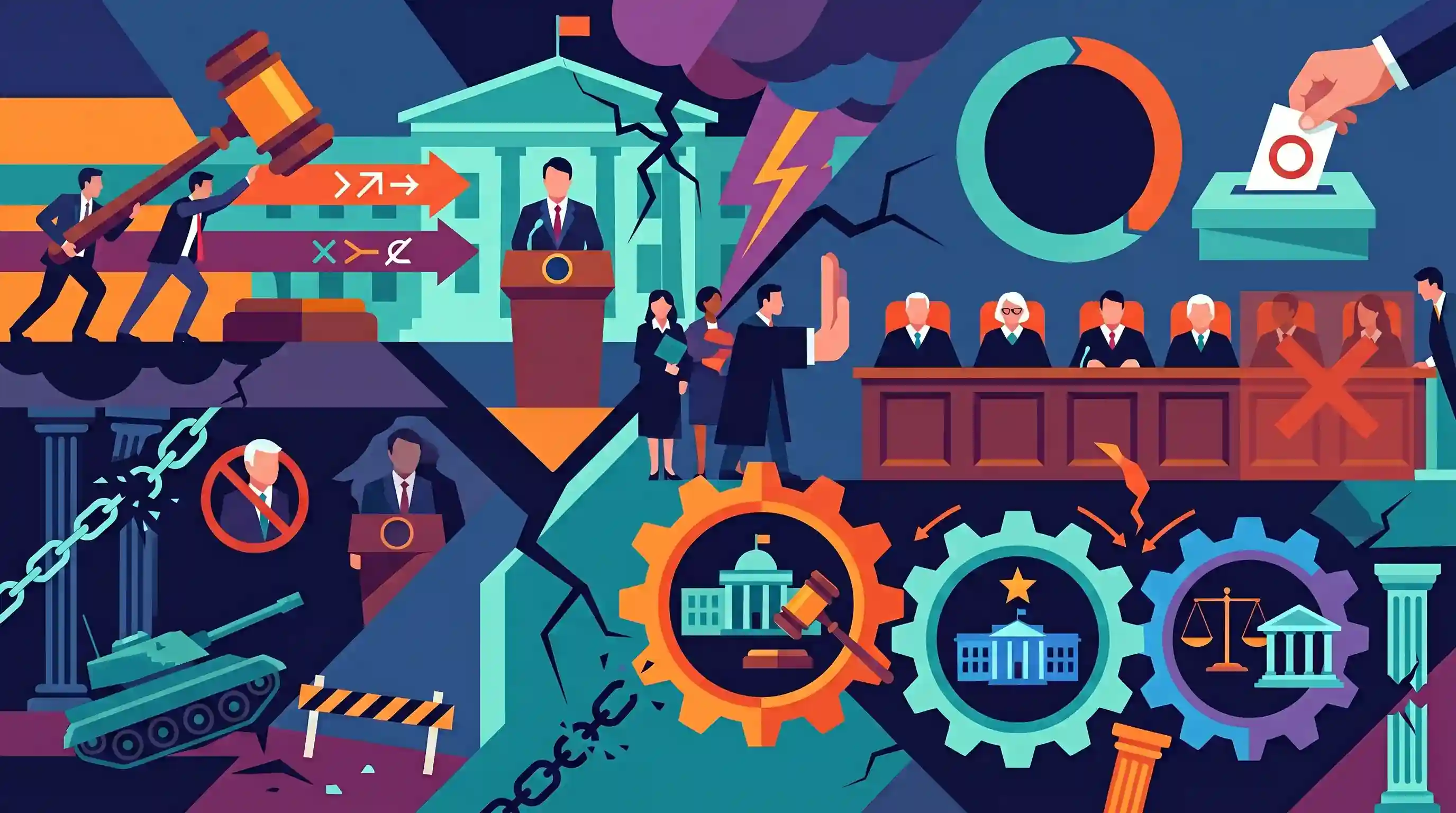
South Korea's political turmoil has escalated into a profound constitutional crisis as the opposition Democratic Party moves to impeach acting President Han Duck-soo. The opposition accuses Han of refusing to appoint three new justices to the Constitutional Court, which is currently presiding over the impeachment trial of suspended President Yoon Suk Yeol following his brief, unconstitutional declaration of martial law. The delay in judicial appointments threatens to paralyze the court, as South Korean law requires six justices to agree on a president's removal, meaning the current bench would need to vote unanimously. This crisis serves as a stark example of the vulnerabilities in the separation of powers and the importance of judicial independence in maintaining democratic order.
Key Points
- South Korea's opposition Democratic Party introduced a bill to impeach acting President Han Duck-soo over his refusal to appoint three Constitutional Court justices.
- The Constitutional Court is currently trying the impeachment of suspended President Yoon Suk Yeol for his December 3 declaration of martial law.
- Under South Korean law, six justices must agree to remove an impeached president; with three vacancies, the remaining justices would have to vote unanimously, raising the stakes for the new appointments.
- If acting President Han is impeached, the Finance Minister will assume the acting presidency, further complicating the executive leadership vacuum.
- The situation highlights critical issues of comparative constitutional law, including emergency powers, judicial independence, and the separation of powers.
Important Terms
Constitutional Court of South Korea

An independent apex court in South Korea that adjudicates constitutional issues, including the final trial and confirmation of presidential impeachments passed by the National Assembly.
UPSC context
GS Paper II: Comparative Constitution. Tests understanding of specialized judicial review models compared to India's unified judiciary.
Impeachment (South Korea)
The legal process of removing high officials; in South Korea, it requires a 2/3 parliamentary majority followed by a trial and confirmation by the Constitutional Court.
UPSC context
GS Paper II: Comparison of constitutional schemes. Tests differences in executive removal processes between South Korea and India.
Martial Law (Article 77)
A constitutional provision (Article 77) allowing the President to declare military rule in emergencies, which must be lifted if the National Assembly demands it by majority vote.
UPSC context
GS Paper II: Emergency Provisions. Comparison with India’s Article 34 and the lack of a defined 'martial law' in the Indian Constitution.
Democratic Party of Korea (DPK)
South Korea's major liberal political party, currently the parliamentary majority, which initiated the impeachment motions against President Yoon Suk Yeol and Acting President Han Duck-soo.
UPSC context
GS Paper II: Political parties and governance. Relevant for understanding the role of opposition in a presidential-parliamentary hybrid system.
People Power Party (PPP)
The conservative political party of suspended President Yoon Suk Yeol, which often clashes with the liberal DPK over governance, judicial appointments, and national security policies.
UPSC context
GS Paper II: Comparative Politics. Tests knowledge of political dynamics in key Asian democracies affecting bilateral relations with India.
Separation of Powers
A constitutional doctrine dividing government authority; the current South Korean crisis illustrates tensions between executive actions (martial law) and judicial/legislative checks.
UPSC context
GS Paper II: Constitutional Framework. Tests the ability to analyze global examples of constitutional breakdowns and institutional friction.
Prelims Trap
The Supreme Court of India adjudicates the final removal of the President during the impeachment process.
India's presidential impeachment (Article 61) is a purely legislative, quasi-judicial process in Parliament. The judiciary has no role, contrasting sharply with South Korea where a Constitutional Court decides.
Static Concepts Connected
How is the impeachment of the Indian President structured under Article 61?
- Grounds: Violation of the Constitution is the sole, explicitly stated ground for impeachment.
- Special Majority: A two-thirds majority of the total membership of both Houses of Parliament is required, making it exceptionally stringent.
- Electoral College difference: Nominated members of Parliament can vote, but elected members of State Legislative Assemblies do not participate.
How does Martial Law (Article 34) differ from National Emergency (Article 352) in India?
- Constitutional Definition: Martial Law is implicitly enabled but nowhere defined in the Constitution, whereas National Emergency is comprehensively detailed under Article 352.
- Government Functioning: Martial Law suspends ordinary law and civil government entirely, whereas during a National Emergency, the civil government and ordinary courts continue to function.
- Scope of Impact: Martial law restricts only Fundamental Rights, whereas an Emergency alters Centre-State relations, legislative powers, and revenue distribution.
Cross-Topic Patterns
Presidential succession and legislative gaps
South Korea's succession to the Finance Minister mirrors India's President (Discharge of Functions) Act, 1969, which empowers the Chief Justice of India to act as President if the VP is also unavailable.
Judicial primacy vs. Executive control
The paralysis of South Korea's court by the executive withholding judges vividly illustrates the rationale behind India's Collegium system, designed to insulate judicial appointments from executive hostage-taking.

Expect a comparative GS2 Mains question on executive accountability, contrasting India's Art 61 impeachment with judicial models.
Linked PYQs · 2
Linked PYQs · 2
- 2023MainsGS2
“Constitutionally guaranteed judicial independence is a prerequisite of democracy.” Comment.
- 2025MainsGS2
Compare and contrast the President's power to pardon in India and in the USA. Are there any limits to it in both the countries? What are 'preemptive pardons'?
