South Korea China Summit Tests East Asian Strategic Balance
Source:The Hindu ↗
Why It Matters
South Korea's strategy to balance the US (security) and China (economy) offers a critical case study in strategic autonomy amidst superpower competition in the Indo-Pacific. Additionally, stability in the Taiwan Strait and the Korean Peninsula directly affects global supply chains and broader Indo-Pacific security dynamics, which are increasingly relevant to India's foreign policy.
Summary
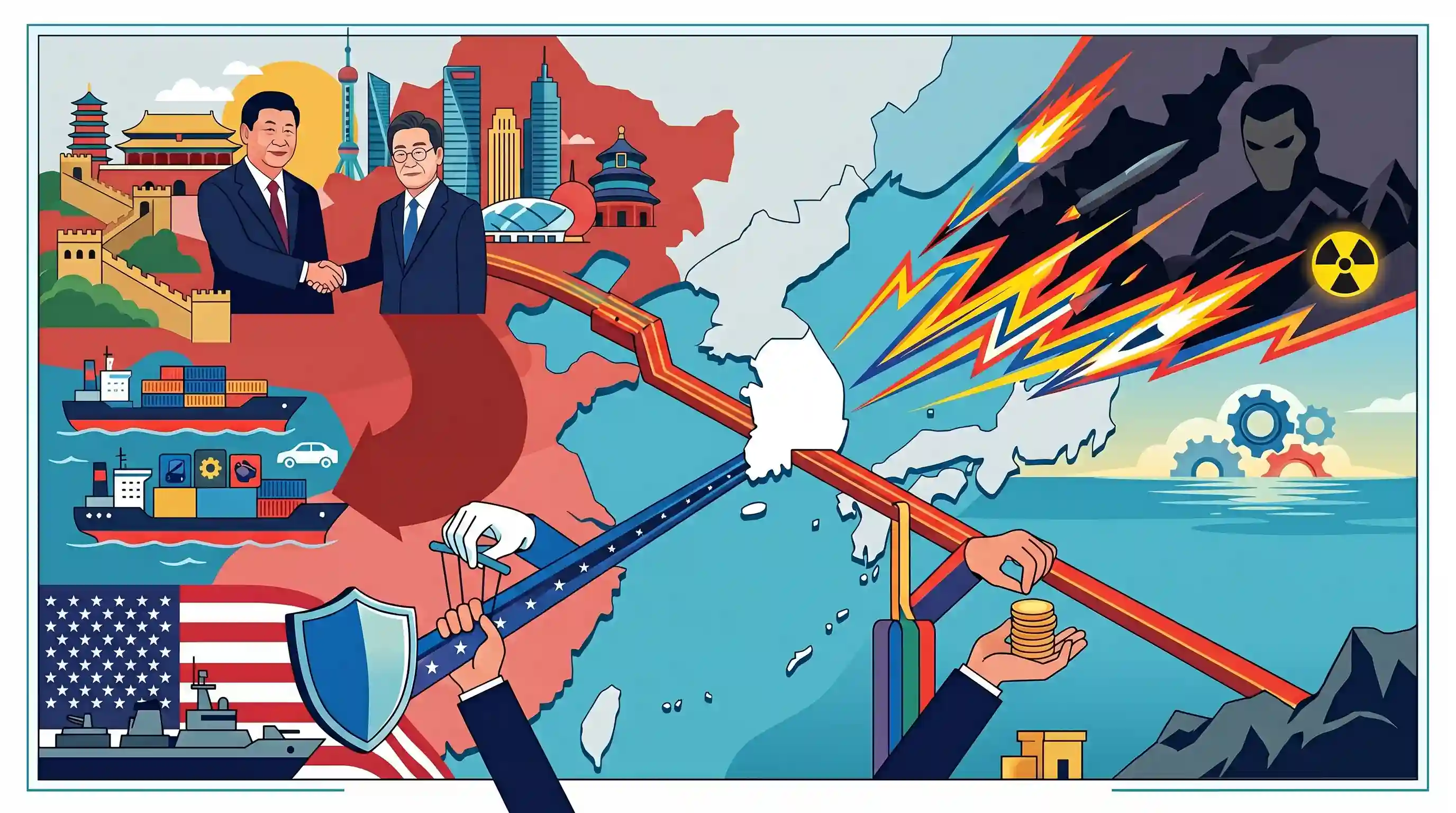
South Korean President Lee Jae-myung met with Chinese President Xi Jinping in Beijing, the first such state visit by a South Korean leader in six years. The summit took place under the shadow of North Korea's recent hypersonic ballistic missile tests and heightened nuclear rhetoric. The visit highlights South Korea's complex diplomatic strategy: balancing its essential security alliance with the United States against deep economic interdependence with China, its largest trading partner. Accompanied by executives from major conglomerates like Samsung and Hyundai, Lee sought to revitalize bilateral trade and requested Beijing's leverage to temper North Korean aggression. Regionally, Lee adopted a cautious approach, affirming the 'one-China' principle and remaining neutral on Taiwan Strait tensions, illustrating Seoul's imperative to maintain stability in Northeast Asia.
Key Points
- South Korean President Lee Jae-myung held a summit with Chinese President Xi Jinping in Beijing, marking the first visit by a South Korean leader in six years.
- The high-stakes meeting occurred immediately after North Korea fired hypersonic ballistic missiles and escalated nuclear threats.
- South Korea aims to navigate a delicate geopolitical balance, sustaining economic ties with its top trading partner (China) while relying on the United States for security guarantees.
- Lee's delegation included leaders from top South Korean conglomerates, underscoring an agenda focused on reviving economic engagement and securing supply chains with Chinese tech and automotive firms.
- Diplomatically, South Korea refrained from joining international condemnation of China's recent military drills around Taiwan, with Lee reaffirming respect for the 'one-China' principle to avoid antagonizing Beijing.
Important Terms
One-China principle

A diplomatic position asserting there is only one sovereign state under the name 'China.' Beijing maintains that the PRC is the sole legitimate government and Taiwan is an inalienable part.
UPSC context
GS Paper II (IR); critical for understanding the Taiwan Strait tensions, China's core interests, and India's balanced diplomatic engagement in East Asia.
CATL
The world's largest manufacturer of lithium-ion batteries for electric vehicles (EVs). Based in China, it dominates the global supply chain for green energy storage technology.
UPSC context
GS Paper III (Economy/Environment); tests knowledge of global EV supply chains, critical mineral dependencies, and India’s efforts toward self-reliance in battery manufacturing.
Samsung
A major South Korean multinational conglomerate (Chaebol) and global leader in semiconductors. It plays a pivotal role in the global electronics and technology value chain.
UPSC context
GS Paper III (Economy); relevant to India's Semiconductor Mission, FDI, and the 'Make in India' initiative within the electronics sector.
Huawei
A Chinese multinational technology firm specializing in telecommunications and consumer electronics. It has been a central figure in global debates over 5G security and tech decoupling.
UPSC context
GS Paper III (Internal Security/S&T); involves concepts like 'Clean Network,' telecom infrastructure security, and the US-China technological rivalry.
Hyundai
A South Korean automotive giant with significant manufacturing operations in India. It is a key player in the transition toward electric and smart urban mobility solutions.
UPSC context
GS Paper III (Economy); highlights successful Foreign Direct Investment (FDI) and the growth of India’s automobile manufacturing hub under the PLI scheme.
Prelims Trap
India explicitly endorses the One-China Principle in all its bilateral joint statements with Beijing.
India follows a 'One-China Policy' (acknowledging the claim), not the 'One-China Principle' (Beijing's absolute claim). India has deliberately omitted mentioning it in joint statements since 2010.
Static Concepts Connected
How do Hypersonic Glide Vehicles (HGVs) differ from traditional Ballistic Missiles?
- Flight Trajectory: Ballistic missiles follow a predictable, unpowered parabolic arc. HGVs detach and glide through the upper atmosphere with highly unpredictable flight paths.
- Maneuverability: HGVs can perform evasive maneuvers mid-flight while maintaining speeds above Mach 5, making them extremely difficult for existing defense systems to track and intercept.
What characterizes the 'Asian Paradox' in East Asian geopolitics?
- Economic vs Security: Regional states depend heavily on China for trade and economic growth, but rely predominantly on the United States for military alliances and security guarantees.
- Hedging Strategy: Nations like South Korea avoid hard alignment, balancing their US treaty alliance against the necessity of maintaining stable tech supply chains with Beijing.
Cross-Topic Patterns
Limits of 'China Plus One' strategy
South Korean conglomerates engaging Beijing shows that complete technological decoupling in semiconductors and EVs is currently impractical, challenging Western 'de-risking' narratives.
Missile defense vs. Economic coercion
North Korea's hypersonic tests may prompt upgraded US missile defenses (like THAAD) in Seoul, which historically triggered massive, undeclared Chinese economic boycotts against South Korean firms.

Expect a 2026 Prelims question contrasting the 'One-China Principle' and 'One-China Policy' alongside India's evolving stance on Taiwan.
Linked PYQs · 3
Linked PYQs · 3
- 2024MainsGS2
‘The West is fostering India as an alternative to reduce dependence on China's supply chain and as a strategic ally to counter China's political and economic dominance.’ Explain this statement with examples.
- 2023PrelimsGS1
Consider the following statements: 1. Ballistic missiles are jet-propelled at subsonic speeds throughout their flights, while cruise missiles are rocket-powered only in the initial phase of flight. 2. Agni-V is a medium-range supersonic cruise missile, while BrahMos is a solid-fuelled intercontinental ballistic missile. Which of the statements given above is/are correct?
- 2022PrelimsGS1
Which one of the following statements best reflects the idea behind the "Fractional Orbital Bombardment System" often talked about in media?
