Premature Menopause Risks Among South Asian Women
Source:The Hindu ↗
Why It Matters
This study highlights significant ethnic and geographical disparities in women's health. It underscores the critical need for Indian and global public health policies (GS2) to integrate gender-specific biological markers like premature menopause into cardiovascular screening and non-communicable disease management, moving beyond generalized healthcare approaches.
Summary
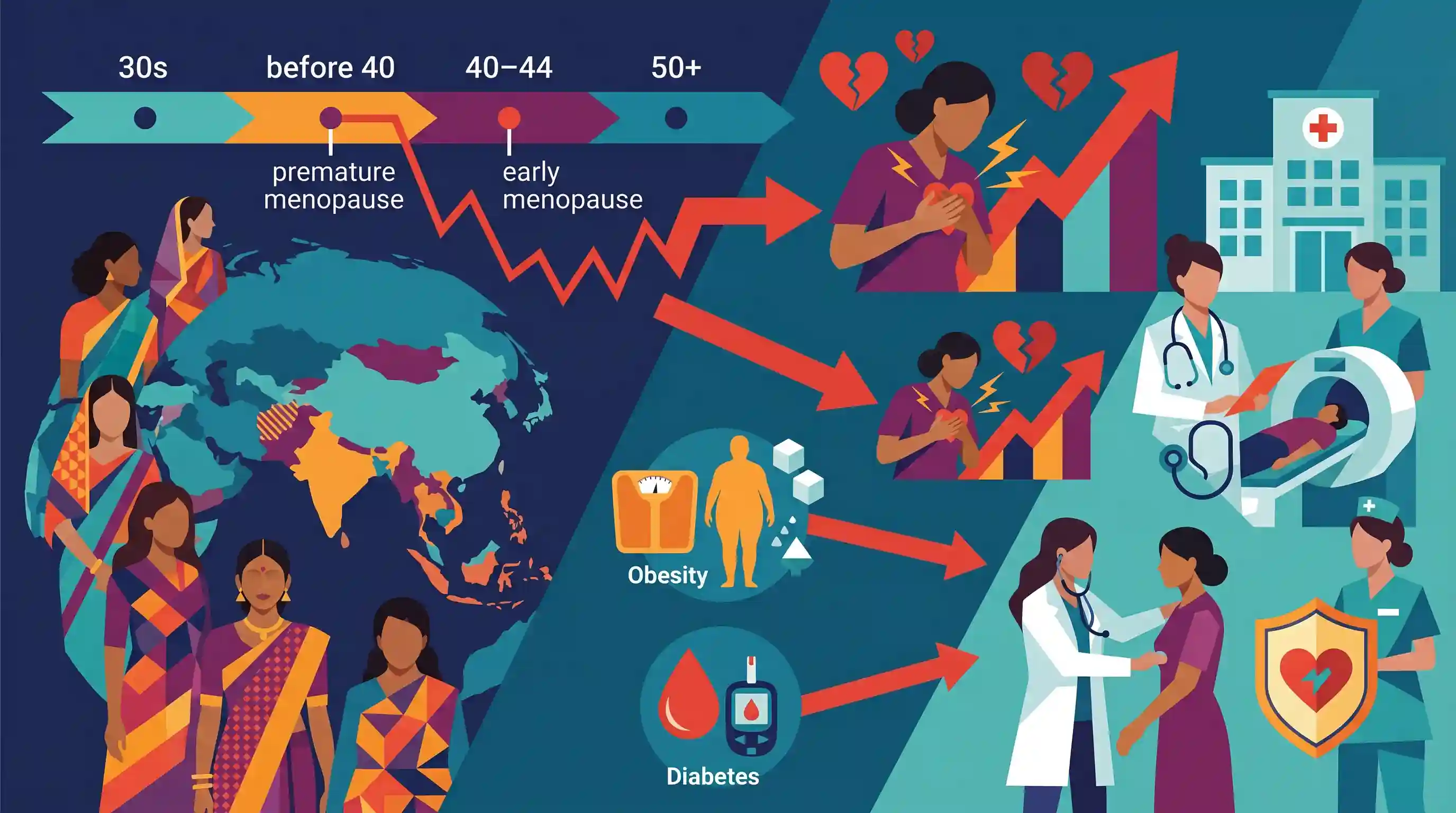
A study published in The Lancet Obstetrics, Gynaecology, and Women's Health reveals that South Asian women and women in low- and middle-income countries (LMICs) are at a significantly heightened risk for premature and early menopause. Based on the global Prospective Urban Rural Epidemiologic (PURE) study, the findings indicate that premature menopause (before age 40) increases the risk of major cardiovascular events like heart attacks or strokes by 27%, while early menopause (age 40-44) increases it by 14%. Importantly, these conditions serve as independent markers for cardiovascular risk globally, operating regardless of traditional risk factors like obesity or diabetes. The study emphasizes the necessity of targeted cardiovascular healthcare interventions for women experiencing early menopause.
Key Points
- South Asian women have a 34% higher risk of premature menopause compared to European women, and women in low and middle-income countries (LMICs) face a 53% increased risk.
- Premature menopause (before age 40) carries a 27% increased risk of major cardiovascular events like heart attacks and strokes, while early menopause (age 40-44) carries a 14% higher risk.
- In LMICs, half of the women reach menopause by the age of 47.5, which is three years earlier than the median age of 50.6 in high-income countries.
- Premature and early menopause serve as independent markers of higher cardiovascular risk, acting independently of traditional factors such as obesity, high blood pressure, and diabetes.
- The findings underline the urgent need for targeted cardiovascular risk management and specialized screening programs for women globally who undergo early menopause.
Important Terms
Premature Menopause

The cessation of ovarian function before the age of 40. It is often referred to medically as Premature Ovarian Insufficiency (POI).
UPSC context
GS Paper II (Social Justice/Health). Crucial for understanding gender-specific health vulnerabilities, reproductive rights, and shifting epidemiological patterns in India.
Prospective Urban Rural Epidemiologic (PURE) study
A landmark global longitudinal study examining the impact of environmental, societal, and biological factors on health outcomes across various income levels and urban-rural settings.
UPSC context
GS Paper II (Public Health). Demonstrates the role of large-scale, data-driven research in framing global and national health policies.
Non-Communicable Diseases (NCDs)
Chronic conditions such as heart disease, stroke, cancer, and diabetes that are not passed from person to person and typically progress slowly.
UPSC context
GS Paper II (Health). Tests knowledge on India’s "silent epidemic" and the transition from infectious to lifestyle-related disease burdens.
Cardiovascular Diseases (CVDs)
A group of disorders of the heart and blood vessels, including coronary heart disease and stroke, which remain the leading cause of death globally.
UPSC context
GS Paper II (Health). Highlights the need for specialized diagnostic frameworks and preventive healthcare strategies within India’s public health infrastructure.
Low- and Middle-Income Countries (LMICs)
Economies classified by the World Bank based on Gross National Income (GNI) per capita; they bear a disproportionate burden of global health disparities.
UPSC context
GS Paper II (International Relations/Social Justice). Relevant for discussing health equity, developmental challenges, and international healthcare cooperation.
The Lancet
One of the world’s oldest and most prestigious independent weekly general medical journals, known for publishing high-impact public health research.
UPSC context
GS Paper II (Health). Frequently cited as a credible source for evidence-based policymaking and assessing global health trends.
Prelims Trap
Premature menopause increases cardiovascular disease risk only if coupled with traditional lifestyle factors like obesity or diabetes.
The study explicitly identifies early menopause as an independent physiological marker for cardiovascular risk, meaning it elevates risk regardless of traditional factors like obesity.
Static Concepts Connected
What is India's public health framework for tackling cardiovascular NCDs?
- NP-NCD framework: The National Programme for Prevention & Control of Non-Communicable Diseases (NP-NCD) drives health promotion, opportunistic screening, and management of CVDs at primary health centres.
- 75/25 Initiative: The Ministry of Health's ambitious target to screen and place 75 million people with hypertension and diabetes on standard care by 2025.
How does menopause biologically influence cardiovascular health in women?
- Estrogen depletion: Estrogen naturally maintains blood vessel flexibility and healthy lipid profiles. Its sharp decline during menopause accelerates arterial stiffening and plaque buildup.
- Metabolic shift: The hormonal transition promotes central adiposity (belly fat) and increases LDL cholesterol, amplifying ischemic heart disease vulnerabilities.
Cross-Topic Patterns
Gender data gaps in public health
Historical research often extrapolated male physiological responses to women. Studies like PURE emphasize the critical need for gender-disaggregated data to design targeted NCD interventions.
NCDs burdening LMIC demographic transitions
Earlier onset of NCDs and vulnerabilities like premature menopause in South Asia directly threaten female workforce participation and exacerbate out-of-pocket health expenditures.

Expect 2026 Prelims to link "independent markers" of CVDs (like menopause or South Asian genetics) with India's NP-NCD targets.
Linked PYQs · 2
Linked PYQs · 2
- 2024MainsGS2
In a crucial domain like the public healthcare system the Indian State should play a vital role to contain the adverse impact of marketisation of the system. Suggest some measures through which the State can enhance the reach of public healthcare at the grassroots level.
- 2020MainsGS2
In order to enhance the prospects of social development, sound and adequate health care policies are needed particularly in the fields of geriatric and maternal health care. Discuss.
