Monsoon onset patterns and urban flooding management challenges
Source:The Hindu ↗
Why It Matters
The monsoon is the lifeline of the Indian economy but also a major trigger for disasters. Understanding its changing patterns due to climate change, the distinction between pre-monsoon and monsoon rains, and the socio-economic impacts on agriculture and urban infrastructure is crucial for GS1 (Geography), GS3 (Economy/Disaster Management), and essay topics on urbanization.
Summary
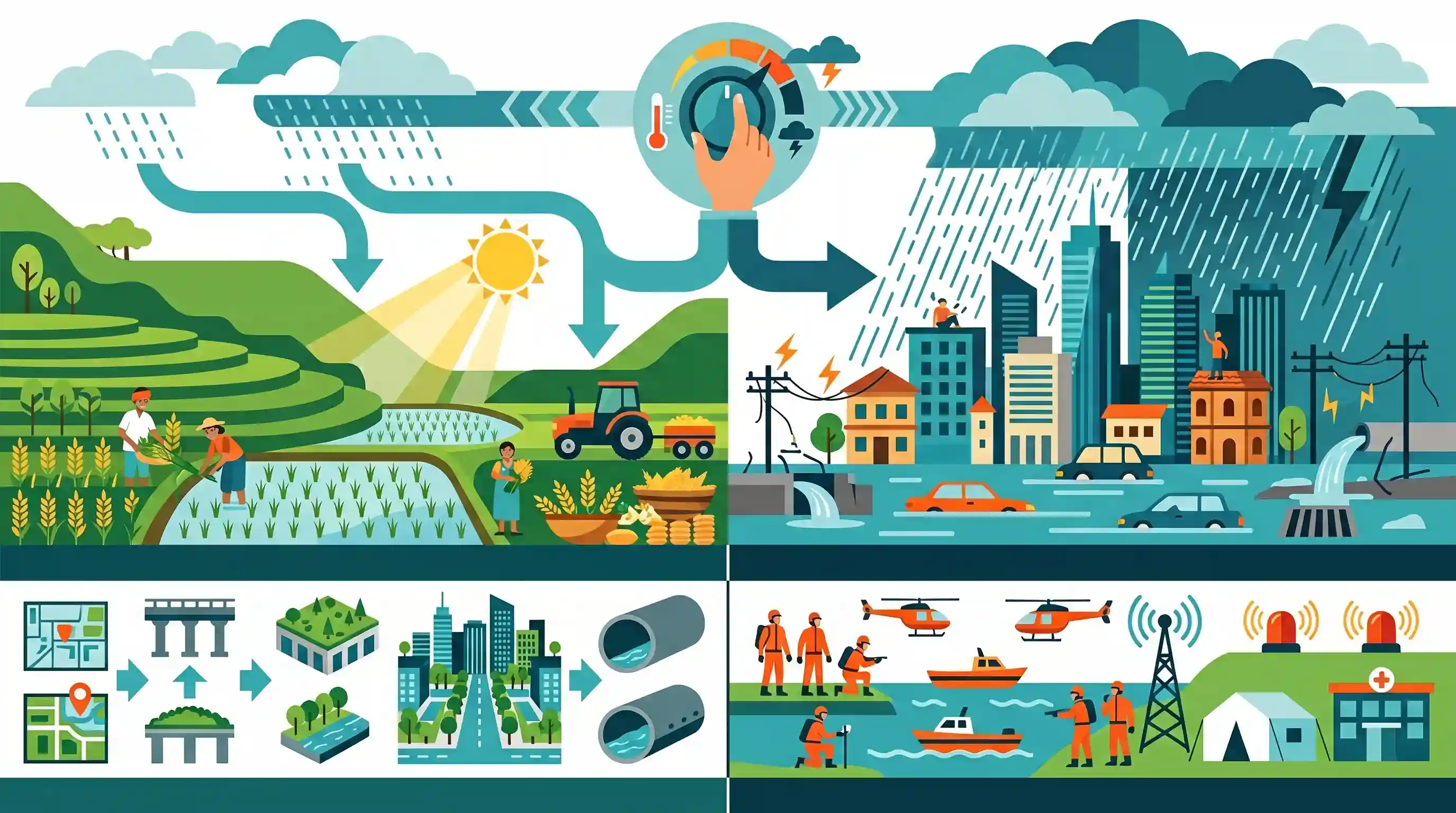
The early onset of the southwest monsoon brings positive prospects for India's agriculture but highlights the growing threat of urban flooding. With climate change causing erratic and intense rainfall, the focus must shift toward better urban planning and disaster management to mitigate disruptions across both major cities and smaller towns.
Key Points
- The southwest monsoon arrived in Kerala on May 24, a week ahead of its normal June 1 onset, driven by a pre-cyclonic circulation in the Arabian Sea.
- The India Meteorological Department (IMD) has forecast an 'above normal' monsoon season at 106% of the long-term average.
- A robust monsoon is positive for India's agricultural sector, aiding kharif sowing, bolstering food stocks, and supporting agricultural exports.
- Erratic rainfall patterns driven by climate change are increasing the frequency of urban flooding, which now affects tier-2 and tier-3 cities in addition to major metropolises.
- State and central administrations must integrate weather forecasts into urban planning and daily governance to mitigate disruptions caused by intense, short-duration rainfall.
Important Terms
Southwest Monsoon

Seasonal wind system from the Indian Ocean delivering ~75% of India's annual rainfall (June-September). It is the lifeline of the country's agrarian economy and water security.
UPSC context
GS Paper I (Geography: Mechanism) and GS Paper III (Agriculture and Economy). Tests understanding of climatic impacts on development.
India Meteorological Department (IMD)
The nodal government agency under the Ministry of Earth Sciences responsible for meteorological observations, weather forecasting, and tracking severe weather phenomena like cyclones and monsoons.
UPSC context
GS Paper III (Disaster Management/Institutions). Crucial for early warning systems and disaster preparedness mandates.
Urban Flooding
Inundation in built environments caused by heavy rainfall exceeding drainage capacity, often exacerbated by unplanned urbanization, loss of wetlands, and outdated infrastructure.
UPSC context
GS Paper I (Urbanization) and GS Paper III (Disaster Management). Focuses on man-made causes and resilient urban planning.
Disaster Management
The systematic process of planning and implementing measures for the prevention, mitigation, preparedness, response, and recovery from natural or man-made hazards.
UPSC context
GS Paper III (Major Sub-topic). Tests knowledge of the DM Act 2005 and institutional frameworks like NDMA.
Climate Change Adaptation
Adjustments in ecological, social, or economic systems in response to actual or expected climatic stimuli to moderate harm or exploit beneficial opportunities.
UPSC context
GS Paper III (Environment). Tests strategies to build resilience against erratic weather patterns and extreme events.
Prelims Trap
The IMD categorizes rainfall as 'above normal' when it exceeds 100% of the 100-year Long Period Average (LPA).
The LPA is based on a 50-year average (currently 1971-2020), not 100 years. 'Above normal' is specifically 104-110% of this LPA, not anything >100%.
Static Concepts Connected
How does the IMD classify seasonal monsoon rainfall using the LPA?
- Long Period Average: LPA is the average rainfall recorded over a 50-year period. The current LPA for the southwest monsoon is 87 cm.
- Normal: Rainfall between 96% and 104% of the LPA.
- Above Normal: Rainfall between 104% and 110% of the LPA.
- Excess: Rainfall greater than 110% of the LPA.
What are the key NDMA guidelines for managing Urban Flooding?
- Catchment Approach: Drainage planning must shift from administrative ward-based systems to a watershed and catchment-based approach.
- Desilting Deadlines: Pre-monsoon desilting of all major drains must be completed by March 31 each year to ensure optimal flow.
- Early Warning: Establishment of local Automatic Rain Gauges (ARGs) networks for real-time monitoring and rapid response.
Cross-Topic Patterns
Pre-monsoon cyclones and onset dynamics
Cyclonic circulations or Monsoon Onset Vortices (MOV) in the Arabian Sea can alter onset timelines, either pulling the monsoon forward or severely disrupting its moisture trajectory.
Concretization vs. Hydrological cycle
Rapid urbanization alters catchment hydrology by severely reducing soil infiltration, which increases peak flood discharge by up to eight times compared to rural baselines.

Expect a GS3 Mains question linking climate-induced intense rainfall bursts with the failure of ward-based drainage in tier-2/3 cities.
Linked PYQs · 4
Linked PYQs · 4
- 2015MainsGS1
How far do you agree that the behaviour of the Indian monsoon has been changing due to humanizing landscapes? Discuss.
- 2016MainsGS1
Major cities of India are becoming more vulnerable to flood conditions. Discuss.
- 2020MainsGS1
Account for the huge flooding of million cities in India including the smart ones like Hyderabad and Pune. Suggest lasting remedial measures.
- 2024MainsGS3
Flooding in urban areas is an emerging climate-induced disaster. Discuss the causes of this disaster. Mention the features of two such major floods in the last two decades in India. Describe the policies and frameworks in India that aim at tackling such floods.
