NPCI integration of UPI payments into ChatGPT via agentic AI framework
Source:Indian Express ↗
Why It Matters
It showcases the evolving status of digitalization in the Indian economy by merging its globally recognized UPI infrastructure with cutting-edge Agentic AI, relevant for questions on technology applications, digital public goods, and cybersecurity.
Summary
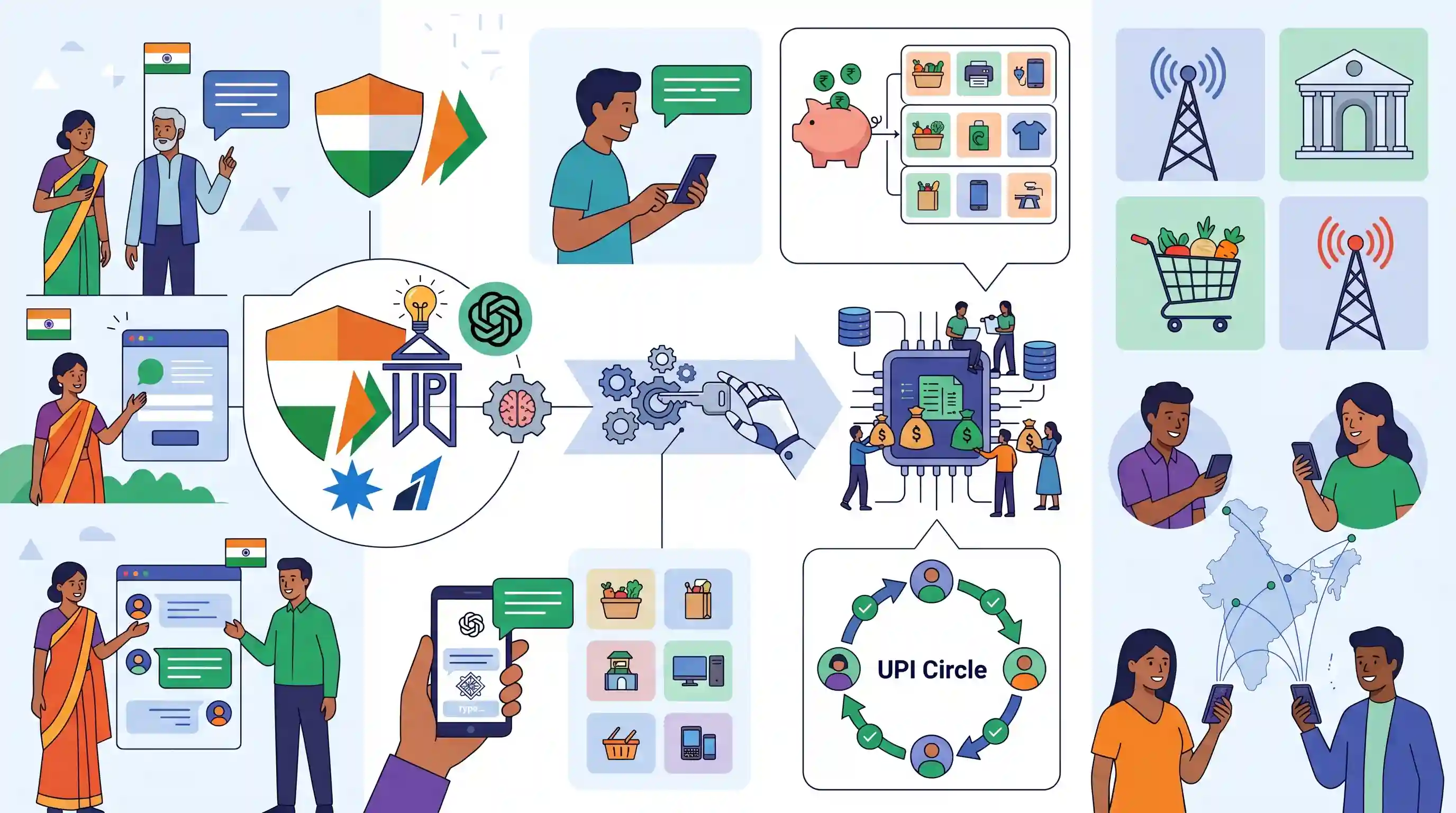
The National Payments Corporation of India (NPCI), in collaboration with OpenAI and Razorpay, is set to enable direct UPI payments through ChatGPT. The system leverages Razorpay's 'Agentic Payments' framework, allowing the AI to act as an agent to execute financial transactions based on user prompts. Innovative features such as 'reserve pay' (earmarking funds for specific merchants) and 'UPI Circle' (in-app transaction completion) will be introduced. Airtel Payments Bank, Axis Bank, BigBasket, and Vodafone Idea are among the early partners. This integration marks a significant milestone in combining India's digital public infrastructure with advanced Agentic Artificial Intelligence.
Key Points
- NPCI has partnered with OpenAI and Razorpay to facilitate direct UPI payments within the ChatGPT interface.
- The integration utilizes Razorpay's 'Agentic Payments', allowing the AI to process transactions on behalf of the user securely.
- New features include 'reserve pay' for earmarking funds for specific merchants and 'UPI Circle' to complete payments without leaving the app.
- Initial rollouts will involve banking partners like Airtel Payments Bank and Axis Bank, alongside platforms like BigBasket and Vodafone Idea.
- The move highlights the rapid adoption of Agentic AI in India's digital public infrastructure and financial ecosystem.
Important Terms
Unified Payments Interface (UPI)

A real-time instant payment system developed by NPCI, enabling inter-bank peer-to-peer (P2P) and person-to-merchant (P2M) transactions via mobile devices using a Virtual Payment Address (VPA) or QR codes.
UPSC context
GS Paper 3 (Economy/S&T); essential for understanding India’s digital economy, financial formalization, and technological self-reliance.
National Payments Corporation of India (NPCI)
An umbrella organization for operating retail payment and settlement systems in India. It is a not-for-profit initiative of the RBI and IBA established under the Payment and Settlement Systems Act, 2007.
UPSC context
GS Paper 3 (Economy); tests knowledge of the institutional architecture governing India’s digital financial infrastructure.
Digital Public Infrastructure (DPI)
Foundational digital systems (e.g., Aadhaar, UPI) built on open standards and APIs that facilitate large-scale delivery of public and private services while fostering inclusive growth and innovation.
UPSC context
GS Paper 3 (S&T/Economy); central to discussions on the "India Stack," governance efficiency, and India’s global leadership in digital diplomacy.
Agentic Artificial Intelligence
Autonomous, goal-driven AI systems capable of planning and executing multi-step tasks independently with minimal human oversight, moving beyond content generation to acting as "autonomous employees."
UPSC context
GS Paper 3 (Science & Technology); relevant for emerging trends in AI, automation, and its socio-economic impact on the IT sector.
Financial Inclusion
The process of ensuring all individuals and businesses have access to useful, affordable, and sustainable financial services, such as payments, savings, credit, and insurance.
UPSC context
GS Paper 3 (Inclusive Growth); a core syllabus topic testing the effectiveness of digital tools in reaching unbanked populations.
UPI Circle
An NPCI feature allowing primary UPI users to delegate payment authority to secondary users (like dependents) who can make transactions from the primary account within set limits.
UPSC context
GS Paper 3 (Economy/S&T); tests knowledge of specific digital tools aimed at bridging the digital divide for the elderly and children.
Prelims Trap
"UPI Circle allows primary account holders to delegate unlimited payment access to secondary users or AI agents."
UPI Circle has strict, predefined monthly transaction limits (up to ₹15,000) set by the primary user. It is not an unlimited delegation.
Static Concepts Connected
What is the regulatory status and core mandate of the NPCI?
- Not-for-profit entity: Incorporated under Section 8 of the Companies Act; an initiative by the RBI and the Indian Banks' Association (IBA).
- Umbrella organization: Created to serve as the single umbrella organization for operating retail payments and settlement systems across India.
- Core innovations: Manages robust platforms like UPI, RuPay, Bharat BillPay, NETC (FASTag), IMPS, and the Aadhaar Enabled Payment System (AePS).
How does Agentic AI functionally differ from traditional Generative AI?
- Execution vs Generation: Generative AI primarily outputs passive content (text/images); Agentic AI independently executes complex, multi-step real-world workflows.
- Autonomous decision-making: Capable of planning, deciding, and taking corrective actions with minimal human supervision to achieve high-level goals.
- External tool usage: Operates as an active agent that can access and trigger external APIs, databases, and frameworks (like payment gateways).
Cross-Topic Patterns
India Stack 3.0: AI + DPI Integration
The merger of Agentic AI with UPI marks a shift from consent-based transactional DPI to intent-based autonomous DPI, expanding the utility of India Stack globally.
Financial Inclusion via Delegated Payments
Features like 'UPI Circle' bridge the digital divide by allowing banked individuals to delegate regulated payment access to unbanked dependents (minors/elderly), expanding grassroots financial inclusion.

Expect a 2026 Prelims multi-statement question contrasting Agentic AI's autonomy with Generative AI, paired with UPI Circle limits.
Linked PYQs · 5
Linked PYQs · 5
- 2017PrelimsGS1
Which of the following is a most likely consequence of implementing the 'Unified Payments Interface (UPI)'?
- 2017PrelimsGS1
Consider the following statements: 1. National Payments Corporation of India (NPCI) helps in promoting the financial inclusion in the country. 2. NPCI has launched RuPay, a card payment scheme. Which of the statements given above is/are correct?
- 2025PrelimsGS1
Consider the following countries : I. United Arab Emirates II. France III. Germany IV. Singapore V. Bangladesh How many countries amongst the above are there other than India where international merchant payments are accepted under UPI?
- 2023MainsGS3
What is the status of digitalization in the Indian economy? Examine the problems faced in this regard and suggest improvements.
- 2020PrelimsGS1
With the present state of development, Artificial Intelligence can effectively do which of the following? 1. Bring down electricity consumption in industrial units 2. Create meaningful short stories and songs 3. Disease diagnosis 4. Text-to-Speech Conversion 5. Wireless transmission of electrical energy Select the correct answer using the code given below:
