ED Submits Findings on National Herald Case to Court
Source:Indian Express ↗
Why It Matters
The case highlights the misuse of corporate structures (like Section 8/Section 25 not-for-profit companies) for potential financial irregularities and money laundering. It underscores the operational scope and mandate of the Enforcement Directorate under the PMLA in tackling high-profile economic offences, directly relevant to GS3 (Internal Security - Money Laundering) and GS2 (Statutory/Regulatory Bodies).
Summary
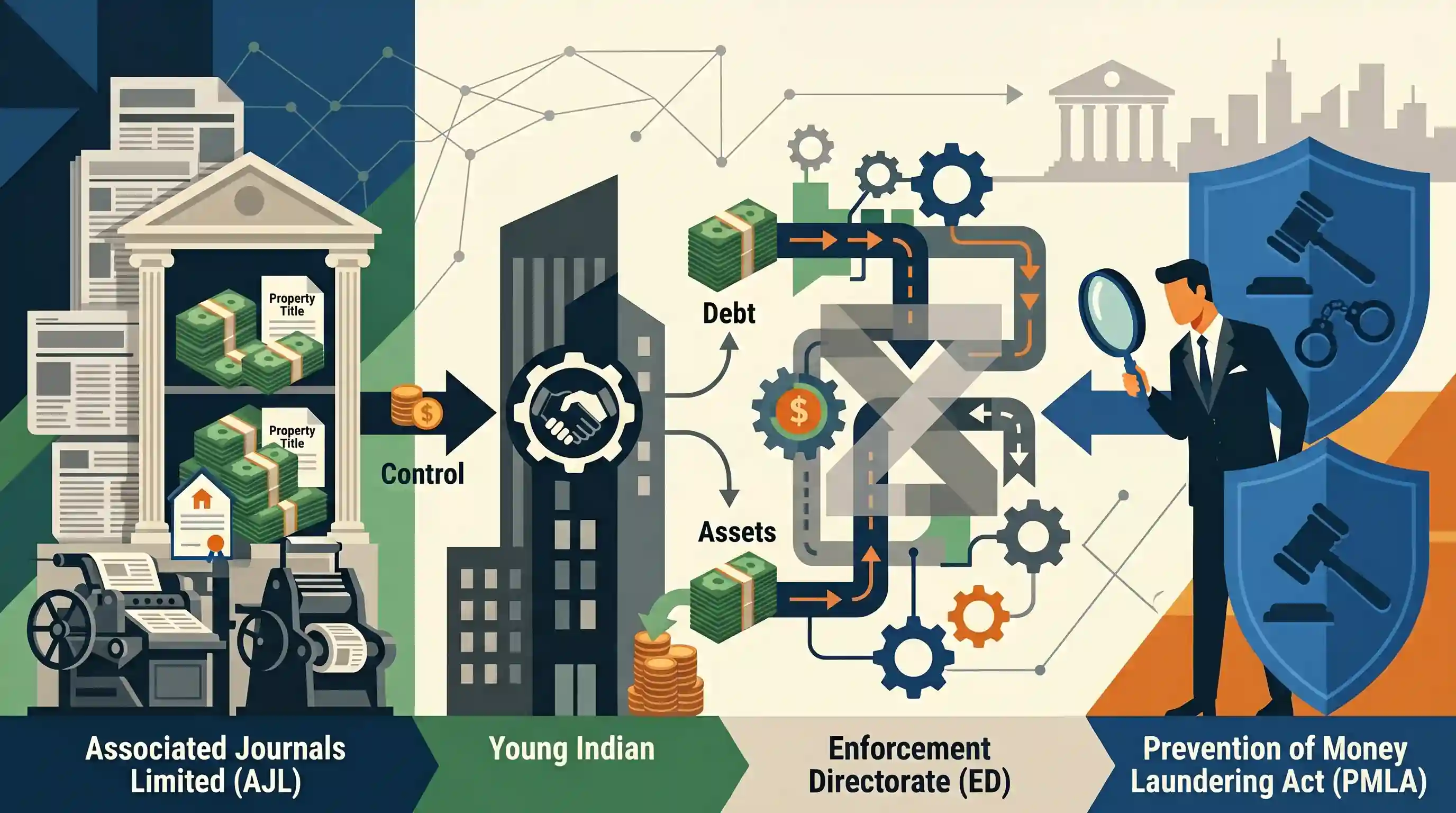
The Enforcement Directorate (ED) has submitted to a Delhi court that Congress leaders Sonia Gandhi and Rahul Gandhi established 'Young Indian', a Section 25 not-for-profit company, as a special purpose vehicle to usurp assets worth Rs 2,000 crore belonging to Associated Journals Limited (AJL). The allegations, forming the core of the National Herald case, suggest that complex corporate structures were utilized to mask money laundering activities under the Prevention of Money Laundering Act (PMLA).
Key Points
- The Enforcement Directorate (ED) informed a Delhi court that 'Young Indian' was created as a special purpose vehicle by Sonia and Rahul Gandhi to acquire Associated Journals Limited (AJL).
- The ED alleges the objective was to usurp AJL assets worth over Rs 2,000 crore under the guise of a not-for-profit Section 25 company.
- The submissions were made in connection with the ongoing National Herald money laundering investigation under the Prevention of Money Laundering Act (PMLA).
- The agency asserts that the transaction involved siphoning off funds and masking illicit financial activities through complex corporate structures.
Important Terms
Prevention of Money Laundering Act (PMLA)

An Indian law (2002) aimed at preventing money laundering, providing for confiscation of crime-derived property, and establishing special courts for prosecution.
UPSC context
GS Paper 3: Internal Security (Money Laundering) and GS Paper 2: Statutory Bodies. Tests understanding of legal frameworks against economic crimes.
Section 25 / Section 8 Company
Provisions (formerly Section 25 of 1956 Act) allowing formation of not-for-profit companies to promote commerce, art, or charity, prohibiting dividend distribution to members.
UPSC context
GS Paper 2: Governance and GS Paper 4: Corporate Governance. Tests knowledge of non-profit legal structures and regulatory compliance.
Enforcement Directorate (ED)
A specialized financial investigation agency under the Ministry of Finance that enforces the PMLA, FEMA, and Fugitive Economic Offenders Act.
UPSC context
GS Paper 2: Statutory/Regulatory Bodies. Vital for topics on institutional overreach, federalism, and enforcement of economic laws.
Associated Journals Limited (AJL)
A public company established in 1937 by Jawaharlal Nehru; it published the National Herald and holds significant real estate assets central to the current investigation.
UPSC context
GS Paper 2: Governance/Case Studies. Represents the intersection of political funding, corporate takeovers, and legal disputes over public assets.
Young Indian (YI)
A Section 25 not-for-profit company incorporated in 2010, allegedly used as a vehicle to acquire AJL's assets worth ₹2,000 crore via a loan-to-equity conversion.
UPSC context
GS Paper 4: Ethics and Corporate Governance. Tests understanding of 'Special Purpose Vehicles' and ethical standards in non-profit operations.
Prelims Trap
A Section 8 (formerly Section 25) non-profit company can distribute a capped percentage of profits as dividends to its founding members.
False. A strict statutory prohibition exists under the Companies Act. A Section 8 company cannot distribute any dividends; all profits must be reinvested to promote its objectives.
Static Concepts Connected
What are the foundational prerequisites for invoking the PMLA?
- Predicate Offence: A prior scheduled offence (e.g., corruption, cheating under IPC) must be registered by an agency like the CBI or state police.
- Proceeds of Crime: There must be property derived or obtained, directly or indirectly, as a result of criminal activity relating to the scheduled offence.
- Burden of Proof: Under Section 24 of the PMLA, the burden of proof is inverted; the accused must prove the untainted nature of the alleged proceeds.
What distinguishes a Section 8 Company (formerly Section 25) from standard private companies?
- Non-profit Objective: Formed exclusively to promote commerce, art, science, sports, education, or charity, rather than to generate personal profit.
- Dividend Prohibition: Absolutely prohibited from paying dividends to its members. All income must be applied solely toward promoting the company's objects.
- Winding-up Rules: Upon dissolution, remaining assets cannot be distributed to members; they must be transferred to another Section 8 company with similar objects.
Cross-Topic Patterns
Special Purpose Vehicles + Money Laundering
Complex corporate webs (like SPVs and Section 8 companies) masking asset transfers are frequently tested alongside the Benami Transactions Act and FATF recommendations on beneficial ownership.
ED vs. CBI mandate overlaps
UPSC frequently tests the administrative differences between agencies, contrasting ED's focus on economic offences (Dept of Revenue) with the CBI's broader mandate under the DSPE Act (DoPT).

The interplay between Section 8 corporate governance, 'beneficial ownership', and PMLA's predicate offence rule is a high-probability 2026 MCQ.
Linked PYQs · 3
Linked PYQs · 3
- 2021MainsGS3
Discuss how emerging technologies and globalisation contribute to money laundering. Elaborate measures to tackle the problem of money laundering both at national and international levels.
- 2025PrelimsGS1
With reference to the Government of India, consider the following information: Organization Some of its functions It works under I. Directorate of Enforcement Enforcement of the Fugitive Economic Offenders Act, 2018 Internal Security Division-I, Ministry of Home Affairs II. Directorate of Revenue Intelligence Enforces the Provisions of the Customs Act, 1962 Department of Revenue, Ministry of Finance III. Directorate General of Systems and Data Management Carrying out big data analytics to assist tax officers for better policy and nabbing tax evaders Department of Revenue, Ministry of Finance In how many of the above rows is the information correctly matched?
- 2021MainsGS2
The jurisdiction of the Central Bureau of Investigation (CBI) regarding lodging an FIR and conducting probe within a particular State is being questioned by various States. However, the power of the States to withhold consent to the CBI is not absolute. Explain with special reference to the federal character of India.
