Opposition Criticises Government Stance on Gaza Conflict
Source:Indian Express ↗
Why It Matters
The article offers a critical perspective on India\'s current foreign policy stance regarding the Israel-Palestine conflict. For UPSC aspirants, analyzing this critique is essential for understanding the complexities of navigating strategic partnerships (like with Israel) while balancing historical ties, human rights considerations, and broader global geopolitical shifts. It provides material for evaluating the ethical and strategic dimensions of foreign policy decisions.
Summary
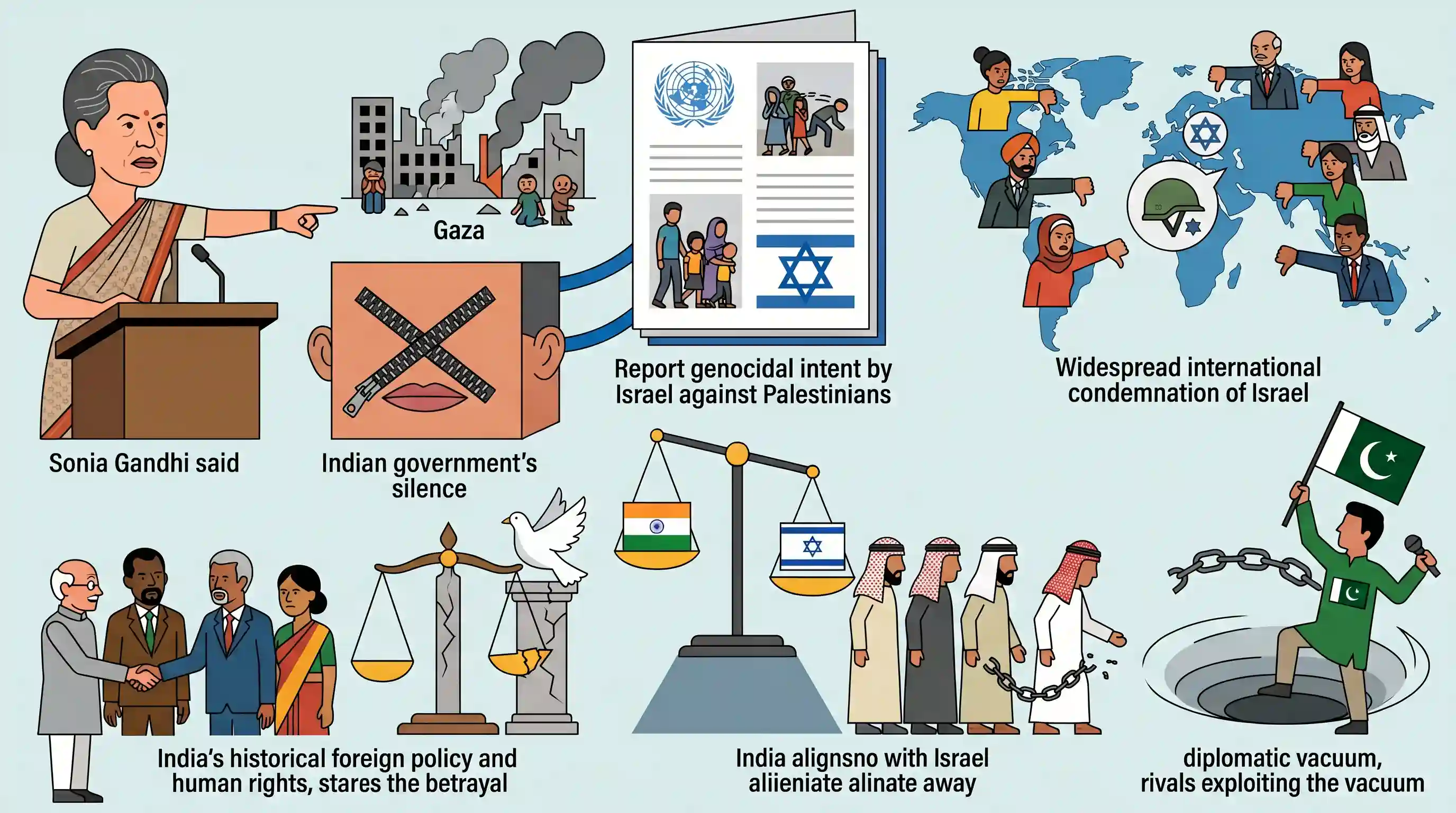
In this opinion piece, Congress Parliamentary Party chairperson Sonia Gandhi criticizes the Indian government\'s silence regarding the ongoing conflict in Gaza, particularly following a UN commission report outlining genocidal intent by Israel against Palestinians. She highlights the widespread international condemnation of Israel\'s actions and argues that India\'s failure to speak out betrays its historical commitment to postcolonial solidarity and human rights. Furthermore, she contends that aligning too closely with Israel is strategically unsound, alienating historical allies in the Middle East and creating a diplomatic vacuum that rivals like Pakistan are exploiting.
Key Points
- A UN Commission of Inquiry headed by retired Indian jurist S. Muralidhar reiterated findings that Israel\'s actions in Gaza demonstrate genocidal intent, highlighting the severe toll on children.
- The author criticizes the Indian government for maintaining silence on the issue, contrasting it with countries globally that have recognized Palestinian statehood, restricted arms sales to Israel, or severed ties.
- The article argues that India\'s silence contradicts its history of postcolonial solidarity and anti-colonialism.
- The author asserts that moving closer to Israel at this time is a poor strategic decision, alienating historical allies in the Middle East and allowing Pakistan to emerge as a mediator.
Important Terms
Genocide Convention of 1948

A 1948 UN treaty (effective 1951) defining genocide as acts intended to destroy a national, ethnic, racial, or religious group. It mandates states to prevent and punish such crimes.
UPSC context
Relevant for GS Paper 2 (International Treaties). India ratified it in 1959 but lacks specific domestic legislation to implement its provisions.
UN Independent International Commission of Inquiry on the Occupied Palestinian Territory
An independent body established by the UN Human Rights Council in 2021 to investigate violations of international humanitarian and human rights law in Israel and the occupied Palestinian territories.
UPSC context
GS Paper 2 (International Institutions). Chaired by former Indian Chief Justice S. Muralidhar, highlighting India's individual contributions to UN human rights mechanisms.
International Court of Justice (ICJ)
The principal judicial organ of the UN that settles legal disputes between member states (e.g., South Africa vs. Israel) and provides advisory opinions on international legal issues.
UPSC context
GS Paper 2 (International Bodies). Tests knowledge of state accountability versus individual criminal responsibility in the context of the Gaza conflict.
International Criminal Court (ICC)
An independent permanent court that prosecutes individuals for the gravest crimes of international concern: genocide, war crimes, crimes against humanity, and the crime of aggression.
UPSC context
GS Paper 2 (International Relations). Crucial for understanding individual liability of leaders; India is not a signatory to the Rome Statute.
Hamas
A Palestinian Islamist political and militant organization that has governed the Gaza Strip since 2007; it is designated as a terrorist group by several Western nations.
UPSC context
GS Paper 2 (International Relations/Security). Central to India's "de-hyphenation" policy—balancing counter-terrorism cooperation with Israel against historical support for Palestinian statehood.
United Nations (UN)
An intergovernmental organization established in 1945 to maintain international peace and security, develop friendly relations among nations, and achieve international cooperation.
UPSC context
GS Paper 2 (Global Groupings). Focuses on the effectiveness of multilateralism and India's evolving voting patterns on West Asian resolutions.
Prelims Trap
India established full diplomatic relations with Israel upon its formation but delayed recognizing the PLO until the 1990s.
False. India actually voted against the 1947 UN Partition Plan, delayed full diplomatic ties with Israel until 1992, and was the FIRST non-Arab state to recognize the PLO (1974).
Static Concepts Connected
What is India's 'De-hyphenation' policy in West Asia?
- Independent tracks: Managing relations with Israel and Palestine on separate, parallel tracks rather than letting one relationship explicitly dictate or limit the other.
- Strategic autonomy: Allows India to pursue deep defense and technology ties with Israel while officially maintaining developmental, financial, and diplomatic support for the Palestinian Authority.
- Policy shift: Marks a shift from the historical zero-sum approach where India's strong pro-Palestine solidarity restricted its diplomatic engagement with Israel.
How do the ICJ and ICC differ in mandate and India's membership?
- Subject matter: The ICJ settles legal disputes between UN member states. The ICC prosecutes individuals for severe international crimes like genocide, war crimes, and crimes against humanity.
- Institutional origin: The ICJ is an official UN organ. The ICC is an independent body established by the Rome Statute (1998).
- India's status: India is automatically a party to the ICJ as a UN member state but has consistently refused to sign the Rome Statute, hence is not an ICC member.
Cross-Topic Patterns
De-hyphenation vs. I2U2 minilateralism
India's shift from historically balancing Arab-Israeli ties to joining the I2U2 (India, Israel, UAE, US) faces severe stress-tests during active, prolonged conflicts in Gaza.
Global South & international tribunals
South Africa's ICJ genocide case against Israel highlights the Global South's increasing use of international legal mechanisms to challenge Western-backed narratives, contrasting with India's diplomatic silence.

Mains 2026: Expect a critical analysis of India's 'de-hyphenation' policy in West Asia amidst the Gaza conflict and new I2U2 dynamics.
Linked PYQs · 3
Linked PYQs · 3
- 2018MainsGS2
“India’s relations with Israel have, of late, acquired a depth and diversity, which cannot be rolled back.” Discuss.
- 2022MainsGS4
Russia and Ukraine war has been going on for the last seven months. Different countries have taken independent stands and actions keeping in view their own national interests. We are all aware that war has its own impact on the different aspects of society, including human tragedy. What are those ethical issues that are crucial to be considered while launching the war and its continuation so far? Illustrate with justification the ethical issues involved in the given state of affair.
- 2020MainsGS4
‘The will to power exists, but it can be tamed and be guided by rationality and principles of moral duty.’ Examine this statement in the context of international relations.
