Examination System Failures and Centralized Educational Governance
Source:The Hindu ↗
Why It Matters
The frequent cancellation of national exams and paper leaks have sparked a critical debate on the efficacy and accountability of regulatory bodies like the NTA. It is highly relevant for GS Paper 2 topics on governance, federalism (as states protest against centralized exams), human resource development, and the demographic dividend, while also serving as potent material for essays on youth distress and the commercialization of education.
Summary
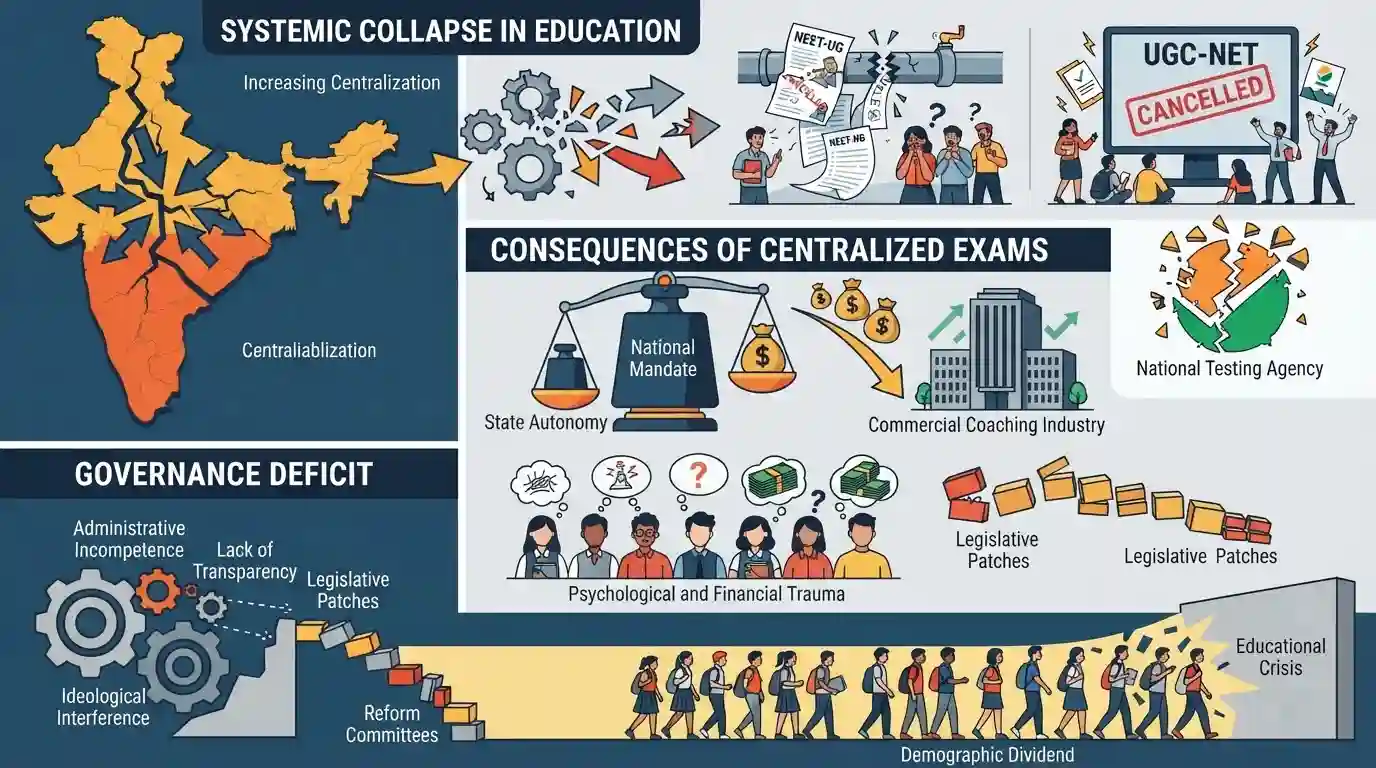
The article critiques the ongoing systemic collapse of India's education and examination sector, particularly highlighting the NEET-UG paper leaks and the sudden cancellation of the UGC-NET exam. It attributes these crises to the increasing centralization of educational governance and the institutional failure of the National Testing Agency (NTA). The author argues that mandatory national exams erode state autonomy in education, inadvertently strengthen the commercial coaching industry, and inflict immense psychological and financial trauma on young students. The piece contends that legislative patches and reform committees are inadequate without addressing the core issues of administrative incompetence, lack of transparency, and ideological interference, warning that this governance deficit threatens India's demographic dividend.
Key Points
- Systemic failure of the National Testing Agency (NTA) has resulted in massive paper leaks, irregularities in NEET-UG, and the abrupt cancellation of UGC-NET, compromising the future of millions of students.
- Centralization of entrance examinations undermines the spirit of federalism, bypassing state boards and severely disadvantaging rural and marginalized students.
- The ongoing crisis has fueled the unchecked expansion of a commercial 'coaching mafia,' creating immense psychological trauma and financial burden for young Indians.
- Government measures, such as the Public Examinations (Prevention of Unfair Means) Act and the K. Radhakrishnan-led reform committee, are critiqued as superficial responses to deep-seated ideological capture and administrative incompetence.
- The recurring collapse of the examination system creates a massive trust deficit in public institutions, actively threatening India's ability to reap its demographic dividend.
Important Terms
Public Examinations (Prevention of Unfair Means) Act, 2024

An Indian legislation designed to combat malpractices, paper leaks, and organized cheating in central recruitment and entrance examinations through stringent penalties, including multi-year imprisonment and heavy fines.
UPSC context
GS Paper II (Governance); tests understanding of administrative reforms and legal measures to safeguard public examination integrity.
National Testing Agency (NTA)
An autonomous, self-sustained testing organization registered under the Societies Registration Act, 1860, established under the Ministry of Education to conduct highly standardized entrance examinations for higher education.
UPSC context
GS Paper II (Statutory/Autonomous Bodies); assesses analysis of institutional capacity, centralized governance challenges, and education sector accountability.
National Education Policy (NEP) 2020
A comprehensive national policy aiming to transform India's educational landscape from school to higher education by promoting multi-disciplinary learning, regional language instruction, flexible curricula, and holistic assessments.
UPSC context
GS Paper II (Social Sector/Education); essential for analyzing federal educational dynamics, structural reforms, and human resource development strategies.
University Grants Commission (UGC)
A statutory body established under the UGC Act, 1956, responsible for coordinating, determining, and maintaining academic standards and disbursing grants across higher education institutions in India.
UPSC context
GS Paper II (Statutory/Regulatory Bodies); key for evaluating higher education regulation, centralization trends, and federal-state educational relationships.
Indian Cyber Crime Coordination Centre (I4C)
An initiative by the Ministry of Home Affairs establishing a national framework to coordinate responses against cybercrimes, improve law enforcement collaboration, and run public threat-reporting systems.
UPSC context
GS Paper III (Cyber Security); relevant for studying cyber fraud prevention mechanisms, technical capacity-building, and digital infrastructure security.
Prelims Trap
The Public Examinations (Prevention of Unfair Means) Act, 2024 prescribes criminal imprisonment up to 5 years for individual candidates caught cheating.
The Act explicitly excludes regular candidates from its criminal penal provisions. Candidates remain subject to the administrative and disciplinary rules of the respective testing institutions.
Static Concepts Connected
How is 'Education' structurally distributed under the Seventh Schedule?
- Concurrent List: Moved from State to Concurrent List (Entry 25) by the 42nd Amendment Act, 1976, giving both Centre and States legislative powers.
- Union Supremacy: Under Article 254, central legislation prevails over state laws in case of repugnancy, enabling nationwide standardized entrance tests.
- Entry 66: The Union List empowers Parliament to coordinate and determine standards in higher education and scientific research institutions.
What is the legal status of the National Testing Agency?
- Non-Statutory Society: NTA is not a statutory body; it is registered as an autonomous testing society under the Societies Registration Act, 1860.
- Administrative Umbrella: It functions under the Department of Higher Education within the Ministry of Education, led by a Ministry-appointed chairperson.
Cross-Topic Patterns
Concurrent list friction in social sector
Centralized execution in concurrent subjects like education can trigger friction between national standardization objectives and federal state autonomy.
Demographic dividend and human capital
Systemic institutional failures in testing systems damage the mental health of youth, risking the conversion of India’s demographic asset into a liability.

Mains 2026 will likely evaluate if over-centralization of examination systems violates cooperative federalism and degrades human capital.
Linked PYQs · 4
Linked PYQs · 4
- 2015MainsGS2
For achieving the desired objectives, it is necessary to ensure that the regulatory institutions remain independent and autonomous. Discuss in the light of the experiences in recent past.
- 2023MainsGS2
Skill development programmes have succeeded in increasing human resources supply to various sectors. In the context of the statement analyse the linkages between education, skill and employment.
- 2016MainsGS2
Demographic Dividend in India will remain only theoretical unless our manpower becomes more educated, aware, skilled and creative." What measures have been taken by the government to enhance the capacity of our population to be more productive and employable?
- 2020MainsGS2
National Education Policy 2020 is in conformity with the Sustainable Development Goal-4 (2030). It intends to restructure and reorient education system in India. Critically examine the statement.
