Ladakh Sixth Schedule Demands and Civil Society Agitations
Source:Indian Express ↗
কেন এটি গুরুত্বপূর্ণ
The article is highly relevant for GS Paper 2 as it highlights the intersection of constitutional safeguards for tribal regions (Sixth Schedule) and the administrative challenges of Union Territories. It also provides a contemporary case study on how civil society movements and peaceful protests can prompt the state apparatus to re-engage in dialogue.
সারসংক্ষেপ
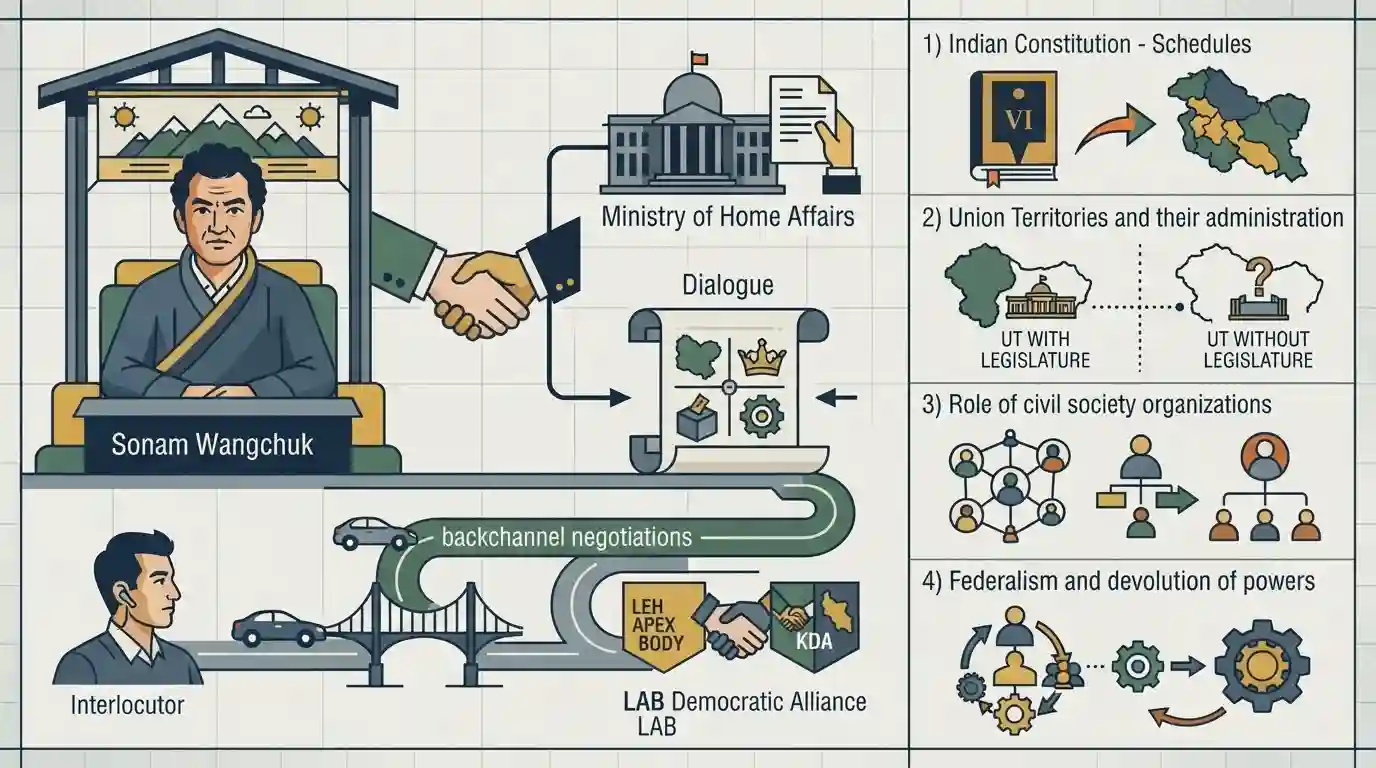
Climate activist Sonam Wangchuk has concluded his indefinite fast demanding Sixth Schedule status, statehood, and expanded democratic representation for Ladakh. The protest ended after a formal assurance from the Ministry of Home Affairs to resume dialogue on the four-point agenda put forth by the Leh Apex Body and Kargil Democratic Alliance. The breakthrough followed three days of intensive backchannel negotiations facilitated by an interlocutor associated with the National Security Advisor. The agitation brings to the forefront critical questions regarding the democratic deficit in Union Territories without legislatures and the constitutional mechanisms available to protect ecologically sensitive tribal areas.
মূল বিষয়
- Climate activist Sonam Wangchuk ended his fast demanding constitutional safeguards for Ladakh after receiving written assurances from the Ministry of Home Affairs to resume dialogue.
- The Leh Apex Body and Kargil Democratic Alliance are advocating a four-point agenda: Sixth Schedule status, statehood for Ladakh, separate parliamentary seats for Leh and Kargil, and a dedicated public service commission.
- The breakthrough was achieved via backchannel diplomacy involving a lawyer associated with the National Security Advisor, demonstrating the utility of informal mediation in civil society-state standoffs.
- The ongoing protests highlight systemic friction regarding Ladakh's governance structure as a Union Territory without a legislature, which locals argue suffers from a democratic deficit under bureaucratic administration.
গুরুত্বপূর্ণ শব্দ
Sixth Schedule of the Indian Constitution

A constitutional framework (Articles 244(2) and 275(1)) providing administrative autonomy to tribal-dominated areas through Autonomous District Councils with legislative, executive, and judicial powers.
UPSC context
GS Paper II (Schedules) — tests tribal governance, local self-administration, and regional autonomy.
Jammu and Kashmir Reorganisation Act, 2019
Parliamentary legislation that bifurcated the former state of Jammu and Kashmir into two distinct Union Territories: Jammu & Kashmir (with a legislature) and Ladakh (without a legislature).
UPSC context
GS Paper II (Federalism) — tests constitutional provisions regarding state boundaries, UT administration, and Article 370.
Ministry of Home Affairs
The interior ministry of the Government of India, primarily responsible for the maintenance of internal security, border management, center-state relations, and administration of Union Territories.
UPSC context
GS Paper II (Executive Organs) — tests the administrative apparatus governing union-center relations and Union Territories.
Leh Apex Body
A representative coalition of political, religious, and civil society groups in Ladakh's Leh district, formed to advocate for statehood and local constitutional safeguards.
UPSC context
GS Paper II (Pressure Groups & Civil Society) — tests public mobilization, federal dialogue, and regional representation.
Kargil Democratic Alliance
A collective platform of political, religious, and social organizations in Ladakh's Kargil district, partnering with Leh groups to demand statehood and Sixth Schedule inclusion.
UPSC context
GS Paper II (Pressure Groups) — tests political negotiation, regional consensus-building, and federal decentralization demands.
প্রিলিমস ফাঁদ
"The Ladakh Autonomous Hill Development Councils (LAHDCs) exercise judicial powers over customary matters under the Sixth Schedule."
LAHDCs are statutory bodies established by a 1997 Act and lack constitutional backing. Only Sixth Schedule ADCs possess constitutional protection and judicial authority over customary matters.
সংযুক্ত স্থির ধারণা
How does the Constitution distinguish Fifth and Sixth Schedule areas?
- Fifth Schedule: Under Article 244(1), it applies to the administration of 'Scheduled Areas' in states other than Assam, Meghalaya, Tripura, and Mizoram.
- Sixth Schedule: Under Article 244(2), it provides for Autonomous District Councils (ADCs) specifically in designated 'Tribal Areas' of Assam, Meghalaya, Tripura, and Mizoram.
How is a legislature established for a Union Territory?
- Article 239A: Empowers Parliament to create a legislature, a Council of Ministers, or both for certain Union Territories.
- Ordinary Law: Creation of a UT legislature requires only an ordinary parliamentary law, explicitly declared not to be a constitutional amendment under Article 368.
- Presidential Powers: Under Article 240, the President can make regulations for peace and good government in UTs without legislatures, carrying the same force as an Act.
আন্তঃবিষয় প্যাটার্ন
Ecological fragility and democratic deficit
Ladakh’s demands mirror Lakshadweep's recent administrative frictions, highlighting how UTs without legislatures face unique governance-ecology conflicts under direct bureaucratic control.
Internal security and backchannel diplomacy
The NSA's involvement in resolving civil society agitations shows the expanding role of the national security apparatus in informal mediation and internal political conflict resolution.

Expect a tricky Prelims question contrasting LAHDCs' purely statutory powers with Sixth Schedule ADCs' constitutional protections.
সংযুক্ত PYQ · 3
সংযুক্ত PYQ · 3
- 2026PrelimsGS1
Consider the following statements about the provisions pertaining to the Scheduled Castes and the Scheduled Tribes in India : 1. Provisions regarding the administration of the Tribal Areas in the States of Assam, Meghalaya, Tripura and Mizoram are given in the Fifth Schedule of the Constitution of India. 2. Some tribes of India are entitled to exemption from paying Income Tax on certain incomes. 3. The Constitution of India provides for reservation of seats in Panchayats for women belonging to the Scheduled Castes and the Scheduled Tribes. Which one of the following conclusions based on the above statements is correct ?
- 2016MainsGS2
Discuss the essentials of the 69th Constitutional Amendment Act and anomalies, if any, that have led to recent reported conflicts between the elected representatives and the institution of the Lieutenant Governor in the administration of Delhi. Do you think that this will give rise to a new trend in the functioning of the Indian federal politics?
- 2025MainsGS2
Civil Society Organizations are often perceived as being anti-State actors than non-State actors. Do you agree? Justify.
