Sonam Wangchuk Hunger Strike and Student Protests Over Exam Leaks
Source:Indian Express ↗
ఇది ఎందుకు ముఖ్యం
The incident underscores crucial themes of democratic dissent and the right to peaceful assembly under Article 19. Furthermore, it highlights the pressing need for systemic reforms to ensure accountability and integrity in India's higher education and public examination systems, a relevant topic given recent legislation on unfair means in exams.
సారాంశం
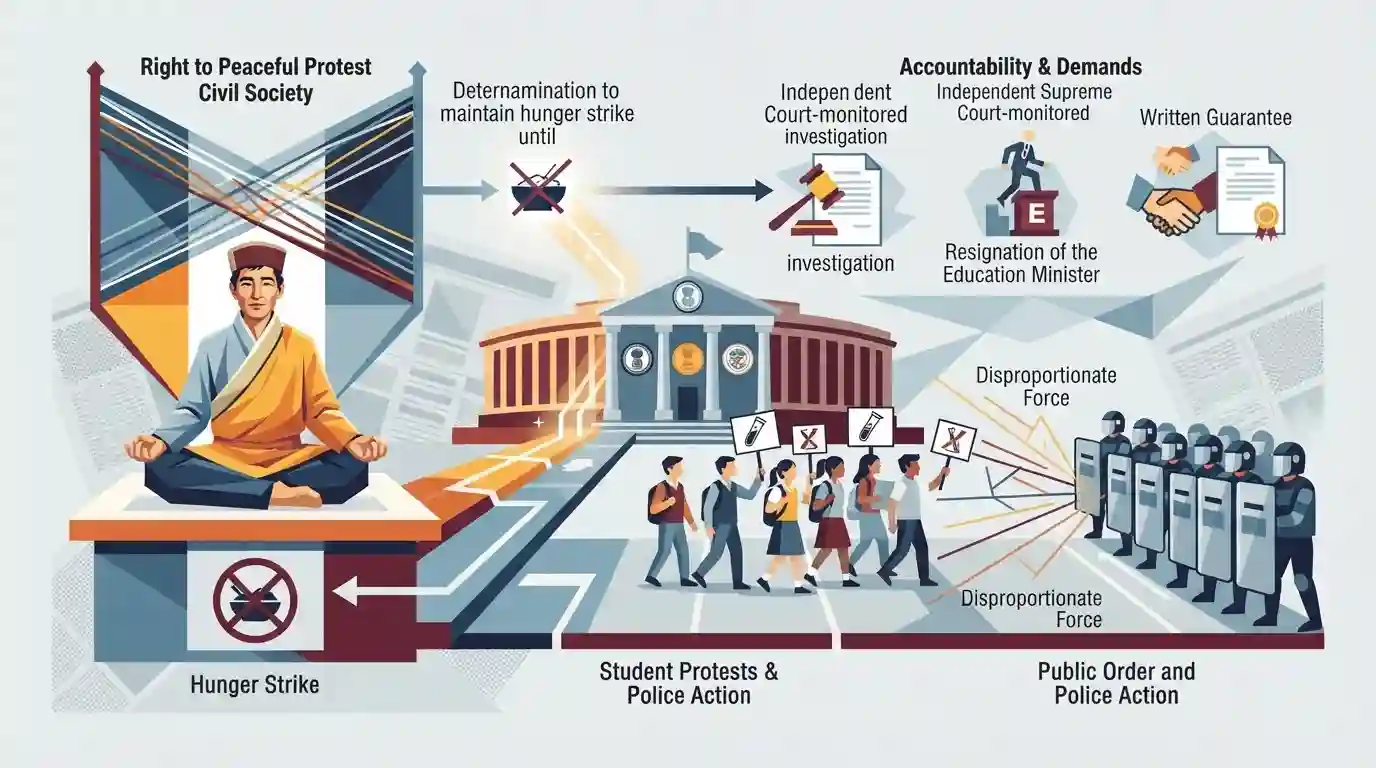
Sonam Wangchuk has refused to end his hunger strike until the government provides a written guarantee that students protesting recent exam paper leaks will not face punitive legal action. The protests, led by the Cockroach Janata Party (CJP), seek accountability for the leaks, including an independent Supreme Court-monitored investigation and the resignation of the Education Minister. Wangchuk’s stance emphasizes the constitutional right to peaceful protest and criticizes the disproportionate use of police force against students during the 'Chalo Sansad' march, highlighting the intersection of civil society activism and systemic governance reforms.
ముఖ్య అంశాలు
- Climate activist Sonam Wangchuk has conditioned ending his fast on a written government assurance that students peacefully protesting exam paper leaks will not face punitive legal action.
- The protests, spearheaded by the Cockroach Janata Party (CJP), demand the resignation of Education Minister Dharmendra Pradhan and a Supreme Court-monitored probe into the paper leaks.
- Wangchuk strongly condemned the disproportionate use of force by police during the recent 'Chalo Sansad' march, defending the democratic right to peaceful dissent.
- Despite outreach from Union Ministers J P Nadda and Jitendra Singh, Wangchuk refused to break his fast until his core demands regarding the protesters' legal immunity were met.
ముఖ్యమైన పదాలు
Cockroach Janata Party (CJP)

A youth-led satirical political movement in India founded in May 2026 by Abhijeet Dipke. It leverages humor, social media, and protests to demand educational reforms and "examination justice" following paper leak controversies.
UPSC context
GS Paper II: Governance, Pressure Groups, and Civil Society. Tests understanding of youth mobilization, satirical dissent, and grassroots advocacy.
Sonam Wangchuk
A prominent Ladakhi engineer, educational reformer, and environmentalist. Known for ecological innovations and peaceful fasts championing Sixth Schedule safeguards for Ladakh and accountability in India's education sector.
UPSC context
GS Paper IV: Ethical Leadership & Satyagraha; GS II: Civil Society. Tests understanding of Gandhian protest methods in contemporary governance.
Right to Peaceful Assembly
A fundamental right guaranteed under Article 19(1)(b) of the Indian Constitution, allowing citizens to gather peacefully without arms, subject to reasonable restrictions like public order and national security.
UPSC context
GS Paper II: Fundamental Rights. Tests understanding of citizen liberties, state power to maintain public order, and judicial checks.
Examination Justice
A reformist concept advocating for transparency, accountability, and the prevention of paper leaks in competitive exams to protect candidates' career prospects and emotional well-being.
UPSC context
GS Paper II: Issues Relating to Education. Tests knowledge of regulatory oversight, structural reforms, and ethical administrative practices.
Civil Society Activism
Collective public actions led by citizens, community groups, and NGOs to raise awareness about policy gaps, protest systemic injustices, and influence state governance outside formal political channels.
UPSC context
GS Paper II: Development Processes & the Development Industry. Tests knowledge of citizen participation, accountability mechanisms, and policy advocacy.
ప్రిలిమ్స్ ఉచ్చు
Bona fide candidates caught cheating face criminal prosecution and imprisonment under the Public Examinations (Prevention of Unfair Means) Act, 2024.
The Act explicitly excludes individual candidates from its criminal purview. They are governed by the administrative/disciplinary rules of the respective exam-conducting authorities, not criminal courts.
అనుసంధానమైన స్థిర భావనలు
What are the constitutional limits on the Right to Assemble peaceably?
- Constitutional Basis: Article 19(1)(b) guarantees citizens the right to assemble peaceably and without arms, excluding assemblies that are disorderly or violent.
- Restrictive Grounds: Under Article 19(3), the State can restrict assembly only for 'sovereignty and integrity of India' and 'public order'.
- Comparison with Speech: The scope of restrictions on assembly is narrower than those on free speech, as decency, morality, or friendly relations are not valid grounds.
What is the difference between Cognizable, Non-Bailable, and Non-Compoundable offenses?
- Cognizable Offense: Police officers have the authority to make an arrest without a warrant and initiate an investigation without a magistrate's prior permission.
- Non-Bailable Offense: Bail cannot be claimed as a matter of right by the accused; its grant remains at the sole discretion of the court.
- Non-Compoundable Offense: The charges cannot be compromised or settled out of court between the victim and the accused, requiring a full trial.
అంతర-అంశ నమూనాలు
Federal friction in exam administration
The restriction of the 2024 Act to central authorities highlights the challenges of standardizing exam integrity across different state-level boards and university systems.
Pressure groups and civic space
Activists shifting demands from environmental issues to youth welfare highlights the fluid, multi-issue nature of civil society movements in Indian democracy.

Expect a 2026 Prelims question testing the explicit exclusion of candidates versus the targeting of syndicates under the 2024 Public Exams Act.
అనుసంధాన PYQలు · 2
అనుసంధాన PYQలు · 2
- 2024MainsGS2
What are the aims and objects of recently passed and enforced, The Public Examination (Prevention of Unfair Means) Act, 2024? Whether University/State Education Board examinations, too, are covered under the Act ?
- 2024MainsGS4
“The 'Code of Conduct' and 'Code of Ethics' are the sources of guidance in public administration. There is code of conduct already in operation, whereas code of ethics is not yet put in place. Suggest a suitable model for code of ethics to maintain integrity, probity and transparency in governance.”
