Sonam Wangchuk Discharged After Ending Ladakh Protest Fast
Source:The Hindu ↗
কেন এটি গুরুত্বপূর্ণ
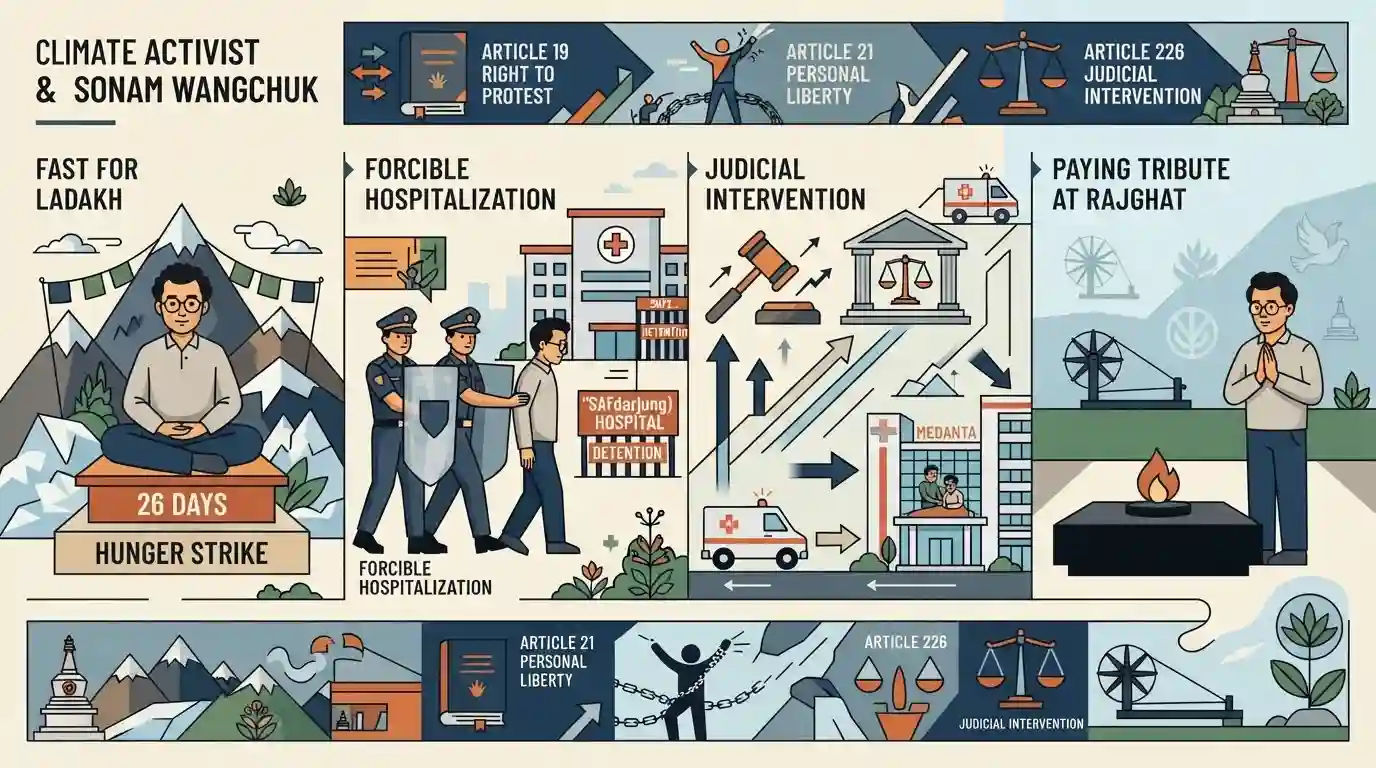
This event represents a critical case study of the intersection between civil society activism, individual liberty, and state authority. It illustrates how the judiciary acts as a custodian of fundamental rights (such as the right to peaceful assembly and protection against arbitrary detention under Articles 19 and 21) when executive actions curtail protest. It also highlights the persistent federal and regional tensions regarding constitutional protections (like the Sixth Schedule) in ecologically sensitive frontier areas like Ladakh.
সারসংক্ষেপ
Climate activist and educator Sonam Wangchuk was discharged from Medanta Hospital in Gurugram on July 27, 2026, after completing a 26-day indefinite fast for Ladakh's ecological and administrative protections. Originally hospitalized forcibly at Safdarjung Hospital under what he termed virtual detention, Wangchuk was transferred to Medanta Hospital following a Delhi High Court directive. Upon discharge, he paid tributes to Mahatma Gandhi at Rajghat, New Delhi, asserting that his agitation was peaceful, that no deals were made with the government, and that his commitment to protecting the mountain region of Ladakh remains steadfast.
মূল বিষয়
- Climate activist and educator Sonam Wangchuk was discharged from Medanta Hospital in Gurugram on July 27, 2026, after a six-day stay following his 26-day indefinite fast.
- Wangchuk had commenced his indefinite fast on June 28, 2026, to protest for constitutional protections and ecological safeguards for Ladakh.
- He was forcibly shifted by authorities to Safdarjung Hospital on July 18, 2026, where he alleged he was kept under virtual detention, before being moved to Medanta Hospital following a Delhi High Court order.
- Upon his discharge, Wangchuk and his wife Gitanjali Angmo paid respects to Mahatma Gandhi at Rajghat in New Delhi, emphasizing the peaceful and Gandhian nature of his agitation.
- Wangchuk clarified on social media that he did not 'cut any deal' with the government and would continue his work for Ladakh's protection.
গুরুত্বপূর্ণ শব্দ
Delhi High Court

The constitutional court for the NCT of Delhi. In this context, it exercised its Article 226 writ jurisdiction to transfer an activist from state detention to a private hospital, upholding personal liberty.
UPSC context
Important for GS-2 (Judiciary); tests Article 226 writ powers, judicial review over police actions, and expansive interpretation of Article 21.
Safdarjung Hospital
A major central government-run public hospital in Delhi. It featured in a constitutional dispute regarding "virtual detention" and forced hospitalization of a fasting activist by state authorities without a valid judicial order.
UPSC context
GS-2 (Governance/Fundamental Rights); raises questions on limits of state intervention, bodily autonomy, and rights against arbitrary detention.
Medanta Hospital
A private multi-specialty hospital in Gurugram. The Delhi High Court ordered an activist's transfer here, establishing that shifting a patient to a facility of their choice fulfills their fundamental rights under Articles 19 and 21.
UPSC context
GS-2 (Indian Constitution); underscores expansive judicial interpretations of the Right to Life and Personal Liberty (Article 21) regarding individual healthcare choices.
প্রিলিমস ফাঁদ
The President can extend Sixth Schedule provisions to Ladakh via executive notification under Article 244.
Fifth Schedule areas can be declared via Presidential notification. However, because the Sixth Schedule explicitly names only four Northeastern states in Article 244(2), extending it to Ladakh requires a constitutional amendment.
সংযুক্ত স্থির ধারণা
What are the core distinctions between the Fifth and Sixth Schedules?
- Geographical Scope: Fifth Schedule applies to scheduled areas across India; Sixth Schedule applies exclusively to tribal areas in Assam, Meghalaya, Tripura, and Mizoram.
- Governance Structures: Fifth Schedule relies on advisory Tribes Advisory Councils; Sixth Schedule creates Autonomous District Councils (ADCs) with legislative, judicial, and taxation powers.
- Governor's Discretion: The Governor has broader legislative vetoes and discretionary regulatory powers in Sixth Schedule areas compared to Fifth Schedule areas.
How does the Constitution balance the Right to Protest with Article 21?
- No Explicit Right: It is derived implicitly from Article 19(1)(a) (speech) and 19(1)(b) (peaceful assembly), subject to public order restrictions.
- State Intervention: The state has a positive duty to preserve life under Article 21, which permits medical intervention/force-feeding if a hunger striker’s life is in critical danger.
আন্তঃবিষয় প্যাটার্ন
Asymmetric Federalism vs Strategic Borders
Ladakh's autonomy demands highlight the tension between local tribal self-governance and direct Central administrative control over geopolitically sensitive border regions bordering China.
Ecological Federalism and Tribal Rights
Accelerated Himalayan glacier melting links environmental vulnerability directly to the constitutional demand for local administrative control over natural resources.

UPSC may test the constitutional amendment route (Art 368) required to extend Sixth Schedule protections to regions outside the Northeast.
সংযুক্ত PYQ · 3
সংযুক্ত PYQ · 3
- 2021PrelimsGS1
'Right to Privacy' is protected under which Article of the Constitution of India?
- 2022MainsGS2
“While the national political parties in India favour centralisation, the regional parties are in favour of State autonomy.” Comment.
- 2021MainsGS1
Bring out the constructive programmes of Mahatma Gandhi during Non-Cooperation Movement and Civil Disobedience Movement.
