Army Personnel Killed During Anti Terror Operation in Kishtwar
Source:Indian Express ↗
Why It Matters
The ongoing encounters in regions like Kishtwar highlight the complex internal security landscape of Jammu and Kashmir. For civil service aspirants, understanding the dynamics of state-sponsored terrorism, counter-insurgency measures, and the human cost of securing borders is essential for GS Paper 3 (Internal Security).
Summary
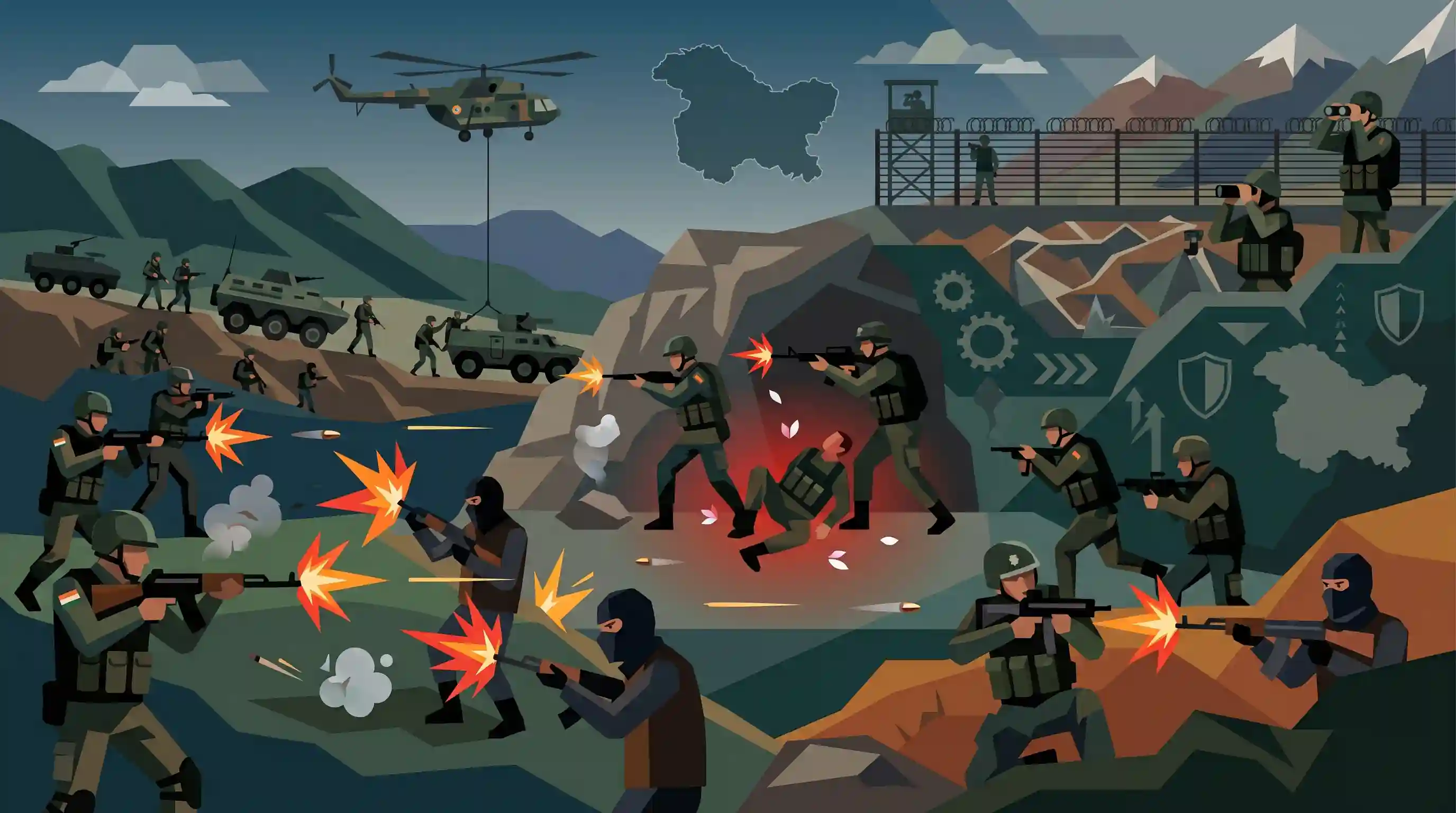
An Indian Army soldier was killed in an ongoing encounter with terrorists in the Kishtwar district of Jammu and Kashmir. The incident underscores the persistent security challenges in the region and the active counter-insurgency operations undertaken by the armed forces to neutralize terrorist threats.
Key Points
- An Indian Army soldier was killed in the line of duty during a firefight with terrorists in the Kishtwar district of Jammu and Kashmir.
- Security forces have been conducting counter-insurgency and combing operations in the area to track down and neutralize the militants.
- The incident highlights the persistent threat of cross-border terrorism and the active nature of counter-terror operations in the Jammu division.
Important Terms
Indian Army

The land-based branch of the Indian Armed Forces, primarily responsible for territorial integrity against external aggression and secondary roles in counter-insurgency and disaster relief.
UPSC context
GS Paper III (Internal Security); tests understanding of security forces' mandates and roles in tackling internal and external threats.
Counter-insurgency (COIN)
A comprehensive military and political strategy aimed at defeating irregular forces (insurgents) by addressing root causes and winning the support of the local population.
UPSC context
GS Paper III (Internal Security); critical for analyzing state responses to separatism, extremism, and the 'Hearts and Minds' strategy.
Internal Security
The preservation of peace, law, and order within a nation's borders, safeguarding citizens and institutions from domestic threats like terrorism, insurgency, and communal violence.
UPSC context
Core subject in GS Paper III; tests knowledge of various security challenges, institutional frameworks, and policy interventions.
Cross-border Terrorism
Acts of terrorism where territory in one country is used to launch, support, or plan attacks against another nation, often via state-sponsored proxies.
UPSC context
GS Paper III (Security Challenges); evaluates understanding of external state actors' roles in destabilizing India, particularly in J&K.
Kishtwar District
A strategically significant hilly district in Jammu and Kashmir, notable for its difficult terrain, hydroelectric potential, and persistence of counter-terror operations.
UPSC context
Geography/Internal Security; relevant for localized security dynamics and the implementation of border area development programs in J&K.
Line of Control (LoC)
The 740 km de facto border between India and Pakistan in Jammu and Kashmir, established after the 1971 war and the 1972 Shimla Agreement.
UPSC context
GS Paper III (Border Management); essential for discussing infiltration, ceasefire violations, and bilateral security relations with Pakistan.
Prelims Trap
"Village Defence Guards (VDGs) in J&K are a specialized statutory battalion under the CAPF."
VDGs are not a statutory armed force or CAPF battalion; they are armed and trained civilian volunteers from local communities acting as a grassroots force multiplier in remote areas.
Static Concepts Connected
How does the Indus Waters Treaty regulate Chenab river projects?
- Western Rivers allocation: Under the 1960 IWT, waters of the Western Rivers (Chenab, Jhelum, and Indus) are primarily allocated to Pakistan.
- Run-of-the-River rights: India is permitted to construct run-of-the-river hydroelectric projects with limited pondage, subject to strict technical design criteria.
- Dispute resolution: Differences over project designs are resolved via the Permanent Indus Commission, Neutral Experts, or a Court of Arbitration.
What forms the core of the security grid in remote J&K districts?
- Rashtriya Rifles (RR): A specialized counter-insurgency force under the Ministry of Defence, drawn from the Indian Army, serving as the primary kinetic backbone.
- Civic Action Strategy: 'Operation Sadbhavana' focuses on Winning Hearts and Minds (WHAM) through civic action and development to reduce local alienation.
- Village Defence Guards: The VDG scheme deploys armed civilian volunteers in remote villages to serve as a grassroots defense layer against militant attacks.
Cross-Topic Patterns
Chenab Basin HEPs & IWT Disputes
Kishtwar's Pakal Dul and Ratle projects on the Chenab and its tributaries frequently trigger Pakistan's objections under the Indus Waters Treaty, blending physical geography with bilateral diplomacy.
Security Overlap with Alpine Conservation
Security challenges in the Kishtwar region geographically overlap with critical high-altitude ecosystems, notably the Kishtwar National Park, a vital habitat for the endangered snow leopard.

Chenab basin tributaries (Marusudar) and their associated HEPs (Pakal Dul, Ratle) are prime candidates for a 2026 Prelims matching pair.
Linked PYQs · 3
Linked PYQs · 3
- 2023MainsGS3
Winning of 'Hearts and Minds' in terrorism-affected areas is an essential step in restoring the trust of the population. Discuss the measures adopted by the Government in this respect as part of the conflict resolution in Jammu and Kashmir.
- 2023MainsGS3
What are the internal security challenges being faced by India? Give out the role of Central Intelligence and Investigative Agencies tasked to counter such threats.
- 2021MainsGS3
Analyse the multidimensional challenges posed by external state and non-state actors, to the internal security of India. Also discuss measures required to be taken to combat these threats.
