Solar and Storage Expo 2026 Concludes in Jaipur
Source:solarquarter ↗
Why It Matters
Rajasthan holds the largest solar potential in India. Information regarding key solar summits, state agencies like RRECL, and solar energy initiatives are vital for the RPSC RAS Prelims exam, which frequently tests state-specific economic growth, energy policies, and nodal implementing bodies.
Summary
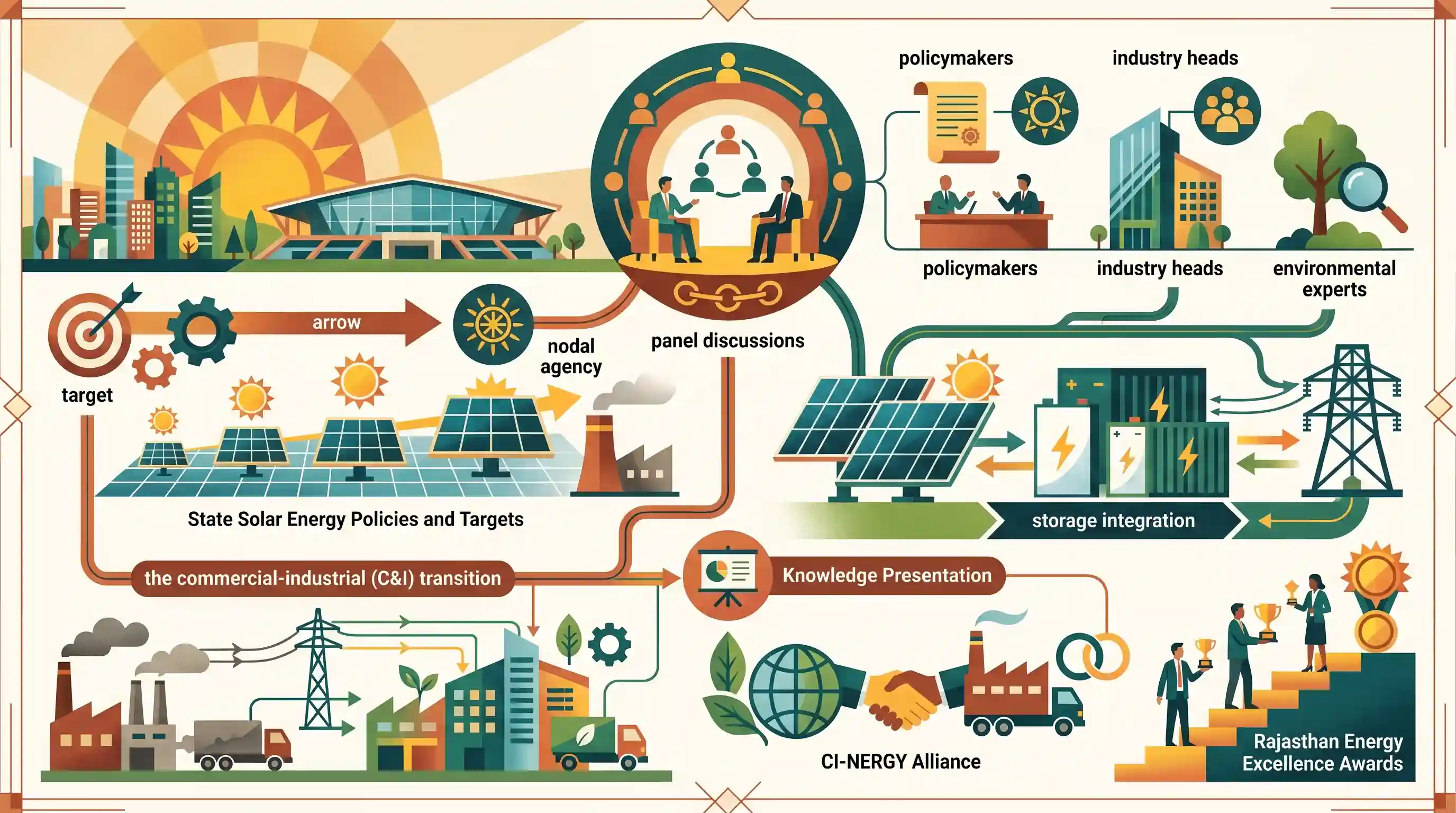
The 6th Edition of the Solar & Storage Expo Rajasthan 2026 held in Jaipur brought together state policymakers, industry heads, and environmental experts to outline Rajasthan's clean energy priorities. Organizers and speakers, including S.K. Rajput (RRECL) and Nitin Agarwal (Rajasthan Solar Association), emphasized policies, storage integration, and the commercial-industrial transition. The expo also witnessed the introduction of the CI-NERGY Alliance by WRI India and concluded with the Rajasthan Energy Excellence Awards 2026.
Key Points
- The 6th Edition of the Solar & Storage Expo Rajasthan 2026 successfully concluded at Jaipur, organized by the FirstView Group.
- Shri S. K. Rajput (Additional Chief Engineer, RRECL) highlighted Rajasthan's renewable energy roadmap, focusing on policy priorities and the role of solar energy and storage systems.
- Discussions revolved around key panels: 'Powering Rajasthan\'s Energy Transition: Policy Reforms, Utility-Scale Solar & Energy Storage Integration' and 'Powering Industry\'s Green Transition: Distributed Solar, Open Access & Corporate Decarbonization'.
- WRI India\'s Abhinav Sharma introduced the 'CI-NERGY Alliance' aimed at accelerating decarbonization across India\'s commercial and industrial sectors.
- The event concluded with the Rajasthan Energy Excellence Awards 2026, celebrating outstanding contributors to the state\'s renewable energy growth.
Important Terms
CI-NERGY Alliance

A collaborative platform launched by WRI India and CII in 2025 to accelerate clean energy adoption and decarbonization in India's commercial and industrial (C&I) sectors.
UPSC context
GS Paper III (Infrastructure and Energy). Tests awareness of industry-led initiatives supporting India's net-zero 2070 emission targets.
Rajasthan Solar Energy Policy
A key state framework, updated via the 2023 and 2024 policies, designed to harness Rajasthan's massive solar potential by setting aggressive capacity targets and promoting decentralized solar.
UPSC context
GS Paper III (Infrastructure: Energy). Tests understanding of state-level policy targets, solar scaling, and alignment with national climate goals.
Rajasthan Renewable Energy Corporation Limited (RRECL)
A state-owned corporation formed by merging RSPCL and REDA that serves as Rajasthan's nodal agency for registering, approving, and facilitating renewable energy and energy conservation projects.
UPSC context
GS Paper III (Infrastructure & Energy). Relates to administrative frameworks and public sector undertakings implementing India's green energy policies.
WRI India
An independent research organization established in 2011 that partners with governments and businesses to design economically and environmentally sound solutions for climate and urban development.
UPSC context
GS Paper III (Conservation and Environment). Useful for highlighting the role of non-governmental research bodies in facilitating India's green transition.
Rajasthan Electronics & Instruments Limited (REIL)
A "Miniratna" Central Public Sector Enterprise operating as a joint venture between the Central and Rajasthan governments to manufacture agro-dairy electronics, IT, and solar photovoltaic systems.
UPSC context
GS Paper III (Investment Models & Indigenisation of Technology). Highlights public-sector contributions to rural and solar technology penetration.
Rajasthan Solar Association (RSA)
An industry association established under the Rajasthan Non-Trading Companies Act 1960 that promotes solar power through industry-academia collaboration, solar-friendly advocacy, and technology awareness.
UPSC context
GS Paper III (Infrastructure & Energy). Relates to industrial interest groups collaborating with state institutions to drive renewable energy targets.
Prelims Trap
CI-NERGY is a Ministry of New and Renewable Energy (MNRE) bilateral treaty with international solar developers.
Aspirants may assume CI-NERGY is a formal government initiative or inter-governmental treaty. It is actually a non-governmental, industry-run platform created jointly by WRI India and CII.
Static Concepts Connected
What are the three core components of the PM-KUSUM scheme?
- Component A: Aims for 10,000 MW of decentralized, grid-connected ground-mounted solar/renewable power plants on barren lands near substations (0.5 to 2 MW).
- Component B: Focuses on the installation of 20 lakh standalone solar-powered agriculture pumps to replace diesel pumps in off-grid areas.
- Component C: Covers solarisation of 15 lakh grid-connected agriculture pumps, including individual pump solarisation and feeder-level solarisation.
What is the dual mandate of State Nodal Agencies (SNAs) like RRECL?
- Renewable Promotion: They act as the state-level agency for promoting, developing, and executing non-conventional and renewable energy projects under central MNRE guidance.
- Energy Conservation: They are designated under the Energy Conservation Act, 2001, to enforce energy efficiency standards and coordinate with the Bureau of Energy Efficiency (BEE).
Cross-Topic Patterns
Interstate Federalism & Grid Transmission
Rajasthan's unmatched solar generation capability requires robust Interstate Transmission Systems (ISTS), testing the federal-state dynamic in building national green energy corridors.
Water-Energy-Food Nexus in Arid Zones
Decentralized solar generation under PM-KUSUM changes agricultural economics but risks accelerating groundwater depletion unless strictly coupled with micro-irrigation policies.

State Designated Agencies (SDAs) under the Energy Conservation Act and the structural components of PM-KUSUM will likely be tested in 2026.
Linked PYQs · 2
Linked PYQs · 2
- 2023RPSC_PRELIMSGS1
Which agency has been given the responsibility of implementing the PM-KUSUM scheme (Component A) in Rajasthan, which involves the establishment of solar power plants with a capacity of 0.5 MW to 2 MW?
- 2021RPSC_PRELIMSGS1
In which year was the Rajasthan Solar Energy Policy announced?
