Solar firms challenge domestic cell mandate in Karnataka High Court
Source:The Hindu ↗
Why It Matters
The article perfectly illustrates the tension between two major policy goals: scaling up renewable energy capacity quickly to meet climate targets versus building a self-reliant domestic manufacturing base (Aatmanirbhar Bharat). It exposes critical supply chain and technological gaps in India's solar industry.
Summary
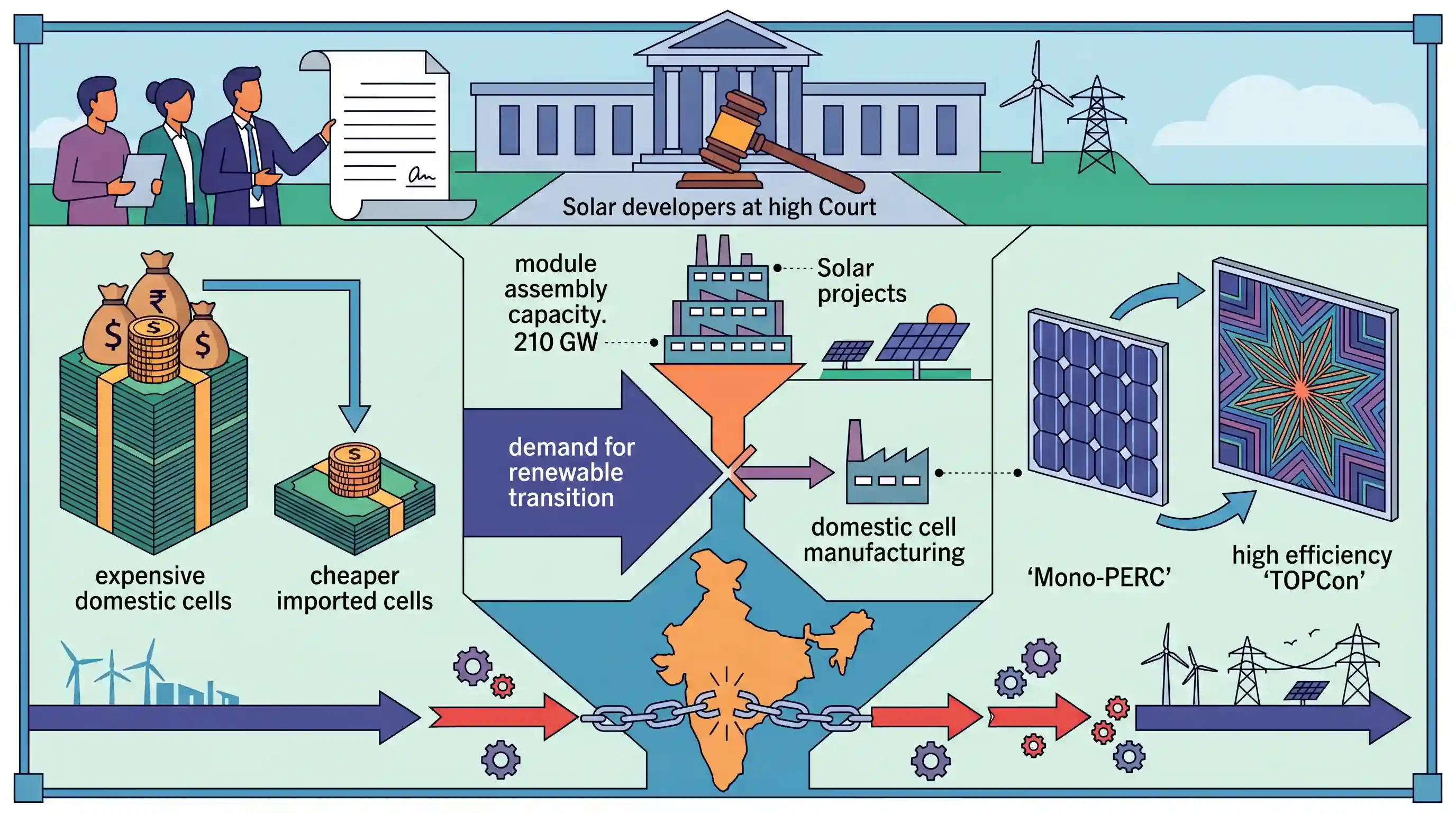
Solar power developers and manufacturers have filed a petition in the Karnataka High Court challenging the Ministry of New and Renewable Energy's (MNRE) mandate to use domestically manufactured solar cells for new projects starting April 2026. The mandate, linked to the Approved List of Models and Manufacturers (ALMM) List-II, faces strong opposition due to the high cost of domestic cells (₹13/watt versus ₹5/watt for imports) and a severe supply-demand gap. India currently has 210 GW of module assembly capacity but only 27 GW of upstream cell manufacturing capacity. Furthermore, domestic production is dominated by older Mono-PERC technology, whereas the industry has shifted to highly efficient TOPCon cells. The industry argues this mandate will lead to sub-optimal project execution and increased costs, stalling India's renewable energy momentum.
Key Points
- Solar developers have approached the Karnataka HC against MNRE's mandate requiring the use of domestically manufactured solar cells (ALMM List-II) from April 2026.
- Domestic cells cost approximately ₹13/watt, compared to imported cells at ₹5/watt, threatening project viability.
- India has a structural imbalance in its solar supply chain: 210 GW of module assembly capacity but only 27 GW of upstream cell manufacturing capacity, meeting only 25-30% of domestic demand.
- There is a significant technology mismatch: domestic capacity mostly produces older Mono-PERC cells, while developers require modern, high-efficiency TOPCon technology.
- Mandating domestic cells may force developers to use less efficient technology, thereby increasing land requirements and hampering India's broader renewable energy targets.
Important Terms
Approved List of Models and Manufacturers (ALMM)

A list of solar PV manufacturers and models approved by MNRE to ensure quality and reliability; its mandate effectively restricts the use of unlisted (mostly imported) components in government-supported projects.
UPSC context
GS-III (Infrastructure: Energy); tests understanding of non-tariff barriers and domestic manufacturing mandates (Aatmanirbhar Bharat).
Production-Linked Incentive (PLI) Scheme
A central government initiative providing financial incentives to manufacturers based on incremental sales to boost domestic production of high-efficiency solar PV modules and other sectors.
UPSC context
GS-III (Indian Economy); critical for questions on industrial policy, import substitution, and the solar supply chain.
Ministry of New and Renewable Energy (MNRE)
The nodal ministry of the Government of India for all matters relating to new and renewable energy, responsible for policy-making and implementing solar energy schemes.
UPSC context
GS-II (Government Policies & Interventions); relevant for institutional frameworks in India's energy transition.
TOPCon (Tunnel Oxide Passivated Contact)
An advanced N-type solar cell technology using a thin tunnel oxide layer to reduce electron recombination, offering higher efficiency (22–24%) compared to traditional technologies.
UPSC context
GS-III (Science & Technology); tests awareness of evolving clean energy technologies and India's technology gap.
Mono-PERC (Passivated Emitter and Rear Cell)
The current mainstream solar cell technology that uses a rear passivation layer to reflect light back into the cell, achieving efficiencies of approximately 20-22%.
UPSC context
GS-III (Science & Technology); relevant for comparing traditional vs. next-gen renewable infrastructure.
Domestic Content Requirement (DCR)
A policy mandate requiring solar power developers to source a specific percentage of components, such as modules or cells, from domestic manufacturers.
UPSC context
GS-III (Energy); relates to trade disputes (WTO) and the balance between local industry protection and project costs.
Prelims Trap
India has achieved self-sufficiency in upstream solar cell manufacturing under the PLI scheme.
India has immense excess downstream module assembly capacity (>200 GW) but severely lacks upstream cell (27 GW) manufacturing, relying heavily on imports.
Static Concepts Connected
What is the Approved List of Models and Manufacturers (ALMM)?
- Purpose: A non-tariff barrier framework introduced by MNRE to ensure solar components meet strict domestic quality standards.
- Applicability: It is mandatory for government-backed, subsidized, or CPSE-procured projects (e.g., PM-KUSUM) to use ALMM-listed components.
- Structure: Currently spans List-I (Solar Modules) and List-II (Solar Cells), with a proposed List-III for ingots and wafers.
What distinguishes Mono-PERC from TOPCon solar cell technology?
- Mono-PERC: Passivated Emitter and Rear Cell (PERC) adds a rear passivation layer to reflect unabsorbed light back into the cell, improving standard efficiency.
- TOPCon: Tunnel Oxide Passivated Contact (TOPCon) uses a thin oxide layer to reduce electron recombination, offering significantly higher baseline efficiency.
- Efficiency advantage: TOPCon panels generate more power per square meter, reducing the land footprint required for large utility-scale solar parks.
Cross-Topic Patterns
Aatmanirbhar Bharat vs. Climate Targets
Premature import substitution inflates project costs, directly pitting India's domestic manufacturing goals (PLI/ALMM) against its urgent target of achieving 500 GW of non-fossil capacity by 2030.
WTO Trade Rules & Non-Tariff Barriers
Mandating domestic content acts as a non-tariff barrier. India's past Domestic Content Requirement (DCR) for solar was successfully challenged by the US at the WTO for violating National Treatment principles.

ALMM framework + solar cell tech (TOPCon vs Mono-PERC) + supply chain gaps are prime for a hybrid tech-economy Prelims question in 2026.
Linked PYQs · 5
Linked PYQs · 5
- 2020MainsGS3
Describe the benefits of deriving electric energy from sunlight in contrast to the conventional energy generation. What are the initiatives offered by our Government for this purpose?
- 2015MainsGS3
To what factors can the recent dramatic fall in equipment costs and tariff of solar energy be attributed ? What implications does the trend have for the thermal power producers and the related industry?
- 2022MainsGS3
Do you think India will meet 50 percent of its energy needs from renewable energy by 2030 ? Justify your answer. How will the shift of subsidies from fossil fuels to renewables help achieve the above objective ? Explain.
- 2014PrelimsGS1
With reference to technologies for solar power production, consider the following statements: 1. 'Photovoltaics' is a technology that generates electricity by direct conversion of light into electricity, while 'Solar Thermal' is a technology that utilizes the Sun's rays to generate heat which is further used in electricity generation process. 2. Photovoltaics generates Alternating Current (AC), while Solar Thermal generates Direct Current (DC). 3. India has manufacturing base for Solar Thermal technology, but not for Photovoltaics. Which of the statements given above is/are correct?
- 2024PrelimsGS1
Consider the following: 1. Battery storage 2. Biomass generators 3. Fuel cells 4. Rooftop solar photovoltaic units How many of the above are considered "Distributed Energy Resources"?
