Adulteration Found in Government Procured Moong in Madhya Pradesh
Source:thestatesman ↗
Why It Matters
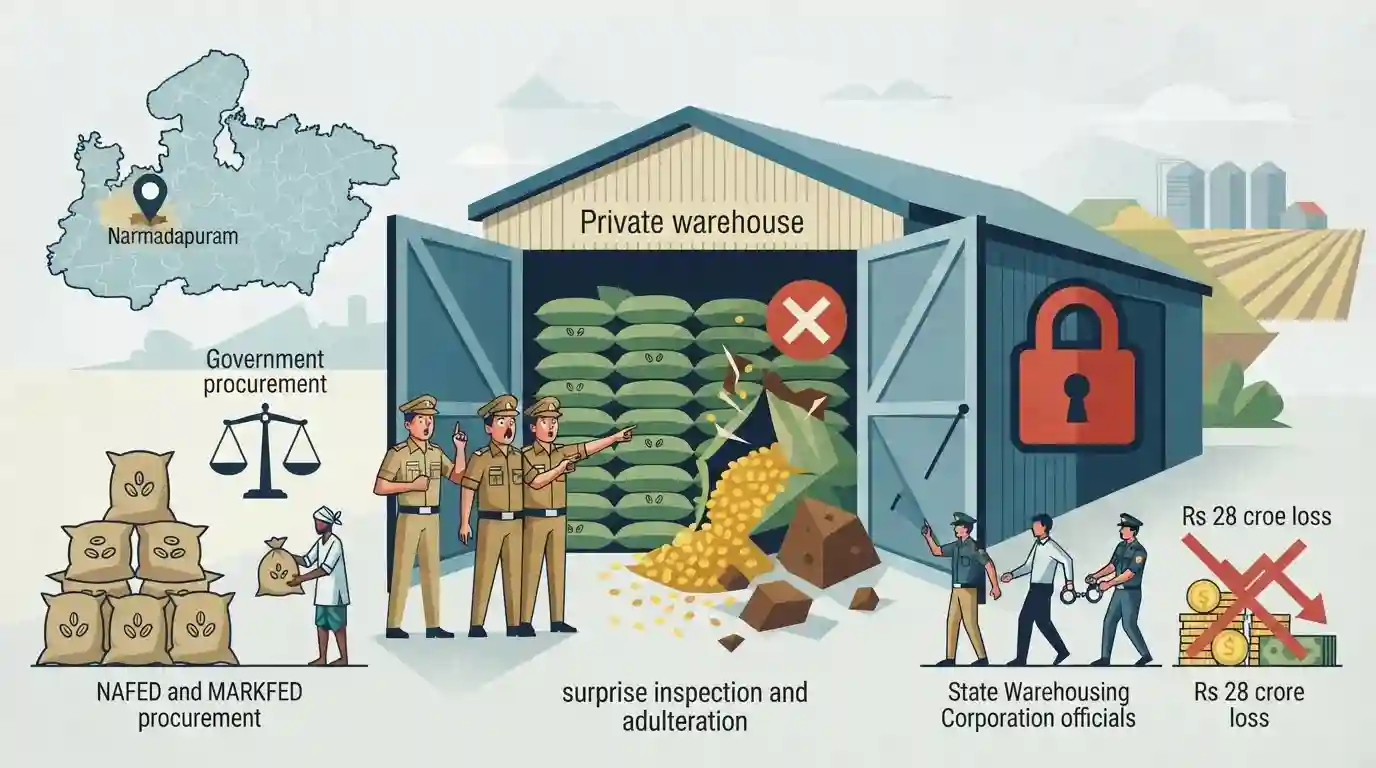
This incident highlights the operational gaps, storage malpractices, and corruption in agricultural procurement and warehousing systems (managed by central/state cooperative marketing bodies like NAFED and MARKFED). This has significant implications for food security, state finances, public distribution, and crop management, especially since Madhya Pradesh is India's leading pulses producer.
Summary
In Madhya Pradesh's Narmadapuram district, a surprise inspection of a private warehouse revealed that approximately 31,300 quintals of government-procured moong (mung beans) belonging to NAFED and MARKFED was heavily adulterated with soil and mud. The scam, which is estimated to have caused a loss of over Rs 28 crore to the government, led to the sealing of the warehouse and registration of an FIR against State Warehousing Corporation officials and the private warehouse owner.
Key Points
- An inspection of the private Kanakdhara Warehouse in the Makhan Nagar area of Narmadapuram district, Madhya Pradesh, revealed massive adulteration in government-procured moong (mung beans).
- Approximately 31,300 quintals of moong, belonging to procurement agencies NAFED and MARKFED from the 2023-24 and 2024-25 seasons, was found mixed with soil and mud, leading to an estimated loss of over Rs 28 crore.
- Some sacks stored in the warehouse contained entirely mud and soil, without any actual pulse grains.
- The surprise inspection was ordered by Narmadapuram District Collector Somesh Mishra and led by SDM Devendra Pratap Singh.
- Following the inspection, the warehouse was sealed, and the police registered an FIR against three individuals: State Warehousing Corporation District Manager Vasudev Dawde, Branch Manager Shyam Hosle, and warehouse owner Taresh Purohit.
- This disclosure comes shortly after a massive three-day protest by local farmers demanding 100 percent government procurement of moong.
Important Terms
NAFED

The National Agricultural Cooperative Marketing Federation of India Ltd. is an apex cooperative organization established in 1958. It handles agricultural procurement, marketing, and price support operations, notably executing the Price Support Scheme for crops like pulses and oilseeds.
UPSC context
Crucial for GS Paper 3 (Agriculture), testing knowledge on MSP, cooperative marketing, and price stabilization.
MARKFED
The Madhya Pradesh State Cooperative Marketing Federation is a state-level apex body established in 1956. It procures agricultural produce at Minimum Support Prices, operates scientific warehouses, and distributes agricultural inputs like fertilizers and seeds to farmers.
UPSC context
Relevant to GS Paper 3, illustrating state-level execution of MSP procurement and the role of cooperatives in agriculture.
State Warehousing Corporation (SWC)
Statutory bodies set up by state governments under the Warehousing Corporations Act, 1962. SWCs provide scientific storage for agricultural produce and fertilizers at district levels, acting as crucial hiring partners for the Food Corporation of India.
UPSC context
Highly relevant for GS Paper 3 (Storage, transport, and marketing of agricultural produce) and food security mechanisms.
Prelims Trap
NAFED is a statutory procurement body established under an Act of Parliament to manage India's buffer stock of pulses.
NAFED is a cooperative society registered under the Multi-State Co-operative Societies Act, not a statutory body or a public sector undertaking.
Static Concepts Connected
What are the three core pillars of the PM-AASHA scheme?
- Price Support Scheme: Involves the physical procurement of pulses, oilseeds, and copra by central nodal agencies like NAFED and FCI with state cooperation.
- Price Deficiency Payment: Covers all oilseeds; registered farmers receive direct cash compensation for the difference between MSP and the actual market selling price without physical procurement.
- PPPS Option: Allows private sector participation in the physical procurement of oilseeds on a pilot basis in selected districts.
What is the legal status and primary mandate of NAFED?
- Cooperative Status: Registered as a cooperative society under the Multi-State Co-operative Societies Act, not a statutory body.
- Price Stabilization: Acts as a central nodal agency for price support operations to protect farmers from post-harvest distress sales.
- Buffer Stocking: Responsible for establishing and maintaining the strategic national buffer stock of pulses and oilseeds to check price volatility.
Cross-Topic Patterns
Scientific Storage vs. Fiscal Leakages
Poor third-party warehouse oversight (GS3: Storage/transport) directly results in massive public financial losses, highlighting the need for real-time digital monitoring in state-led warehousing.
Buffer Stocks and Nutritional Security
Adulteration of pulse buffer stocks compromises the distribution of high-protein grains under NFSA and Poshan 2.0, directly impacting maternal and child nutritional outcomes.

Expect a multi-statement question on PM-AASHA components, distinguishing NAFED's cooperative status from statutory procurement agencies.
Linked PYQs · 3
Linked PYQs · 3
- 2025MPPSC_PRELIMSGS1
During the year 2021-22, which of these states was ranked second in area and first in production of pulses in the country?
- 2024MPPSC_PRELIMSGS1
In the year 2021 - 22, which State of India, had the first rank in production of pulses ?
- 2008MPPSC_PRELIMSGS1
Public Distribution System is aimed at :
