Soft Matter Physics Explains Everyday Household Substances
Source:The Hindu ↗
Why It Matters
UPSC frequently asks questions on the everyday applications of science and fundamental physical phenomena (e.g., states of matter, surface tension, Bose-Einstein statistics). Understanding the physics of non-Newtonian fluids and soft matter helps candidates tackle application-based GS3 and Prelims science questions.
Summary
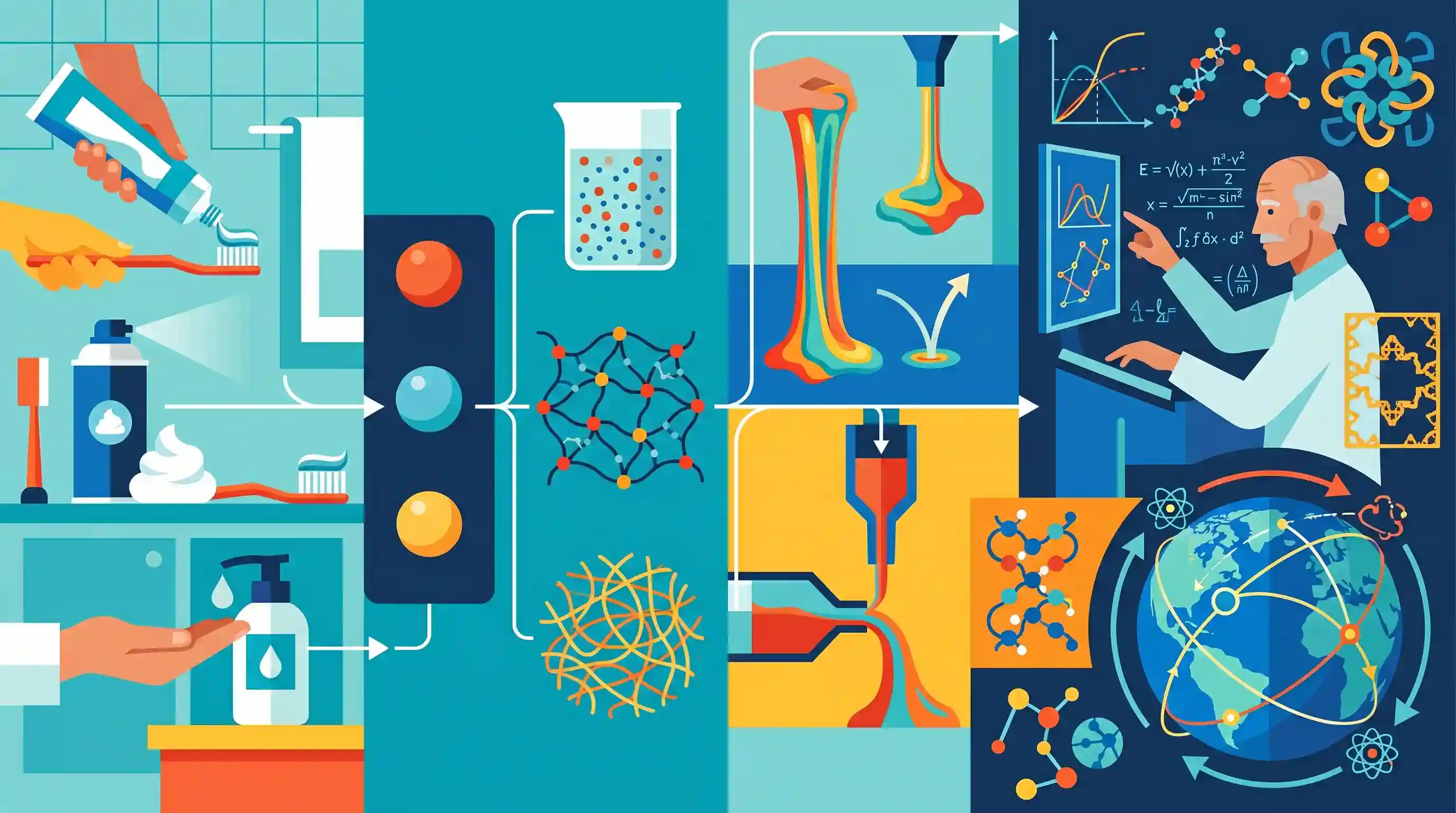
The article delves into the physics of 'soft matter,' a classification that includes everyday items found in household and bathroom cabinets, such as toothpaste, shaving foam, and lotions. Unlike simple solids, liquids, or gases, soft matter consists of complex systems like colloids, polymers, and gels that exhibit unique behaviors such as viscoelasticity and non-Newtonian flow. It highlights the pioneering contributions of Nobel laureate Pierre-Gilles de Gennes in mathematically describing these materials, emphasizing how fundamental physics governs the unusual yet persistent behavior of everyday substances.
Key Points
- Soft matter encompasses everyday materials like foams, gels, colloids, liquid crystals, and polymers that do not fit neatly into traditional solid or liquid categories.
- These materials often exhibit viscoelastic properties and behave as non-Newtonian fluids, meaning their viscosity changes under applied stress (e.g., toothpaste acting as a solid until squeezed).
- French physicist Pierre-Gilles de Gennes, who won the 1991 Nobel Prize in Physics, is widely regarded as the founding father of soft matter physics for mathematically describing the behavior of polymers and liquid crystals.
- The study of soft matter bridges fundamental physics and everyday utility, with critical applications ranging from biology and cosmetics to food science and advanced material engineering.
Prelims Trap
"Colloids found in soft matter, like milk or shaving cream, are homogeneous mixtures with a constant viscosity."
Soft matter colloids are strictly heterogeneous mixtures, despite appearing uniform. Furthermore, most soft matter everyday items are non-Newtonian, meaning their viscosity changes dynamically under applied stress.
Static Concepts Connected
What are the defining physical characteristics of a colloidal solution?
- Heterogeneous nature: Despite appearing perfectly uniform to the naked eye, colloids are heterogeneous mixtures.
- Particle size: The suspended particles range in size from 1 nm to 1000 nm, intermediate between true solutions and suspensions.
- Tyndall effect: Colloidal particles are large enough to scatter a beam of visible light passing through the medium, illuminating the light's path.
How do Newtonian and non-Newtonian fluids differ in everyday physics?
- Newtonian fluids: Viscosity (resistance to flow) remains strictly constant regardless of the amount of shear stress applied (e.g., water, air).
- Non-Newtonian fluids: Viscosity changes dynamically under applied stress. They can act like a solid when squeezed or hit, and a liquid when resting (e.g., toothpaste, cornstarch).
- Dual properties: They exhibit viscoelasticity, meaning they simultaneously show both liquid-like flow and solid-like elasticity during deformation.
Cross-Topic Patterns
Defence tech & shear-thickening fluids
Liquid body armor utilizes shear-thickening non-Newtonian fluids. Upon impact, the fluid instantly hardens to absorb energy, directly bridging everyday soft matter physics with advanced military defense capabilities.
Biological soft matter & drug delivery
Human blood and cell membranes behave as soft matter. Understanding their unique viscoelastic properties is crucial for biotechnology, particularly in formulating targeted drug delivery systems using synthetic polymeric nanoparticles.

Expect an 'Everyday Science' matching question pairing items like toothpaste or milk with technical terms like colloid or non-Newtonian.
Linked PYQs · 2
Linked PYQs · 2
- 2018MainsGS3
Discuss the work of 'Bose-Einstein Statistics' done by Prof. Satyendra Nath Bose and show how it revolutionized the field of Physics.
- 2021PrelimsGS1
Water can dissolve more substances than any other liquid because
