Child Marriage Socio-Economic Drivers and Legal Frameworks
Source:The Hindu ↗
Why It Matters
The article provides crucial data points (NFHS statistics) and multi-dimensional analysis connecting social issues (child marriage) with structural drivers (poverty, education) and legal complexities (PCMA vs. POCSO). It is highly relevant for GS1 (Social Issues) and GS2 (Social Justice, Vulnerable Sections, Health, Education).
Summary
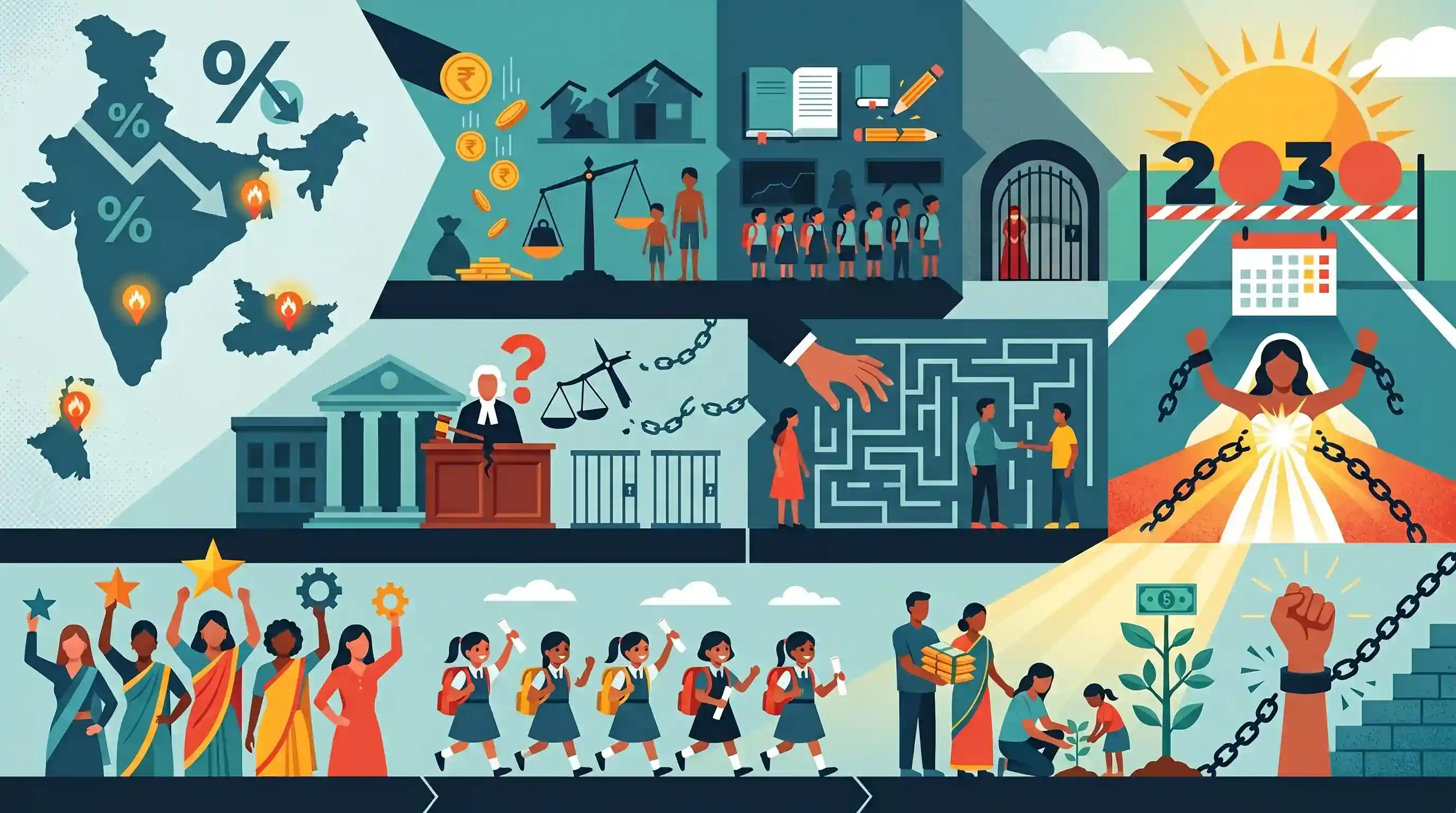
The article examines India's ongoing battle against child marriage, noting a significant national decline to 23.3% but highlighting persistent high rates in states like West Bengal and Bihar. It emphasizes the deep-rooted socio-economic drivers of the practice, particularly poverty and lack of education. The piece also critiques legal bottlenecks, citing the low conviction rates under the Prevention of Child Marriage Act and the unintended consequences of the stringent POCSO Act on consenting adolescents. To achieve the UN SDG target of eradicating child marriage by 2030, it calls for a holistic approach that tackles structural gender inequality, poverty, and educational deficits, ensuring campaigns like 'Beti Bachao Beti Padhao' reach the most vulnerable communities.
Key Points
- India's child marriage rate declined from 47.4% in 2005-06 to 23.3% in 2019-21, though progress remains uneven across states like West Bengal, Bihar, and Tripura.
- Data reveals a stark correlation between child marriage, poverty, and lack of education, with girls from the lowest wealth quintile and without education being disproportionately affected.
- The Prevention of Child Marriage Act (PCMA), 2006, suffers from low conviction rates and infrequent application.
- The stringent nature of the POCSO Act complicates consensual adolescent relationships, often driving underage girls to seek unsafe medical help to avoid criminalizing their partners.
- Ending child marriage by 2030, in line with UN Sustainable Development Goals, necessitates addressing structural drivers like poverty, health, and gender inequality alongside campaigns like 'Beti Bachao Beti Padhao'.
Important Terms
Sustainable Development Goal (SDG) 5.3

A specific UN target under Goal 5 (Gender Equality) aiming to eliminate all harmful practices, including child, early, and forced marriage, by the year 2030.
UPSC context
GS II/III: Essential for discussing India's international commitments and progress in social justice and gender empowerment.
Prevention of Child Marriage Act (PCMA), 2006
The primary Indian legislation establishing 18 for women and 21 for men as the legal marriage age; it allows for the annulment of child marriages and penalizes facilitators.
UPSC context
GS II: Core legal framework for protecting vulnerable sections and evaluating the effectiveness of social legislation.
Protection of Children from Sexual Offences (POCSO) Act, 2012
A specialized, gender-neutral law enacted to protect individuals under 18 from sexual abuse, which treats all sexual activity with minors as 'statutory rape' regardless of consent.
UPSC context
GS II: Relevant for legal nuances regarding child protection and conflicts between protective laws and adolescent autonomy.
Beti Bachao Beti Padhao (BBBP)
A flagship government initiative launched in 2015 to combat the declining child sex ratio, prevent gender-biased sex selection, and ensure the education and survival of the girl child.
UPSC context
GS II: Key welfare scheme often tested for its multi-sectoral approach and impact on women's empowerment.
Bal Vivah Mukt Bharat Abhiyan
Launched in late 2024 by the Ministry of Women and Child Development, this national campaign aims to eradicate child marriage by 2030 through community-driven and technology-enabled prevention.
UPSC context
GS II: Current affairs-specific government intervention targeting specific high-burden districts for social reform.
National Crime Records Bureau (NCRB)
The central nodal agency in India responsible for collecting and analyzing crime data, including cases registered under the Prevention of Child Marriage and POCSO Acts.
UPSC context
GS II/III: Primary source of statistical evidence for evaluating law enforcement and social security trends.
Prelims Trap
Under the Prohibition of Child Marriage Act, 2006, all child marriages are void ab initio.
Under PCMA 2006, child marriages are generally "voidable" at the option of the minor upon reaching majority, not automatically void, except in cases of trafficking/coercion.
Static Concepts Connected
What is the legal status of child marriages under the PCMA, 2006?
- Voidable nature: Marriages are voidable at the option of the contracting party who was a child at the time of marriage.
- Maintenance provisions: The district court can order the adult groom or the minor groom's parents to pay maintenance to the female child until her remarriage.
- Legitimacy of children: Any child born or conceived from a child marriage is considered a legitimate child for all legal purposes.
Which Sustainable Development Goal (SDG) addresses child marriage?
- SDG 5: Goal 5 aims to achieve gender equality and empower all women and girls globally.
- Target 5.3: Specifically mandates the elimination of all harmful practices, such as child, early and forced marriage, and female genital mutilation by 2030.
Cross-Topic Patterns
POCSO vs. Adolescent Consent
The strict 18-year age of consent under POCSO often criminalizes consensual adolescent relationships, contradicting child protection intents, discouraging medical help-seeking, and burdening the judiciary.
Personal Laws & Uniform Civil Code
The conflict between the secular PCMA and certain personal laws (which allow marriage at puberty) frequently drives constitutional debates around implementing a Uniform Civil Code (Article 44).
Early Marriage & Economic FLFPR
High child marriage rates in states like Bihar directly stunt Female Labour Force Participation Rates (FLFPR), undermining India's broader ability to capitalize on its demographic dividend.

Expect a GS-2 question analyzing the conflict between POCSO's rigid age of consent, the PCMA, and personal laws on adolescent rights.
Linked PYQs · 4
Linked PYQs · 4
- 2024MainsGS1
Distinguish between gender equality, gender equity and women's empowerment. Why is it important to take gender concerns into account in programme design and implementation?
- 2021MainsGS2
Can the vicious cycle of gender inequality, poverty and malnutrition be broken through microfinancing of women SHGs? Explain with examples.
- 2019MainsGS1
“Empowering women is the key to control population growth.” Discuss.
- 2016MainsGS2
Examine the main provisions of the National Child Policy and throw light on the status of its implementation.
