Maharashtra Snakebite Notifiable Disease Public Health Mandate
Source:thelivenagpur ↗
Why It Matters
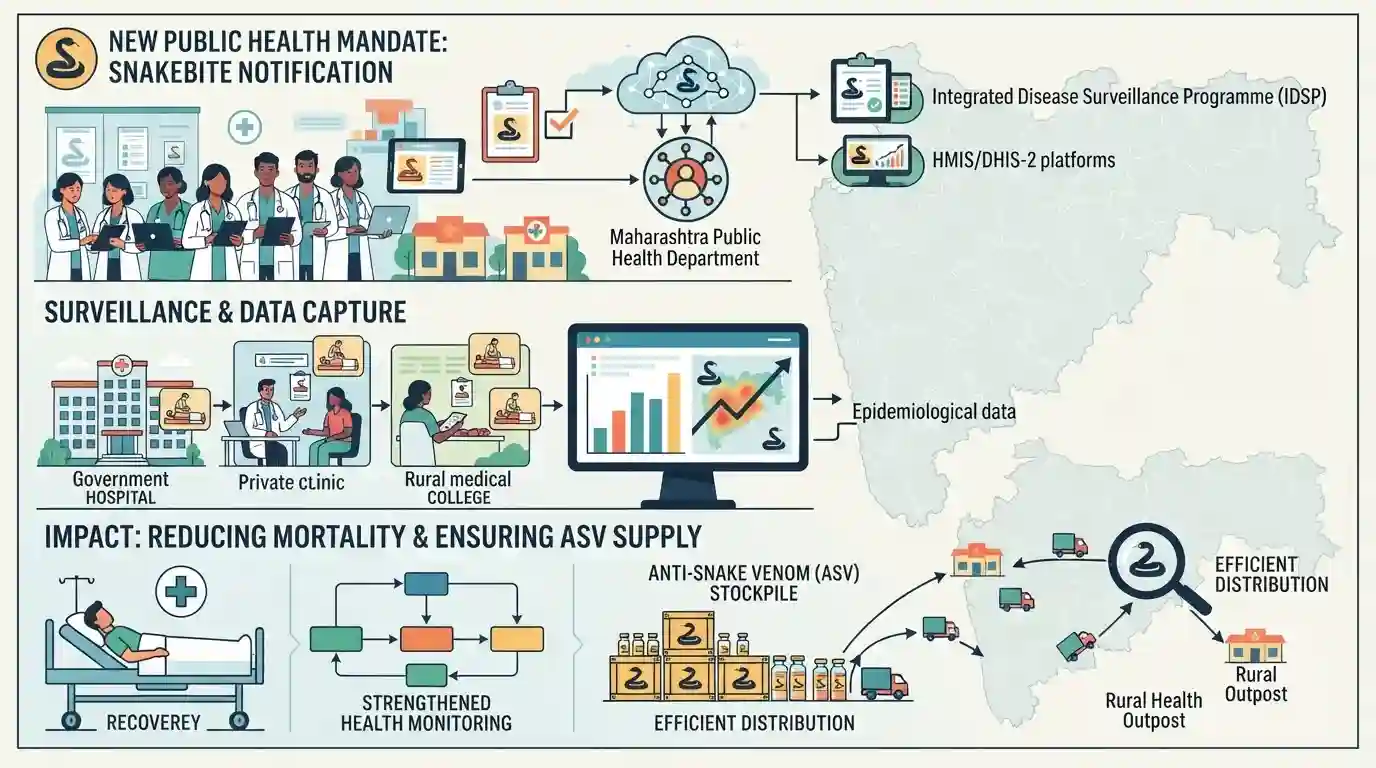
Declaring a disease 'notifiable' is a critical public health tool. It allows the government to track accurate epidemiological data, appropriately allocate resources (such as anti-snake venom), and lower preventable mortality rates. For MPSC aspirants, it highlights significant policy shifts in Maharashtra's healthcare administration.
Summary
The Maharashtra Public Health Department has officially declared snakebite a notifiable disease. Under this new mandate, all healthcare facilities—including government and private hospitals, medical colleges, and private practitioners—are required to report snakebite cases and resulting deaths. The reporting must be done via the Integrated Disease Surveillance Programme (IDSP) and HMIS/DHIS-2 platforms. This administrative move is designed to capture the exact epidemiological burden of snakebites, strengthen health monitoring, and ensure an adequate, well-distributed inventory of life-saving anti-snake venom (ASV) to reduce mortality, particularly in rural regions.
Key Points
- The Maharashtra Public Health Department has declared snakebite a notifiable disease to map its accurate burden and improve medical response.
- It is now mandatory for all government hospitals, private hospitals, medical colleges, and private practitioners to immediately report snakebite cases and related deaths.
- Reporting will be conducted through the Integrated Disease Surveillance Programme (IDSP) portal and the HMIS/DHIS-2 platforms.
- The initiative aims to optimize the distribution, availability, and inventory management of anti-snake venom (ASV) across the state.
- The Director (Hospitals) will act as the state-level nodal officer, while Civil Surgeons and District Health Officers (DHOs) will monitor the process at the district level.
Important Terms
Notifiable Disease Declaration

An official government administrative mandate requiring healthcare facilities and medical practitioners to legally report every diagnosed or suspected case of a specific disease to public health authorities.
UPSC context
MPSC GS-3 (Health): Tests knowledge of state healthcare regulations, epidemiological surveillance policies, and disease control measures in Maharashtra.
Maharashtra Public Health Department
The state government department responsible for administering public healthcare infrastructure, managing state-level health policies, disease prevention, and monitoring medical services across Maharashtra.
UPSC context
MPSC GS-2 (State Administration) & GS-3: Evaluates understanding of state governance, public health service delivery, and local healthcare administrative machinery.
Integrated Disease Surveillance Programme (IDSP)
A decentralized, IT-enabled, and laboratory-supported national program launched in 2004 to detect, track, and monitor epidemic-prone diseases for prompt public health action.
UPSC context
MPSC GS-3 (Health & Tech): Tests knowledge of national epidemiological surveillance systems, decentralization of healthcare, and outbreak management protocols.
Health Management Information System (HMIS)
A digital portal used across India for systematic registration, monitoring, and analysis of healthcare data from public and private facilities to support strategic planning.
UPSC context
MPSC GS-3 (Health): Evaluates awareness of digital governance, health monitoring infrastructure, and data-driven policymaking in India and Maharashtra.
Prelims Trap
Only government-run hospitals are legally mandated to report snakebite cases, while private clinics and practitioners are exempted under the state order.
The notification legally binds all healthcare providers—including private clinics, medical colleges, and individual practitioners—to report cases to state authorities.
Static Concepts Connected
What is a 'Notifiable Disease' and who has the authority to declare it in India?
- Definition & Purpose: Any disease that is legally required to be reported to government health authorities to monitor epidemiology and initiate rapid response.
- Constitutional Authority: Since 'Public Health' is a State subject (List II, Entry 6), state governments possess autonomous power to declare a disease notifiable.
- Penal Provisions: Non-compliance by doctors or hospitals can attract penalties under relevant sections of the Bharatiya Nyaya Sanhita (BNS) for endangering public safety.
What is the Integrated Disease Surveillance Programme (IDSP)?
- Launch & Objective: Launched by the Ministry of Health and Family Welfare in 2004 with World Bank assistance to detect and respond to early warning signals of outbreaks.
- Decentralized Network: Operates via a decentralized network consisting of State Epidemiological Units and District Surveillance Units (DSUs) to track epidemic-prone diseases.
Cross-Topic Patterns
Health Governance and Seventh Schedule
Illustrates Entry 6 of the State List (Public Health), highlighting how state administrations execute decentralized health policies without needing central parliamentary assent.
ASV Supply Chain & Rural Infrastructure
Connects digital health tracking (HMIS/DHIS-2) with last-mile cold-chain inventory management of ASV in tribal-dominated districts of Maharashtra.

MPSC may ask a multi-statement question on the specific nodal monitoring officers and platforms (IDSP/HMIS) chosen for the mandate.
Linked PYQs · 3
Linked PYQs · 3
- 2025MPSC_PRELIMSGS1
Identify the correct statements regarding Bhagwan Birsa Munda Road Linking Scheme. A. This scheme was started by Maharashtra Government. B. This scheme was only launched to connect the tribal villages. C. This scheme was made to connect tribal areas with primary health centres and Ashram schools through main roads. D. This scheme was discontinued by Govt. of Maharashtra in January 2025.
- 2018MPSC_PRELIMSGS1
In Maharashtra, Dr. Abdul Kalam Amrut Ahar Yojana is related with
- 2023MPSC_PRELIMSGS1
Match the following - Vitamins and respective deficiency diseases : | Vitamins | Deficiency disease | |---|---| | a. Vit. A | i. Rickets | | b. Vit. D | ii. Scurvy | | c. Vit. C | iii. Anaemia | | d. Vit. B12 | iv. Night blindness | Code: a b c d
