Carbon Monoxide Poisoning Cause of Death in Lucknow Building Fire
Source:The Hindu ↗
Why It Matters
This article addresses critical topics in General Science (biochemistry of toxic gases like carbon monoxide) and Disaster Management (urban fire safety, building bylaws, and NDMA guidelines), both of which are recurrent focus areas in the UPPSC PCS Prelims GS Paper 1.
Summary
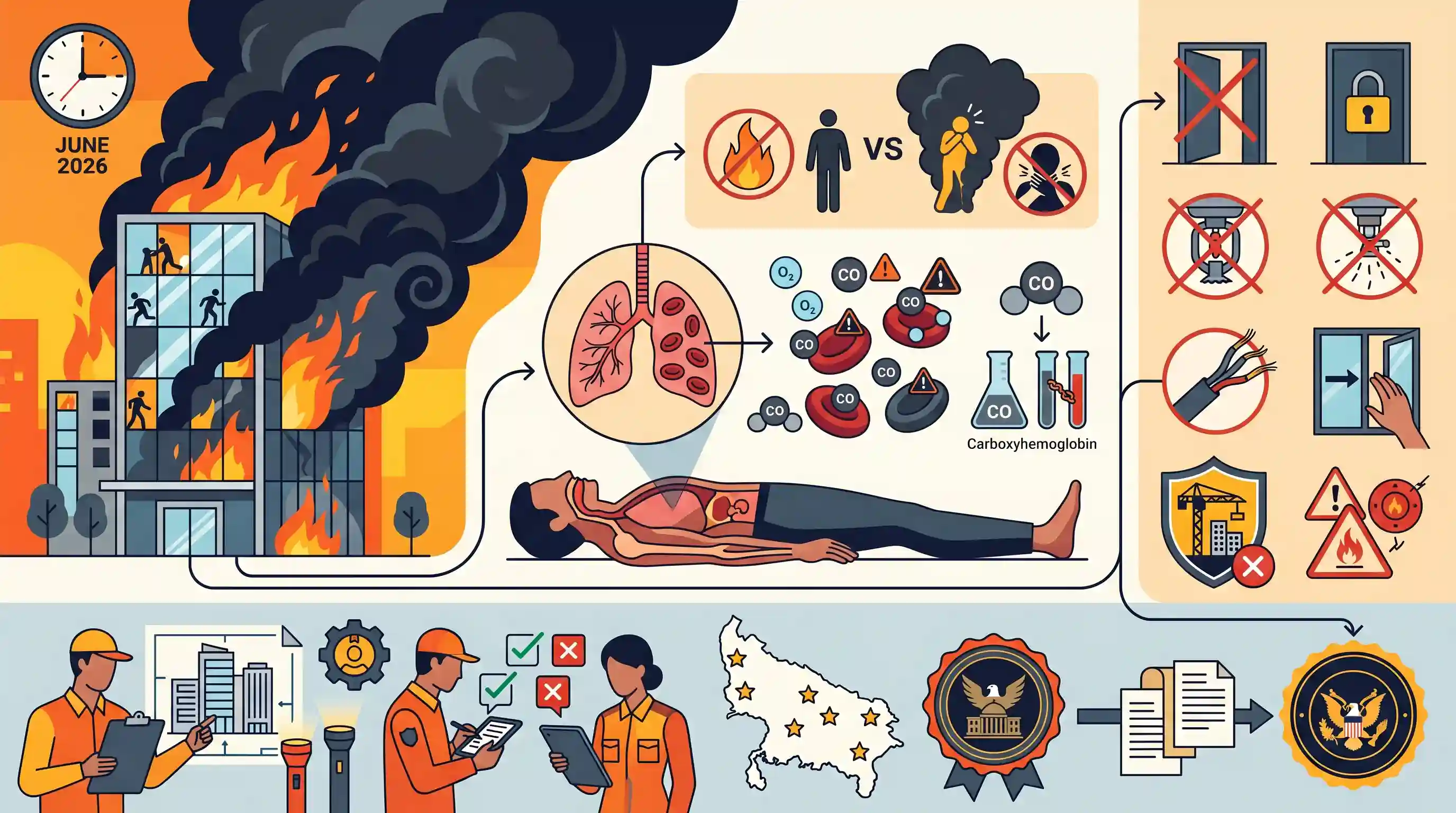
A post-mortem report of the June 2026 Lucknow commercial building fire reveals that all 15 victims died of asphyxiation caused by inhaling toxic smoke containing carbon monoxide rather than direct fire burns. The incident has triggered structural inspections and high-level safety probes across Uttar Pradesh due to massive building bylaws and fire safety violations.
Key Points
- On June 22, 2026, a tragic fire at a commercial complex on Usha Mehta Marg, Aliganj (Lucknow) claimed the lives of 15 people, primarily students.
- Post-mortem reports revealed that all 15 victims died due to asphyxiation (suffocation) from smoke inhalation rather than direct burn injuries.
- The burning of synthetic materials (plastics, foams) in enclosed spaces drops oxygen levels and releases toxic carbon monoxide (CO), which causes rapid unconsciousness by forming carboxyhemoglobin.
- The Lucknow Development Authority (LDA) issued violations against the building for building bylaws non-compliance and unauthorized commercial use of residential premises.
- A two-member Special Investigation Team (SIT) was constituted by the UP government, and four individuals, including the building owner, were arrested.
Important Terms
National Building Code of India (NBC)

A comprehensive national instrument formulated by the Bureau of Indian Standards (BIS) providing guidelines for regulating building construction activities, structural design, and fire safety compliance across India.
UPSC context
GS Paper III (Disaster Management/Infrastructure). Evaluates standard safety codes, building bylaws, and proactive urban disaster risk reduction mechanisms.
Disaster Management Act, 2005
A landmark Indian legislation that established the institutional framework—national, state, and district authorities—to shift the country's disaster management paradigm from reactive relief to proactive preparedness, mitigation, and response.
UPSC context
GS Paper III (Disaster Management). Crucial statutory framework tested for governance, emergency powers, institutional roles, and disaster risk reduction strategies.
National Disaster Management Authority (NDMA)
The apex statutory body in India for disaster management, chaired by the Prime Minister, responsible for formulating policies, plans, and guidelines to ensure timely and effective disaster response.
UPSC context
GS Paper III (Disaster Management). Tests understanding of institutional mechanisms, national policy execution, and coordinating administrative responses to catastrophes.
Bureau of Indian Standards (BIS)
The National Standards Body of India, established under the BIS Act 2016, operating under the Ministry of Consumer Affairs, Food and Public Distribution to formulate standards, product certifications, and quality markings.
UPSC context
GS Paper III (Economy/Regulatory Bodies). Examines statutory regulatory bodies, quality control, standardization's role in consumer protection, and industrial safety.
Prelims Trap
The National Building Code is a mandatory statutory code enacted by Parliament for uniform nationwide fire safety enforcement.
The NBC is published by the Bureau of Indian Standards (BIS) and is recommendatory. It only gains statutory force when adopted by state governments or urban local bodies.
Static Concepts Connected
What is the constitutional and statutory framework governing fire safety in India?
- Constitutional Status: Fire services fall under the State List (Seventh Schedule) and are designated as a municipal function under the Twelfth Schedule (Article 243W).
- National Building Code: Published by the Bureau of Indian Standards (BIS), Part IV of NBC deals with fire safety but is recommendatory unless adopted into state bylaws.
How do the 'Toxic Twins' of combustion cause rapid asphyxiation?
- Carbon Monoxide (CO): Binds to hemoglobin 200-250 times more effectively than oxygen, forming carboxyhemoglobin, which halts oxygen delivery and causes cellular hypoxia.
- Hydrogen Cyanide (HCN): Released from burning synthetic materials, it inhibits cytochrome c oxidase in mitochondria, blocking aerobic cellular respiration and compounding asphyxiation.
Cross-Topic Patterns
Urban Governance + Fire Safety
Weak municipal governance under Article 243W directly compromises disaster resilience, as urban local bodies struggle to enforce recommendatory National Building Code guidelines due to capacity constraints.
Synthetic Chemistry + Disaster Vulnerability
The widespread use of modern synthetic polymers in interiors shifts fire threats from physical thermal burns to rapid chemical asphyxiation, linking material science with public health disasters.

Expect a 2026 prelims question linking the recommendatory nature of the NBC (BIS) with the biochemistry of carbon monoxide poisoning.
Linked PYQs · 3
Linked PYQs · 3
- 2016UPPSC_PRELIMSGS1
Which of the following air pollutants gets dissolved in hemoglobin of the blood more rapidly than oxygen?
- 2013UPPSC_PRELIMSGS1
Which one of the following air pollutants can affect blood stream leading to death?
- 2021UPPSC_PRELIMSGS1
The National Disaster Management Division in India is the nodal division in the Ministry of Home Affairs for disaster management. Who is the Ex-officio Chairman of the National Disaster Management Authority?
