Delhi Air Pollution Crisis and Internal Migration of Residents
Source:The Hindu ↗
Why It Matters
The emergence of 'smog refugees' serves as a critical case study for UPSC aspirants on the intersection of environmental degradation, public health, and social inequality. It illustrates how unchecked urban pollution acts as a push factor for out-migration and demands a regional, multi-sectoral governance approach rather than localized emergency fixes.
Summary
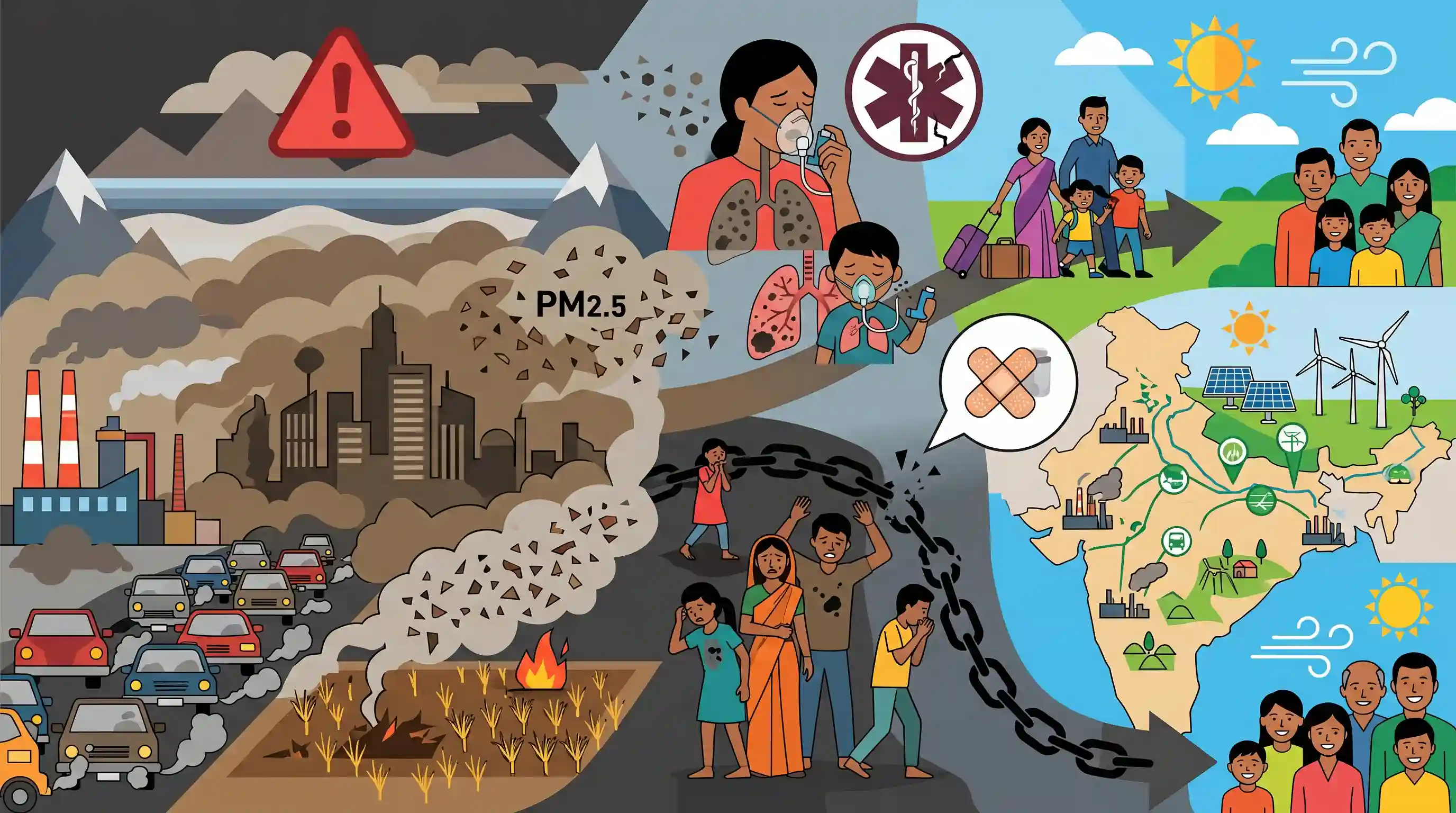
A growing number of residents in Delhi and the National Capital Region (NCR) are becoming 'smog refugees', forced to relocate due to severe and persistent air pollution. With PM2.5 levels vastly exceeding WHO guidelines, the pollution is causing severe health crises, particularly respiratory issues in children. The crisis is compounded by the region's land-locked geography, winter inversions, and local emissions. This phenomenon also highlights a stark socio-economic divide, as only the affluent can afford to migrate, leaving the vulnerable urban poor behind. Experts urge a shift from emergency stopgap measures like GRAP to comprehensive regional interventions, including clean energy transitions and basin-wide emission controls across the Indo-Gangetic Plains.
Key Points
- The worsening air quality in Delhi and the NCR is driving a phenomenon of 'smog refugees', where families permanently or temporarily migrate to avoid health hazards.
- Over 34% of people in Delhi-NCR are reportedly considering relocation due to severe respiratory impacts like strokes, asthma, bronchitis, and COPD linked to high PM2.5 levels.
- Delhi's average air quality significantly exceeds national standards (40µg/m3) and WHO guidelines (5µg/m3), peaking at extreme levels during winter.
- Pollution drivers include the land-locked geography of the Indo-Gangetic Plains, winter temperature inversion, local emissions, and external smoke like stubble burning.
- The exodus deepens socio-economic inequality, as only highly educated and skilled workers can afford to relocate, leaving the vulnerable working class trapped.
- Experts advocate for systemic shifts—such as energy transition, zero-emission vehicles, and basin-wide elimination of waste burning—rather than relying solely on emergency measures like GRAP.
Important Terms
Graded Response Action Plan (GRAP)

A statutory emergency framework of measures implemented by the Commission for Air Quality Management (CAQM) in Delhi-NCR to curb air pollution based on varying Air Quality Index (AQI) thresholds.
UPSC context
GS Paper 3: Environmental Pollution. Tests knowledge of emergency mitigation strategies and the role of statutory bodies like CAQM.
PM2.5 (Particulate Matter 2.5)
Fine particulate matter with a diameter less than 2.5 micrometers; capable of entering the bloodstream and causing severe respiratory and cardiovascular diseases due to its ability to bypass lung barriers.
UPSC context
GS Paper 3: Science & Tech/Pollution. Fundamental for understanding air quality metrics and public health hazards in urban India.
Thermal Inversion
A meteorological phenomenon where a layer of warm air traps cooler, denser air near the surface, preventing the upward dispersion of pollutants and exacerbating smog during winter months.
UPSC context
GS Paper 1: Geography. Explains the atmospheric dynamics behind Northern India's seasonal pollution crisis and localized climatic conditions.
Indo-Gangetic Plain (IGP) Air Basin
A regional 'airshed' where pollutants from across Northern India accumulate due to shared geography (Himalayas to the north) and stagnant wind patterns, necessitating basin-wide rather than city-specific interventions.
UPSC context
GS Paper 3: Environment. Relevant for trans-boundary pollution management and the transition from city-specific to regional air quality governance.
Smog Refugees
Individuals forced to relocate from polluted urban centers due to health risks; the term highlights the socio-economic inequality where only affluent residents can afford migration to cleaner environments.
UPSC context
GS Paper 1: Social Issues/Migration. Tests understanding of environmental displacement, social equity, and the disproportionate impact of pollution on the poor.
WHO Air Quality Guidelines (AQGs)
Updated in 2021, these evidence-based standards provide safe limits for six major pollutants, significantly tightening recommended PM2.5 annual mean levels from 10 µg/m³ to 5 µg/m³.
UPSC context
GS Paper 3: Environment. Key for evaluating the stringency of India's National Clean Air Programme (NCAP) against global health benchmarks.
Centre for Science and Environment (CSE)
A prominent New Delhi-based non-profit public interest research and advocacy organization that acts as a think tank on sustainable development and environmental policy issues in India.
UPSC context
GS Paper 3: Environment. Relevant for the role of non-state actors and civil society in environmental governance and policy advocacy.
Prelims Trap
"GRAP is a permanent, year-round preventive framework for emission control in Delhi-NCR."
GRAP is strictly an emergency, reactive stopgap measure that kicks in only after air quality breaches specific AQI thresholds. It is not a permanent, year-round policy.
Static Concepts Connected
What is 'Temperature Inversion' and how does it worsen winter pollution?
- Thermal reversal: Normally, temperature decreases with altitude. During an inversion, a layer of warm air settles above, trapping cooler air near the Earth's surface.
- Pollution trap: The cold, dense air near the ground cannot rise, effectively acting as a lid that traps local urban pollutants and external smoke (e.g., stubble burning).
- Winter meteorology: It is highly pronounced in the land-locked Indo-Gangetic Plains during winter due to long nights, clear skies, and calm surface winds.
What is the 'Airshed' approach to air quality management?
- Geographic boundary: An airshed is a geographical area where local topography and meteorology restrict the dispersion of pollutants, meaning emissions within the area stay trapped.
- Regional governance: It shifts the focus from isolated, city-specific emergency responses (like GRAP) to comprehensive, basin-wide regional governance spanning multiple states.
Cross-Topic Patterns
Urban Migration + Environmental Geography
Environmental distress migration is traditionally viewed as a rural push factor (e.g., droughts). 'Smog refugees' highlight a rising GS1 trend of urban distress out-migration, sharply divided by socio-economic class.
Inter-state Federalism + Transboundary Pollution
The failure of city-centric measures like GRAP underscores the need for cooperative federalism and regional mechanisms to govern shared transboundary "airsheds" across the Indo-Gangetic Plains.

Expect a multi-statement Prelims question comparing WHO vs India's NAAQS PM2.5 limits, alongside 'Airshed' management concepts in 2026.
Linked PYQs · 4
Linked PYQs · 4
- 2015MainsGS1
Mumbai, Delhi and Kolkata are the three mega cities of the country but the air pollution is much more serious problem in Delhi as compared to the other two. Why is this so?
- 2022PrelimsGS1
In the context of WHO Air Quality Guidelines, consider the following statements: 1. The 24-hour mean of PM2.5 should not exceed 15 µg/m³ and annual mean of PM2.5 should not exceed 5 µg/m³. 2. In a year, the highest levels of ozone pollution occur during the periods of inclement weather. 3. PM10 can penetrate the lung barrier and enter the bloodstream. 4. Excessive ozone in the air can trigger asthma. Which of the statements given above are correct?
- 2021PrelimsGS1
Magnetite particles, suspected to cause neurodegenerative problems, are generated as environmental pollutants from which of the following? 1. Brakes of motor vehicles 2. Engines of motor vehicles 3. Microwave stoves within homes 4. Power plants 5. Telephone lines Select the correct answer using the code given below.
- 2024MainsGS1
Why do large cities tend to attract more migrants than smaller towns? Discuss in the light of conditions in developing countries.
