Pune SMEs Seek Structural Cost Reforms Against US Tariffs
Source:Indian Express ↗
Why It Matters
Highlights the real-world vulnerability of India's labour-intensive MSME and manufacturing sectors to global protectionist trade policies, demonstrating the critical link between high domestic input costs (power, credit) and international export competitiveness.
Summary
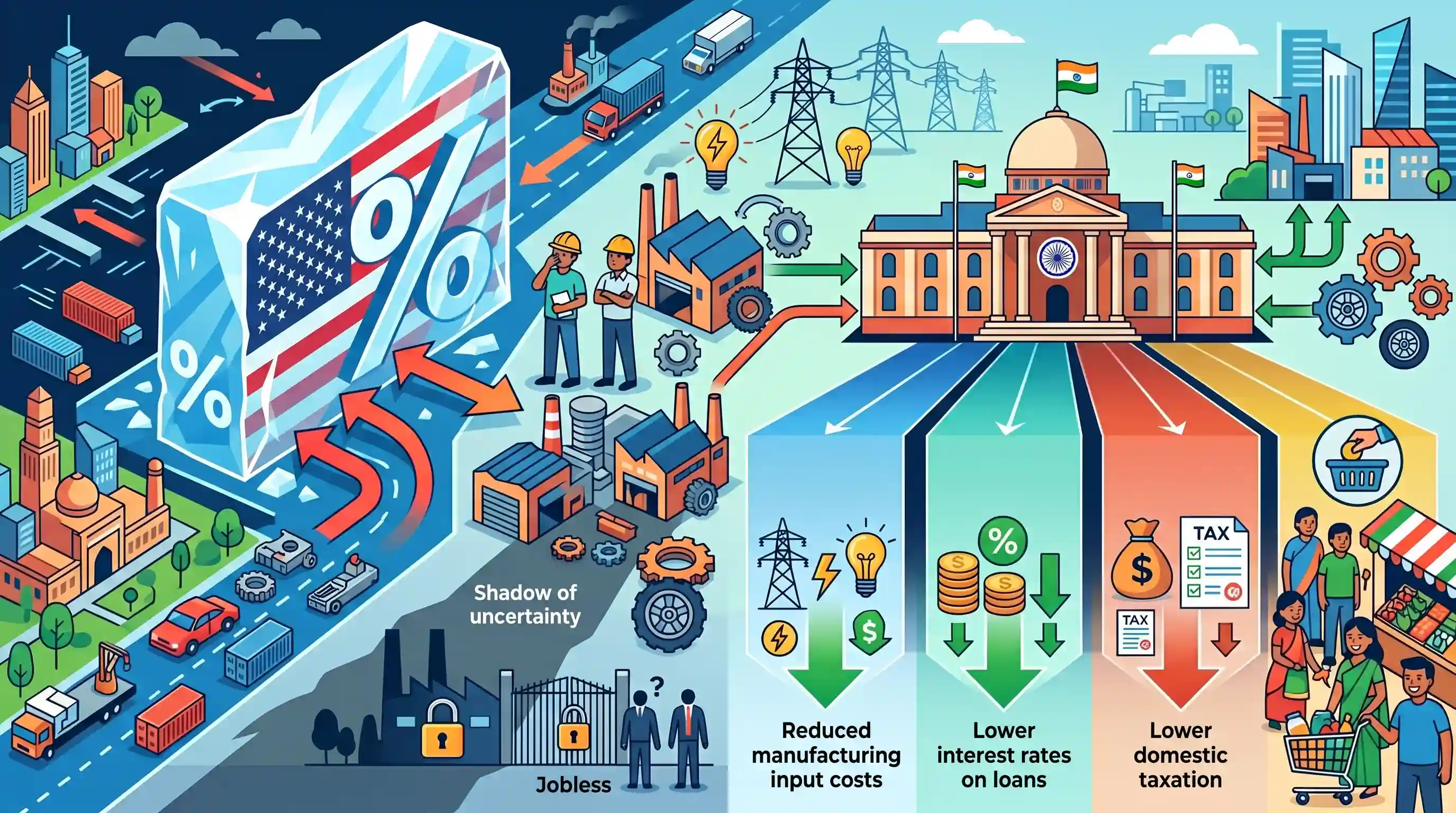
Small and Medium Enterprises (SMEs) in the Pune and Pimpri-Chinchwad auto hub are urging both the Central and Maharashtra governments to implement structural reforms to mitigate the impact of proposed 25% tariffs by US President Donald Trump on Indian goods. Recognizing that government subsidies alone cannot offset the tariff blow, industry leaders are demanding sweeping reductions in manufacturing input costs, specifically calling for drastically lower electricity charges and reduced interest rates on term loans and working capital. Furthermore, they are calling for lower domestic taxation to stimulate local consumption. The proposed US tariffs, along with threatened penalties over India's trade with Russia, have raised fears of mass job losses and unit closures among the 5,000+ SMEs in the region that rely heavily on the engineering, auto-components, and export sectors.
Key Points
- Small and Medium Enterprises (SMEs) in Pune and Pimpri-Chinchwad are seeking government intervention to cushion the blow of a proposed 25% US tariff on Indian imports.
- Industry leaders argue that rather than offering short-term subsidies, the government should drastically reduce manufacturing costs by slashing industrial electricity charges and interest rates on term loans and working capital.
- The SMEs fear that without domestic cost rationalization, the combination of US tariffs and potential penalties on India's defense and energy imports from Russia will make Indian exports uncompetitive.
- The Pimpri-Chinchwad industrial belt alone hosts over 5,000 small industries employing 3-4 lakh people, many of which serve as auto industry vendors and rely on indirect or direct export demand.
- SME associations are also calling for reduced domestic taxation to boost local consumer purchasing power, which can absorb excess inventory if export markets shrink.
Important Terms
SME Chamber of India

A premier national-level organization in India that advocates for policy changes, promotes exports, and facilitates financial and technical support for small and medium enterprises across various industrial sectors.
UPSC context
Relevant for GS3 (Economy); tests knowledge of institutional support frameworks and policy advocacy for the MSME sector.
Pimpri-Chinchwad Small Scale Industries Association
A local industrial body representing over 5,000 SMEs in the Pune-Pimpri-Chinchwad auto hub, focusing on regional infrastructure, credit access, and labor challenges for small-scale manufacturers.
UPSC context
Significant for GS3 (Industrial Growth); illustrates the role of regional clusters and local industry voices in national economic policy.
MSME Sector
The 'backbone' of the Indian economy, defined by investment and turnover limits; it contributes ~29% to GDP and ~45% to total exports, facing challenges like high input costs.
UPSC context
Core GS3 topic; frequently tested regarding employment, export contribution, and challenges like formalization and credit gaps.
Trade Protectionism
A trade policy involving the imposition of tariffs or quotas to shield domestic industries from foreign competition; exemplified by proposed 25% US tariffs on Indian engineering goods.
UPSC context
Key for GS2 (International Relations) and GS3 (Economy); tests impact of global policies on India's interests and export-led growth.
Interest Subvention Scheme
A financial incentive where the government pays a part of the interest on loans; MSMEs often demand this to lower borrowing costs and maintain global competitiveness.
UPSC context
Relevant for GS3 (Economy); specifically relates to fiscal measures and government interventions to support stressed industrial sectors.
Auto-Component Sector
A vital pillar of Indian manufacturing, contributing 30% to sector revenue; it is highly vulnerable to global trade shifts, with the US being its largest export destination (27%).
UPSC context
Significant for GS3 (Industrial Policy); tests understanding of sectoral vulnerabilities in global supply chains and the 'China Plus One' strategy.
Prelims Trap
To counter US tariffs, the Indian government can announce direct export subsidies for the MSME sector.
Direct export subsidies are strictly prohibited under the WTO SCM Agreement. India replaced previous export subsidy schemes with RoDTEP, which only remits embedded domestic taxes.
Static Concepts Connected
Why are industrial electricity tariffs disproportionately high in India?
- Cross-subsidy burden: State DISCOMs charge premium tariffs to industrial and commercial consumers to cross-subsidize heavily discounted or free electricity for agricultural and domestic users.
- AT&C losses: High Aggregate Technical and Commercial (AT&C) losses force DISCOMs to aggressively recover revenue shortfalls from formal, paying industrial units.
- Competitiveness impact: These inflated energy costs act as an implicit tax, heavily eroding the export competitiveness of manufacturing MSMEs globally.
What drives the persistently high cost of capital for Indian MSMEs?
- High risk perception: A lack of adequate collateral and poor formal accounting histories force commercial banks to apply a high risk premium to MSME working capital loans.
- Poor rate transmission: Policy rate cuts by the RBI often suffer from sluggish transmission, failing to quickly translate into lower commercial lending rates for smaller enterprises.
Cross-Topic Patterns
Protectionism vs. WTO SCM Agreement
The demand for systemic cost reduction over direct subsidies reflects WTO compliance realities; direct export subsidies violate the WTO's Agreement on Subsidies and Countervailing Measures (SCM).
Secondary Sanctions and Local Employment
Geopolitical leverage via secondary sanctions (like US threats over Russia trade) can trigger hyper-local economic crises in specialized auto-clusters, directly merging GS2 IR with GS3 employment.

Expect a Mains GS3 question linking global protectionism (tariffs/sanctions) to the urgent need for domestic MSME structural reforms.
Linked PYQs · 3
Linked PYQs · 3
- 2023MainsGS3
Faster economic growth requires increased share of the manufacturing sector in GDP, particularly of MSMEs. Comment on the present policies of the Government in this regard.
- 2017MainsGS3
Account for the failure of manufacturing sector in achieving the goal of labour-intensive exports. Suggest measures for more labour-intensive rather than capital-intensive exports.
- 2012MainsGS2
Discuss the likely negative impact of the protectionist measures proposed by the US on India's software industry.
