Invasive Small Hive Beetle threatens beekeeping industry in Himachal
Source:tribuneindia ↗
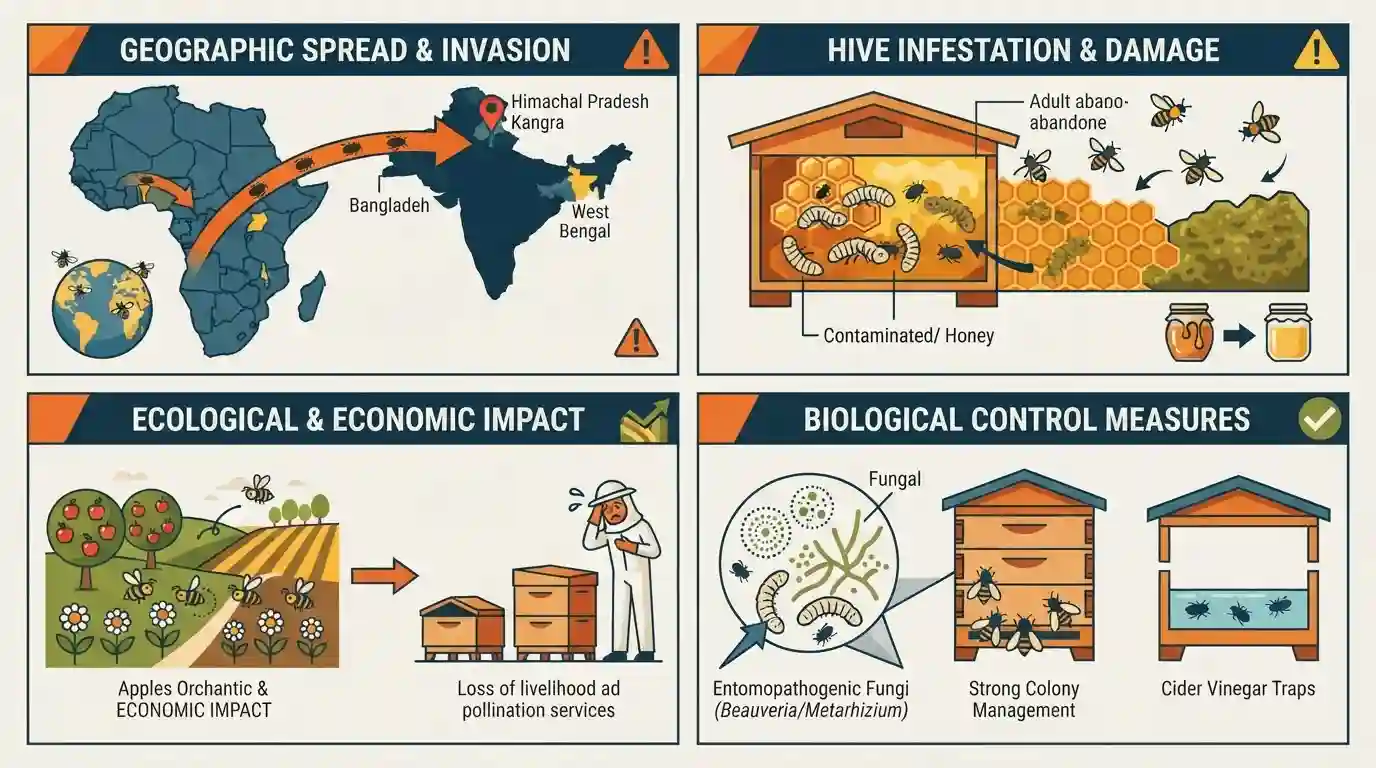
Why It Matters
Highlights the economic and ecological impact of an invasive species on local agriculture, testing candidates' awareness of biological pest control alternatives and the broader agricultural role of pollinators.
Summary
The Small Hive Beetle (SHB), an invasive species originating in sub-Saharan Africa, has emerged as a major threat to Himachal Pradesh's beekeeping industry. After spreading to Bangladesh and West Bengal, the aggressive pest has now invaded North India, severely impacting the Kangra region. SHBs infiltrate colonies of honeybees, stingless bees, and bumble bees, where their larvae feed on brood, honey, and pollen. This process contaminates the honey, turning it into a fermented, slimy mass and frequently forces weakened colonies to abandon their hives. The resulting loss directly threatens beekeepers' livelihoods and risks disrupting agricultural pollination and ecological balance. Because chemical pesticides are dangerous to the bees themselves, experts advise implementing biological control measures, such as applying Beauveria and Metarhizium fungi, alongside maintaining strong colonies and using cider-vinegar traps.
Key Points
- The Small Hive Beetle (SHB), an invasive pest originally from sub-Saharan Africa, has recently invaded bee colonies in Himachal Pradesh and North India.
- SHB larvae destroy hives by feeding on bee brood, pollen, and honey, causing the stored honey to leak, ferment, and spoil.
- The beetle can cause entire bee colonies to abandon their hives, posing severe economic risks to beekeepers and threatening pollination for agricultural and horticultural crops.
- Because chemical treatments can harm honeybees, experts recommend using biological control agents like the entomopathogenic fungi Beauveria and Metarhizium to manage the infestations.
Prelims Trap
"Small Hive Beetle is a native Asian pest managed primarily through broad-spectrum chemical pesticides in commercial apiaries."
SHB is native to sub-Saharan Africa, not Asia. Furthermore, chemical pesticides are strictly avoided to protect bees; biological controls (like fungi) are used instead.
Static Concepts Connected
What are entomopathogenic fungi in biological pest control?
- Parasitic Action: These fungi (e.g., Beauveria bassiana, Metarhizium) infect and act as parasites on insects, effectively killing or disabling pests without leaving toxic chemical residues.
- Infection Mechanism: Spores attach to the targeted insect, germinate, penetrate its exoskeleton, and grow internally, eventually destroying the host.
- Apiculture Safety: They offer a sustainable alternative to chemical pesticides, which is critical in apiculture where chemicals would kill the honeybees.
What are the core features of the National Beekeeping and Honey Mission (NBHM)?
- Central Scheme: A 100% centrally funded Central Sector Scheme under the AtmaNirbhar Bharat Abhiyan, implemented by the National Bee Board (NBB).
- Sweet Revolution: Aims to promote scientific beekeeping for honey production and enhance agricultural/horticultural yields via improved cross-pollination.
- Ecosystem Services: Beyond honey and wax, it focuses on unpriced ecosystem services like pollination, crucial for crops like Himachal's apples.
Cross-Topic Patterns
Invasive Species + HP Apple Economy
The SHB invasion directly threatens HP's apple orchards, linking ecological threats (invasive pests) to severe downstream impacts on state horticulture yields and rural livelihoods.
Biocontrol Agents + Sweet Revolution
Non-chemical pest management utilizing fungi like Beauveria is critical to sustaining the NBHM's 'Sweet Revolution' without poisoning the pollinators required for the mission's success.

Expect a multi-statement question pairing SHB's African origin with the application of entomopathogenic fungi (Beauveria) in biocontrol.
Linked PYQs · 3
Linked PYQs · 3
- 2023HPAS_PRELIMSGS1
Consider the following statements : (1) Manure and fertilizers are the main source of nutrient supply to crops. (2) Inorganic farming is practised with minimal use of fertilisers and pesticides. (3) Growing of different crops on a piece of land in pre-planned succession is called intercropping. (4) Bee-keeping is done to get wax. Choose the correct answer from the options given below :
- 2020HPAS_PRELIMSGS1
Read the passage carefully and attempt the question by choosing the most appropriate option: Desertification is a term used to explain a process of decline in the biological productivity of an ecosystem, leading to total loss of productivity. While this phenomenon is often linked to the arid, semi-arid and sub-humid ecosystems, even in the humid tropics, the impact could be most dramatic. Impoverishment of human-impacted terrestrial ecosystems may exhibit itself in a variety of ways; accelerated erosion as in the mountain regions of the country, salinization of land as in the semi-arid and arid 'green revolution' areas of the country, e.g., Haryana and Western Uttar Pradesh, and site quality decline – a common phenomenon due to general decline in tree cover and monotonous monoculture of rice / wheat across the Indian plains. A major consequence of deforestation is that it relates to adverse alterations in the hydrology and related soil nutrient losses. The consequence of deforestation invariably arise out of site degradation through erosive losses. Tropical Asia, Africa and South America have the highest levels of erosion. The ultimate consequences of site desertification are soil degradation, alteration in available water and its quality and the consequent decline in food, fodder and fuel-wood yields essentials for the economic well beings of rural communities. Deforestation adversely affects the __________.
- 2018HPAS_PRELIMSGS1
In which of the following conditions bio-gas is produced ?
