Uttarakhand Faces Slow Registration Pace under New Madrasa Authority
Source:garhwal-post ↗
Why It Matters
This development represents a critical study of state-level educational reforms targeting minority institutions, directly relating to the constitutional rights under Article 30 (right of minorities to establish and administer educational institutions) versus the state's regulatory powers to enforce educational standardization and mainstreaming.
Summary
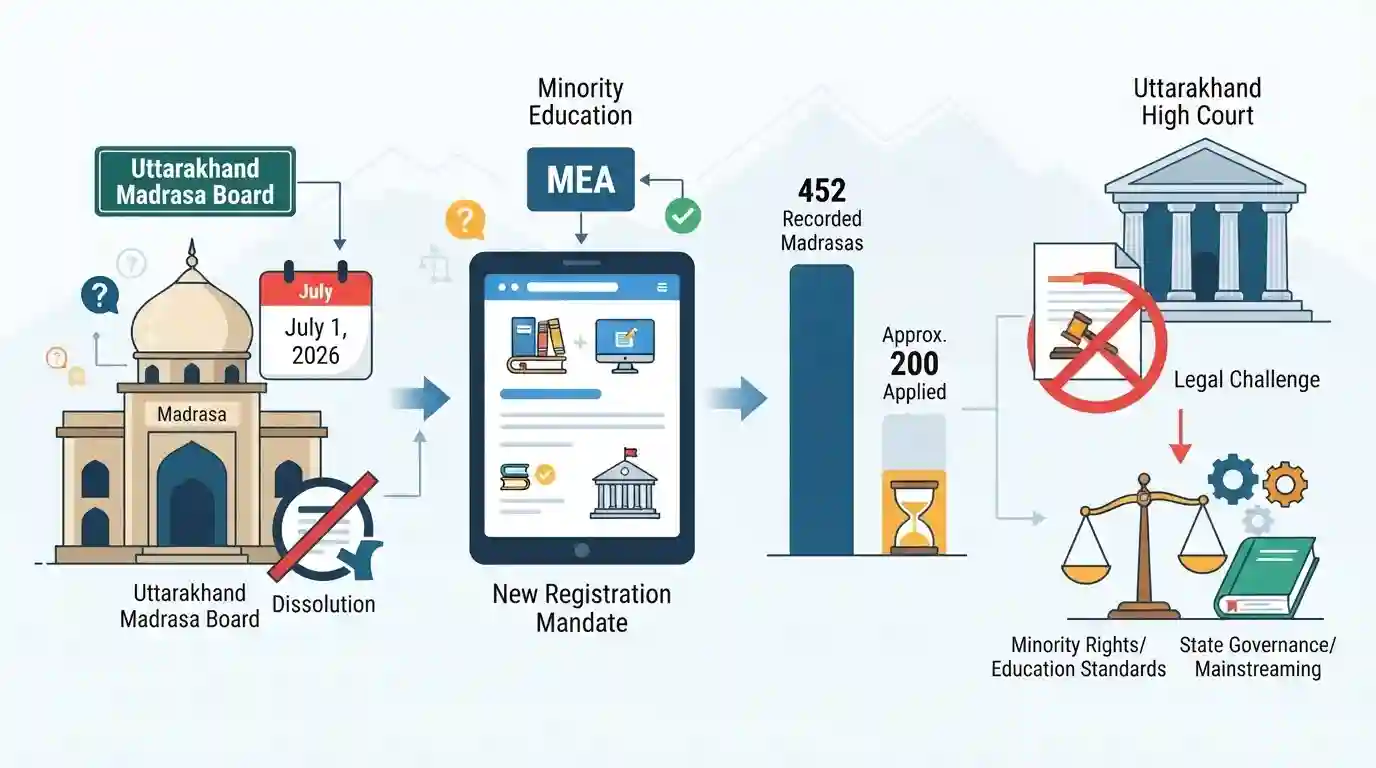
This article covers the slow pace of madrasa registration in Uttarakhand following the dissolution of the Uttarakhand Madrasa Board on July 1, 2026. Madrasas are now mandated to register online under the newly established Minority Education Authority (MEA) to meet the educational and structural standards set by the state. While the government aims to mainstream these institutions, only about 200 of the 452 recorded madrasas have applied, and some organizations have legally challenged the dissolution of the Madrasa Board in the Uttarakhand High Court.
Key Points
- The Uttarakhand Madrasa Board was abolished on July 1, 2026, transitioning control of madrasas to a new system.
- Madrasas are now required to register under the newly constituted Minority Education Authority (MEA) to align with standards set by the state's Education Department and the Uttarakhand Board.
- Out of 452 recorded madrasas in Uttarakhand, only around 200 have applied online for registration under the new system so far, indicating a slow registration pace.
- The state government is set to issue the first batch of recognition certificates to 22 madrasas that have completed the registration requirements.
- The reform aims to integrate madrasas into mainstream education by aligning curriculum, infrastructure, and academic standards.
- Several Islamic organizations have challenged the abolition of the Madrasa Board in the Uttarakhand High Court.
Important Terms
Minority Education Authority

A newly established unified regulatory body in Uttarakhand that replaced the Madrasa Board on July 1, 2026, overseeing and standardizing educational institutions run by all six notified minority communities.
UPSC context
GS Paper II (Polity and Governance, minority rights under Articles 29 and 30, and educational reforms).
Uttarakhand Madrasa Board
A statutory body established under the Madrasa Education Board Act, 2016, to regulate Islamic education in the state; officially dissolved on July 1, 2026.
UPSC context
GS Paper II (Polity, Governance, and State-level policies/legislative changes).
Uttarakhand High Court
The highest judicial organ of the state of Uttarakhand, located in Nainital, responsible for reviewing the legal validity of state legislative and executive actions.
UPSC context
GS Paper II (State Judiciary, judicial review, and enforcement of fundamental rights).
Education Department
The state administrative department responsible for implementing educational policies, enforcing standards, and managing district-level recognition for both public and private schools.
UPSC context
GS Paper II (Social Justice, human resources, and state executive/governance).
Uttarakhand Board
The primary school education board in Uttarakhand responsible for standardizing curricula and granting institutional affiliation to high schools and intermediate colleges.
UPSC context
GS Paper II (Issues relating to development and management of Education).
Prelims Trap
The newly established Minority Education Authority (MEA) in Uttarakhand is a regulatory body exclusively created for the administration of madrasas.
The USMEA is a unified statutory body regulating educational institutions of ALL six notified minorities (Muslims, Sikhs, Christians, Buddhists, Jains, Parsis) in Uttarakhand, not just Islamic madrasas.
Static Concepts Connected
What is the scope and limit of Article 30 of the Indian Constitution?
- Core Right: Article 30(1) grants all religious and linguistic minorities the right to establish and administer educational institutions of their choice.
- Non-discrimination: Article 30(2) prohibits the State from discriminating against minority-managed institutions when granting financial aid.
- State Regulation: The Supreme Court (T.M.A. Pai case) ruled that the State can impose reasonable regulations for academic excellence, syllabus, and welfare without violating Article 30.
What is the administrative setup of the Uttarakhand Board of School Education (UBSE)?
- HQ and Origin: Established in 2001, UBSE is headquartered in Ramnagar, Nainital, and functions under the Uttarakhand School Education Act.
- Primary Mandate: It is responsible for prescribing courses, conducting board exams (Grades 10 and 12), and granting affiliations across the state.
Cross-Topic Patterns
State uniformity reforms and the UCC
The dissolution of the exclusive Madrasa Board aligns with Uttarakhand's pioneering legislative push for uniformity across religious communities, mirroring the spirit of the state's Uniform Civil Code.
NEP 2020 implementation & Federalism
This reform demonstrates how states leverage NEP 2020 guidelines to restructure local minority education, highlighting dynamic federal-state jurisdiction conflicts under the Concurrent List (Education).

UKPSC is highly likely to pair USMEA statutory provisions with constitutional protections under Articles 29 and 30 in a multi-statement MCQ.
Linked PYQs · 2
Linked PYQs · 2
- 2024UKPSC_PRELIMSGS1
Which has been considered as "Magna Carta" of English Education System in India ?
- 2025UKPSC_PRELIMSGS1
Which of the following Central Ministries are responsible for the implementation of Protection of Civil Right Rules, 1977 ? 1. Ministry of Home Affairs 2. Ministry of Social Justice | Empowerment 3. Ministry of Minority Affairs 4. Ministry of Tribal Affairs
